2023 · Zhu — Two-Dimensional Mg₂Si Nanosheet-Enabled Sustained Hydrogen Generation for Improved Repair and Regeneration of Deeply Burned Skin
Super-Abstract
A hydrogel dressing embedded with magnesium silicide nanosheets can continuously release molecular H₂ for about one week — and in animal and cell experiments, this sustained H₂ supply significantly accelerated healing of deep burn wounds without visible scarring. The mechanism involves anti-inflammatory macrophage reprogramming and scavenging of reactive oxygen species. This is an in-vitro and animal study; results cannot be directly extrapolated to humans.
Commentary
This study addresses a genuine unmet clinical need: deep burns (second- and third-degree) heal slowly and often with fibrosis and scarring. The novelty here is the sustained-release H₂ delivery platform — Mg₂Si nanosheets embedded in a chitosan/hyaluronic acid hydrogel that generates H₂ continuously for approximately one week through reaction with wound fluid. Most prior H₂ wound studies used transient gas exposure; this approach provides local, prolonged, and high-dose H₂ directly at the wound site. The proposed mechanism is mechanistically plausible: H₂ scavenges ROS and promotes M2 macrophage polarization via CCL2 upregulation, which drives angiogenesis and reduces fibrosis. These are established wound-healing pathways. However, the work is entirely preclinical — in-vitro cell experiments and animal burn models — and the jump to human clinical use is large: biocompatibility data in humans, regulatory toxicology, and clinical efficacy trials are all absent.
Key quotes
- „The MSN@CS/HA hydrogel dressing can continuously generate hydrogen molecules for about 1 week in the physiological conditions in support of local, long-term, and plentiful hydrogen supply“ — the core technical achievement: week-long local H₂ release
- „a sustained supply of hydrogen molecules induces anti-inflammatory M2 macrophage polarization in time by enhancing CCL2 (chemokine C-C motif ligand 2) expression to promote angiogenesis and reduce fibrosis“ — the proposed molecular mechanism linking H₂ to wound healing
- „remarkably promotes the healing and regeneration of deep second-degree and third-degree burn wounds without visible scar and toxic side effect“ — the headline efficacy claim — but only in animal/cell models, not humans
Our assessment
This is a preclinical study combining in-vitro and animal experiments. It demonstrates a technically innovative, well-mechanistically-grounded H₂ delivery platform for burn wound care. The results in animal models are promising, and the mechanism (ROS scavenging, M2 polarization, CCL2/angiogenesis) is biologically coherent. No conclusions for human treatment can be drawn at this stage: no human trials have been conducted, clinical-grade safety data are absent, and the translation from animal burn models to human wounds involves substantial biological complexity. The study is best read as a strong preclinical proof-of-concept motivating further development.
Study design
- Type: in-vitro + animal preclinical study · Model: cell cultures + murine/rat deep burn wound models · H₂ delivery: Mg₂Si nanosheet–chitosan/hyaluronic acid hydrogel dressing (sustained H₂ release ~1 week)
- Result: significantly accelerated healing of deep second- and third-degree burns vs. control; reduced fibrosis; no visible scarring; M2 macrophage polarization via CCL2 upregulation; enhanced angiogenesis through local ROS scavenging
Abstract
Molecular hydrogen holds a high potential for wound healing owing to its anti-inflammatory effect and high biosafety, but commonly used hydrogen administration routes hardly achieve the sustained supply of high-dosage hydrogen, limiting hydrogen therapy efficacy. Here, two-dimensional Mg2 Si nanosheet (MSN) is exploited as a super-persistent hydrogen-releasing nanomaterial with high biocompatibility, and the incorporation of MSN into the chitosan/hyaluronic acid hydrogel (MSN@CS/HA) is developed as a dressing to repair deeply burned skin. The MSN@CS/HA hydrogel dressing can continuously generate hydrogen molecules for about 1 week in the physiological conditions in support of local, long-term, and plentiful hydrogen supply and remarkably promotes the healing and regeneration of deep second-degree and third-degree burn wounds without visible scar and toxic side effect. Mechanistically, a sustained supply of hydrogen molecules induces anti-inflammatory M2 macrophage polarization in time by enhancing CCL2 (chemokine C-C motif ligand 2) expression to promote angiogenesis and reduce fibrosis and also enhances the proliferation and migration capability of skin cells directly and indirectly by locally scavenging overexpressed reactive oxygen species, synergistically favoring wound repair. The proposed synthesis method, therapeutic strategy, and mechanisms will open a window for synthesizing a variety of MSene nanomaterials and developing their various proangiogenesis applications besides wound healing.
Source & links
Screenshot of the PubMed page
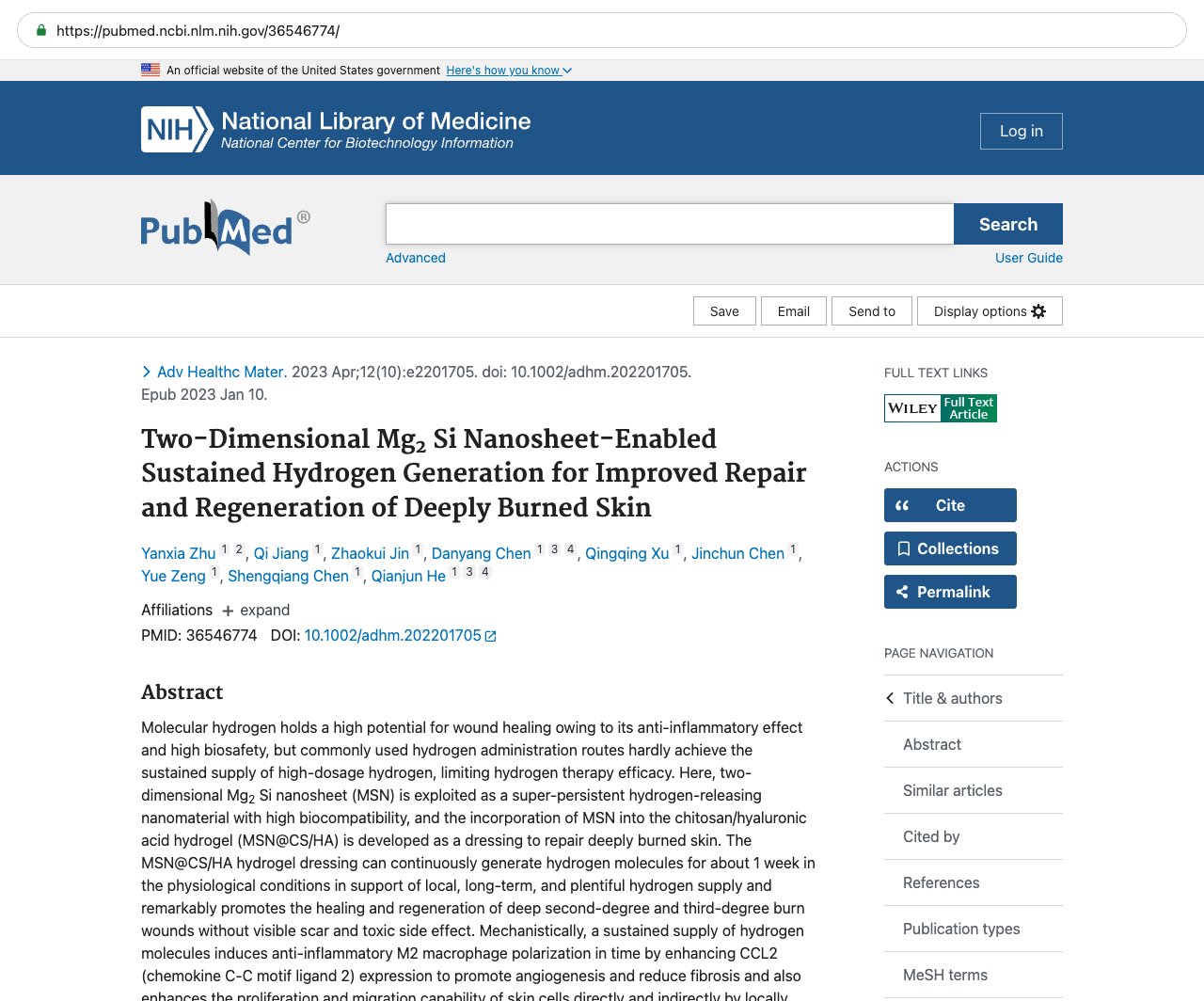
This page mirrors the published abstract (© the authors / publisher) for reference and citation. The canonical source is the PubMed record linked above. This is not medical advice.