2022 · Tanaka — Hydrogen-rich bath with nano-sized bubbles improves antioxidant capacity and inflammation levels in human serum
Super-Abstract
A 10-minute bath in hydrogen-rich water with nano-bubbles raised blood antioxidant capacity by about 11% and lowered the inflammatory marker CRP by roughly 30% in healthy volunteers — and sustained CRP reductions were observed in patients with autoimmune conditions over months of daily bathing. The nano-bubble delivery system achieved substantially higher dissolved H₂ than conventional methods. (Medical Gas Research, 2022.)
Commentary
This study is notable for its delivery method: nano-sized bubbles (110 ± 10 nm diameter) allow much higher dissolved hydrogen concentrations (338–682 µg/L) than standard hydrogen baths. Both healthy volunteers and patients with connective tissue diseases participated. In healthy subjects, a 10-minute bath significantly raised oxygen radical absorption capacity at 120 minutes post-bath, while a normal hot-water bath had no effect. CRP — a broad marker of systemic inflammation — was suppressed to 70.2% of baseline in healthy subjects after one HRW bath. In connective tissue disease patients, CRP fell to 3–24% of pre-treatment levels after 9 days to 4 months of daily bathing. In a separate subgroup of 6 patients with various autoimmune conditions, daily HRW baths over 2–25 months reduced pre-bath CRP from 5.31 mg/dL to 0.24 mg/dL — within the normal range. These are striking numbers, but the study is small and uncontrolled in its patient subgroups, and lacks randomisation or blinding in the longer-term data.
Key quotes
- „Ten-minute HW bath increased the oxygen radical absorption-based antioxidant capacity to 110.9 ± 9.2% at post-bathing 120 minutes, although unaltered with 10-minute normal water bath at 40°C in healthy subjects.“ — the antioxidant effect of HRW bath versus plain hot water — specific to the H₂ content
- „The CRP level was repressed to 70.2 ± 12.1% at 120 minutes after HW bath, although rather increased for normal water bath.“ — CRP — a marker of systemic inflammation — drops after HRW but rises after a regular bath
- „Upon daily HW bathing as long as 2–25 months, the pre-bathing CRP level of 5.31 mg/dL decreased to 0.24 mg/dL being within the standard-range.“ — the most dramatic long-term finding — though from an uncontrolled observational subgroup
Our assessment
An interesting proof-of-concept study with a novel delivery method (nano-bubbles). The healthy-volunteer data are internally controlled and the H₂ specificity is supported by the active vs. plain water comparison. Limitations: the patient subgroups are small (6 and several unspecified patients), unrandomised, and unblinded; the 2–25 month follow-up data are observational with no control arm; CRP is a non-specific marker; the ethics approval was from a non-governmental anti-aging organisation (not a hospital IRB), which limits institutional credibility. The nano-bubble approach itself is a promising delivery innovation worth exploring in rigorous trials.
Study design
- Type: controlled comparison (healthy volunteers) + uncontrolled observational (patient subgroups) · n: healthy volunteers (unspecified n, paired comparison HRW vs. normal bath); connective tissue disease patients; 6 autoimmune-disease patients
- H₂ delivery: hydrogen-rich nano-bubble bath (110 nm bubbles, 338–682 µg/L dissolved H₂, 120 min electrolysis), 10 min bathing
- Result: healthy subjects: ↑ antioxidant capacity to 110.9%, ↓ CRP to 70.2% at 120 min post-bath; patient subgroup (2–25 months daily): CRP 5.31 → 0.24 mg/dL
Abstract
This study compared the effects of hydrogen-water (HW) bath on the oxygen radical absorption-based antioxidant capacity and the inflammatory indicator, C-reactive protein (CRP), in serum between healthy volunteers and inflammatory/collagen disease-patients. The HW bath apparatus supplied nano-bubbles with a diameter of 110 ± 10 nm and 338-682 μg/L of dissolved hydrogen after 120 minutes electrolysis, and nano-bubbles increased to 9.91 × 10⁷/mL along with the increase of correlative dissolved hydrogen. Ten-minute HW bath increased the oxygen radical absorption-based antioxidant capacity to 110.9 ± 9.2% at post-bathing 120 minutes, although unaltered with 10-minute normal water bath at 40°C in healthy subjects. The CRP level was repressed to 70.2 ± 12.1% at 120 minutes after HW bath, although rather increased for normal water bath. In the patients with connective tissue diseases, the CRP level was repressed to 3-24% upon 9 days to 4 months of HW bathing. In another six patients with diverse autoimmune-related diseases, upon daily HW bathing as long as 2-25 months, the pre-bathing CRP level of 5.31 mg/dL decreased to 0.24 mg/dL being within the standard-range, with relief of visible inflammatory symptoms for some cases. Thus, the HW bath with high-density nano-bubbles has beneficial effects on serum antioxidant capacity, inflammation, and the skin appearance. The study was approved by the Committee of Ethics, Japanese Center of Anti-Aging Medical Sciences (Authorization No. H-15-03-2, on January 15, 2019), which was a non-profitable organization officially authenticated by the Hiroshima Prefecture Government of Japan.
Source & links
Screenshot of the PubMed page
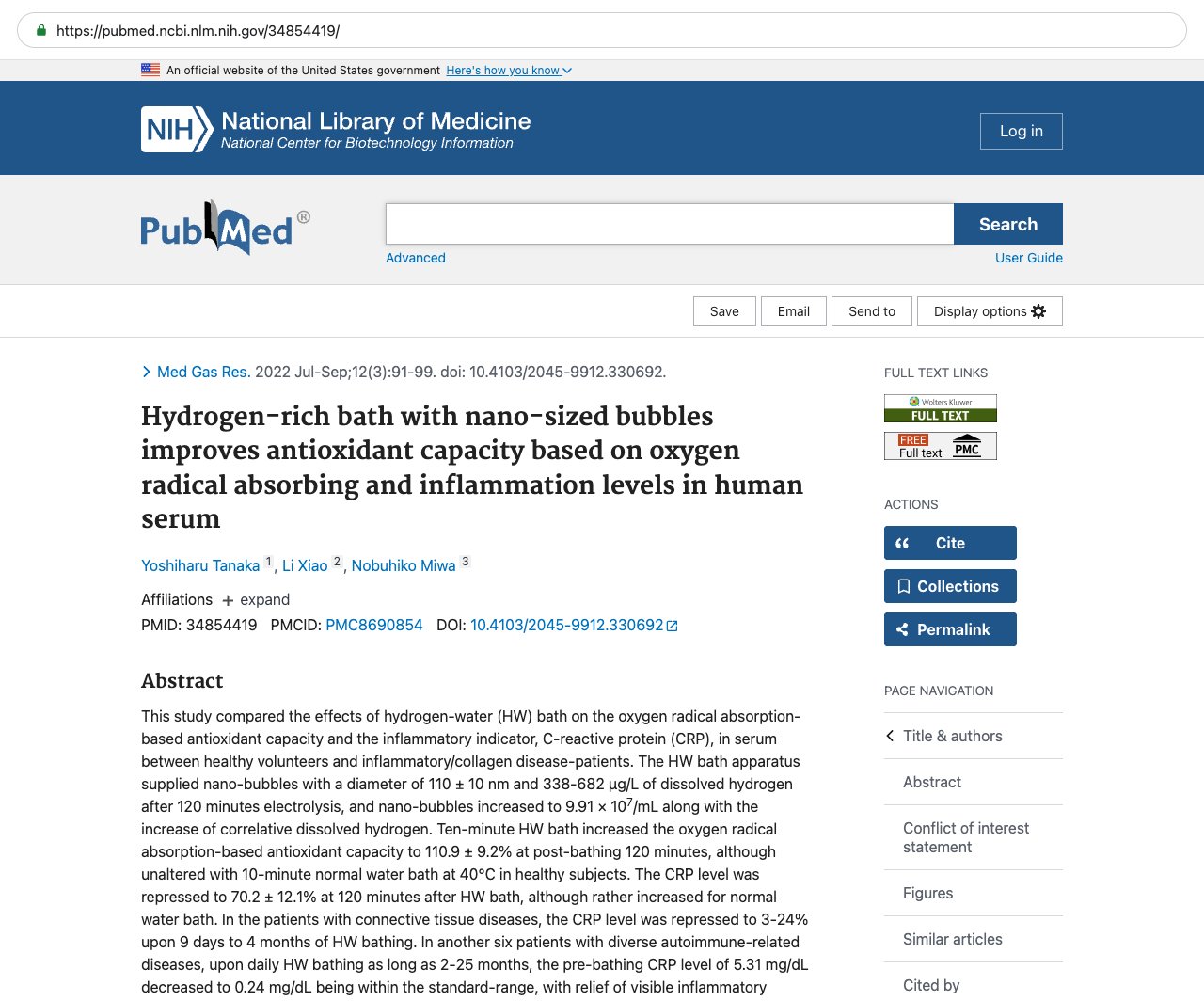
This page mirrors the published abstract (© the authors / publisher) for reference and citation. The canonical source is the PubMed record linked above. This is not medical advice.