2021 · Takeuchi — Intravenous Hydrogen Therapy With Intracisternal Magnesium Sulfate Infusion in Severe Aneurysmal Subarachnoid Hemorrhage
Super-Abstract
In a three-arm randomised trial of 37 patients with life-threatening subarachnoid haemorrhage, adding intravenous hydrogen therapy to intracisternal magnesium sulphate infusion reduced brain injury biomarkers and delayed cerebral ischaemia compared to controls. Functional outcomes at one year were better in the combination group, though differences in recovery scores at 3 months did not reach significance. (Stroke, 2021.)
Commentary
Subarachnoid haemorrhage (SAH) from a ruptured brain aneurysm carries devastating mortality and disability. This RCT — published in the prestigious journal Stroke — is one of the more rigorous trials in the H₂ clinical literature. Patients were randomised to: magnesium sulphate alone, magnesium sulphate plus H₂, or control. Both Mg groups received intracisternal infusion (directly into the brain's fluid spaces) to prevent vasospasm — a major cause of delayed damage. The Mg+H₂ group additionally received H₂-rich saline intravenously for 14 days. The H₂-specific findings were reduced serum and cerebrospinal fluid neuron-specific enolase (a brain injury marker) and a better Barthel index at 12 months. Critically, cerebral vasospasm and delayed ischaemia rates were significantly lower in both Mg groups versus controls — but not significantly different between Mg and Mg+H₂, making it hard to isolate H₂'s unique contribution. The study was appropriately small (37 patients total) for a severe, acute neurosurgical condition, and replication in a larger trial is needed.
Key quotes
- „Serum neuron-specific enolase levels were significantly lower in the Mg+H2 group from days 3 to 14 than in the control group.“ — H₂ reduced a direct brain injury marker — adding measurable neuroprotection beyond magnesium alone
- „Incidences of cerebral vasospasm and delayed cerebral ischemia were significantly higher in the control group than in other groups.“ — both Mg groups were superior to control — the H₂ benefit was additive, not standalone
- „Intracisternal magnesium sulfate infusion combined with intravenous hydrogen therapy decreases serum malondialdehyde and neuron-specific enolase and improves Barthel index.“ — the combined-therapy advantage at 1 year: functional independence improved
Our assessment
One of the most clinically serious H₂ RCTs published — high-stakes neurosurgical setting, multi-arm design, published in a top-tier journal, pre-registered (UMIN000014696). Limitations: n=37 is underpowered for firm conclusions; the intracisternal magnesium is itself an active intervention, making it difficult to cleanly isolate H₂'s contribution; modified Rankin Scale at 3 months did not differ significantly between groups; the intravenous H₂-saline route is not widely available outside specialist centres. The Barthel index improvement at 12 months and the biomarker reduction are the strongest H₂-specific signals. A properly powered follow-up RCT is warranted.
Study design
- Type: randomised controlled trial (3 arms) · n: 37 patients with poor-grade subarachnoid haemorrhage · H₂ delivery: intravenous H₂-rich saline, 14 days (Mg+H₂ group)
- Comparators: intracisternal magnesium sulphate (2.5 mmol/L at 20 mL/h, 14 days) alone; control (neither) · Primary outcomes: cerebral vasospasm, delayed cerebral ischaemia
- Result: Mg+H₂ group: ↓ serum NSE days 3–14, ↓ CSF NSE days 3–7, ↑ Barthel index at 12 months; vasospasm/DCI lower in both Mg groups vs. control; modified Rankin Scale at 3 months: no significant inter-group difference
Abstract
BACKGROUND AND PURPOSE: Poor-grade subarachnoid hemorrhage still has a poor prognosis. This randomized controlled clinical trial evaluated intracisternal magnesium sulfate infusion combined with intravenous hydrogen therapy in patients with poor-grade subarachnoid hemorrhage. METHODS: Thirty-seven patients with poor-grade subarachnoid hemorrhage were randomized to Mg+H2, Mg, and control groups. Mg and Mg+H2 groups received intracisternal magnesium sulfate infusion (2.5 mmol/L) at 20 mL/h for 14 days. Mg+H2 group also received intravenous hydrogen-rich solution infusion for 14 days. Primary outcome measures were occurrence of delayed cerebral ischemia and cerebral vasospasm. Secondary outcome measures were modified Rankin Scale and Karnofsky performance status at 3 and 12 months, Barthel index at 12 months, and serum and cerebrospinal fluid malondialdehyde and neuron-specific enolase. RESULTS: Serum neuron-specific enolase levels were significantly lower in the Mg+H2 group from days 3 to 14 than in the control group. Cerebrospinal fluid neuron-specific enolase levels were also significantly lower in the Mg+H2 group from days 3 to 7 than in the control group. Incidences of cerebral vasospasm and delayed cerebral ischemia were significantly higher in the control group than in other groups. Modified Rankin Scale and Karnofsky performance status did not significantly differ between the three groups at 3 months. Modified Rankin Scale scores 0 to 2 were more common in the Mg and Mg+H2 groups at 1 year. Barthel index was higher in the Mg+H2 group than in the control group. CONCLUSIONS: Intracisternal magnesium sulfate infusion started immediately after surgery reduces the incidence of cerebral vasospasm and delayed cerebral ischemia and improves clinical outcomes without complications in patients with poor-grade subarachnoid hemorrhage. Intracisternal magnesium sulfate infusion combined with intravenous hydrogen therapy decreases serum malondialdehyde and neuron-specific enolase and improves Barthel index, indicating hydrogen has additional effects. Registration: URL: https://www.umin.ac.jp/ctr/index.htm. Unique identifier: UMIN000014696.
Source & links
Screenshot of the PubMed page
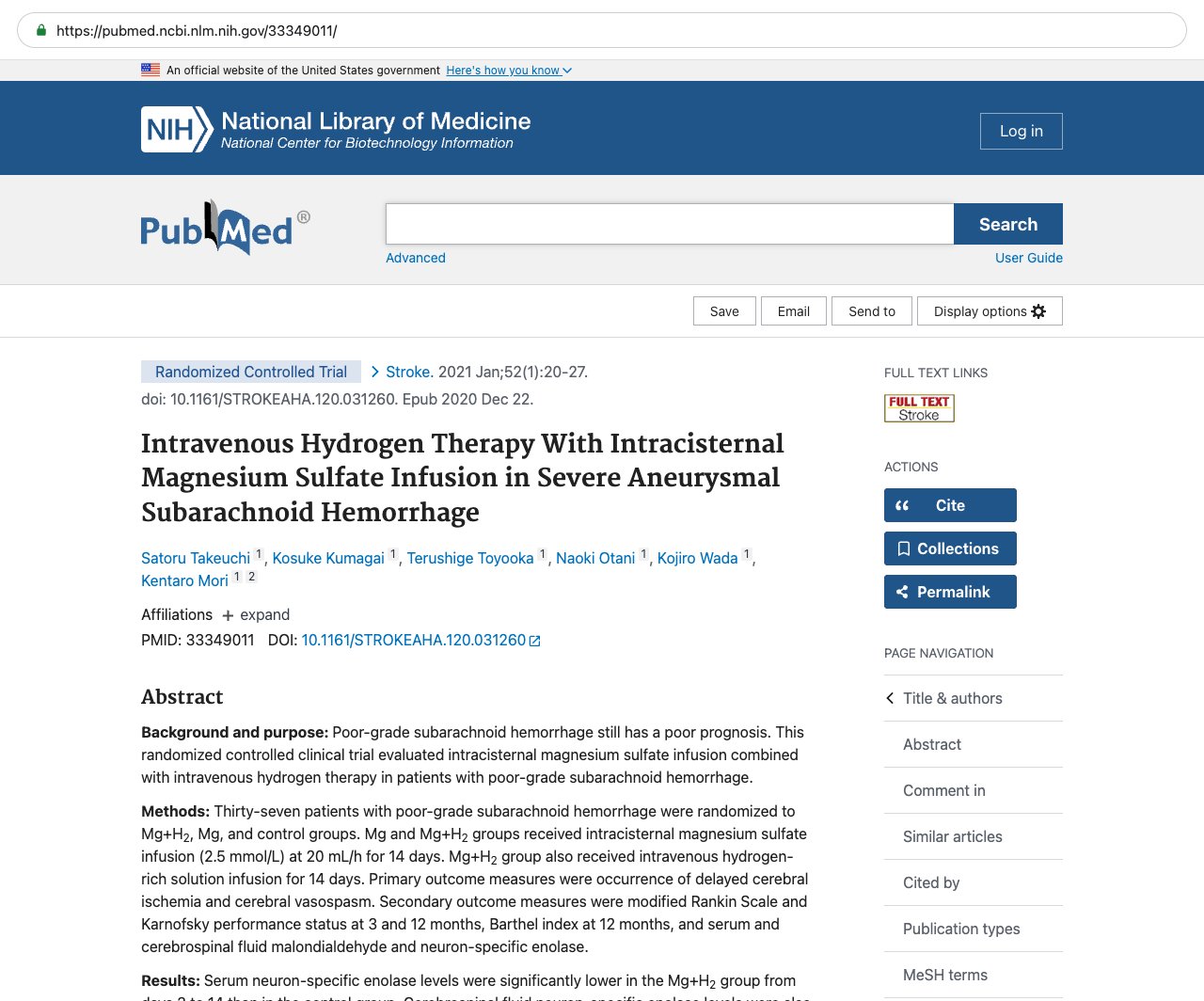
This page mirrors the published abstract (© the authors / publisher) for reference and citation. The canonical source is the PubMed record linked above. This is not medical advice.