2017 Journal of stroke and cerebrovascular diseases : the official journal of National Stroke Association RCT Human H₂ therapy InhalationSaline / IV
2017 · Ono et al. — Hydrogen Gas Inhalation Treatment in Acute Cerebral Infarction: A Randomized Controlled Clinical Study on Safety and Neuroprotection.
Super-Abstract
In this randomized controlled trial with 50 stroke patients, inhaling 3% H₂ gas twice daily for 7 days was safe and led to measurable improvements in MRI lesion intensity, stroke severity scores (NIHSS), and functional independence (Barthel Index). The study was conducted in an acute setting (6–24 h after symptom onset) with mild-to-moderate strokes. (Journal of Stroke and Cerebrovascular Diseases, 2017.)
Commentary
This is one of the first randomized controlled trials to test H₂ inhalation directly in acute ischemic stroke patients in a hospital setting. The idea is mechanistically sound: H₂ acts as a selective antioxidant, and the reperfusion injury that occurs after a stroke involves a burst of reactive oxygen species (ROS) that damages surrounding tissue. The study enrolled patients within 6–24 hours — a practically relevant window. Both MRI lesion severity and clinical scales improved, and no adverse effects were observed. However, the sample size is small (25 per group), the design is open-label for gas delivery (blinding is difficult), and the control group received standard IV medications rather than a sham inhalation gas. Larger confirmatory trials are needed before clinical recommendations can be made.
Key quotes
- „The H2 group showed no significant adverse effects with improvements in oxygen saturation.“ — safety signal: H₂ inhalation well-tolerated in acute stroke setting
- „significant effects were found: the relative signal intensity of MRI, which indicated the severity of the infarction site, NIHSS scores for clinically quantifying stroke severity, and physical therapy evaluation, as judged by the Barthel Index.“ — three parallel outcome measures all showed improvement
- „H2 treatment was safe and effective in patients with acute cerebral infarction. These results suggested a potential for widespread and general application of H2 gas.“ — authors' conclusion — cautious optimism, not yet a clinical standard
Our assessment
A promising pilot RCT for one of the most urgent clinical applications of H₂. The direction of effect is consistent across MRI, NIHSS, and Barthel Index, which strengthens the signal. Limitations: n=50 is underpowered for stroke endpoints; active control (sham gas) is absent; protocol blinding is limited; the 7-day observation window is short for stroke outcome assessment. The study supports further investigation but does not yet constitute proof of clinical efficacy.
Study design
- Type: Randomized controlled trial (open-label, rater-blinded) · n: 50 (25 H₂, 25 control) · H₂ delivery: inhalation of 3% H₂ gas, 1 h twice daily for 7 days
- Population: Acute cerebral infarction, NIHSS 2–6, therapeutic window 6–24 h after onset
- Result: MRI lesion intensity reduced, NIHSS improved, Barthel Index improved in H₂ group; no adverse effects; oxygen saturation improved
Abstract
BACKGROUND: Molecular hydrogen (H2) acts as a therapeutic antioxidant. Inhalation of H2 gas (1-4%) was effective for the improvement of cerebral infarction in multiple animal experiments. Thus, for actual applications, a randomized controlled clinical study is desired to evaluate the effects of inhalation of H2 gas. Here, we evaluate the H2 treatment on acute cerebral infarction. METHODS: Through this randomized controlled clinical study, we assessed the safety and effectiveness of H2 treatment in patients with cerebral infarction in an acute stage with mild- to moderate-severity National Institute of Health Stroke Scale (NIHSS) scores (NIHSS = 2-6). We enrolled 50 patients (25 each in the H2 group and the control group) with a therapeutic time window of 6 to 24 hours. The H2 group inhaled 3% H2 gas (1 hour twice a day), and the control group received conventional intravenous medications for the initial 7 days. The evaluations included daily vital signs, NIHSS scores, physical therapy indices, weekly blood chemistry, and brain magnetic resonance imaging (MRI) scans over the 2-week study period. RESULTS: The H2 group showed no significant adverse effects with improvements in oxygen saturation. The following significant effects were found: the relative signal intensity of MRI, which indicated the severity of the infarction site, NIHSS scores for clinically quantifying stroke severity, and physical therapy evaluation, as judged by the Barthel Index. CONCLUSIONS: H2 treatment was safe and effective in patients with acute cerebral infarction. These results suggested a potential for widespread and general application of H2 gas.
Source & links
Screenshot of the PubMed page
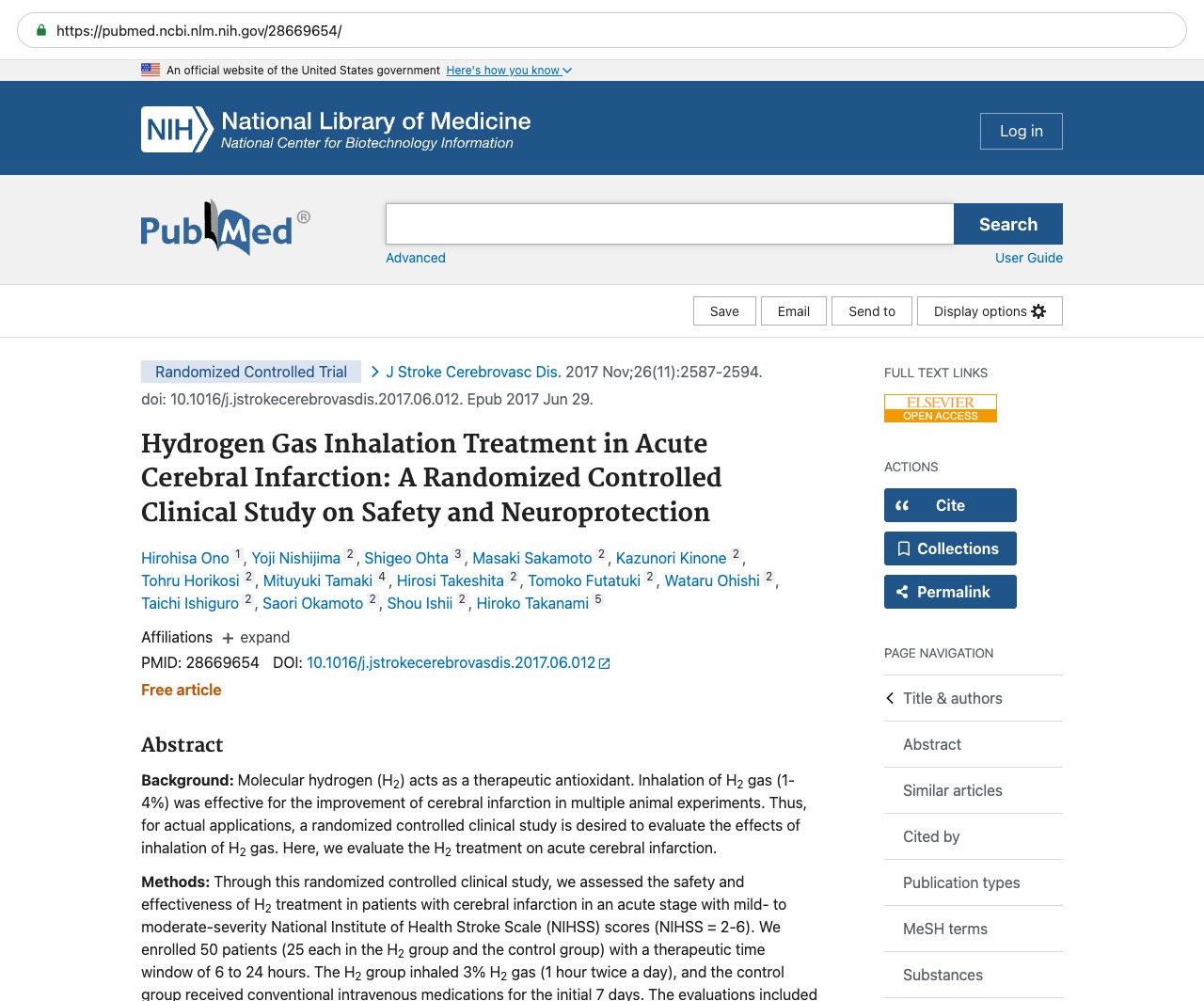
This page mirrors the published abstract (© the authors / publisher) for reference and citation. The canonical source is the PubMed record linked above. This is not medical advice.