2011 · Schoenfeld — Hydrogen Therapy May Reduce the Risks Related to Radiation-Induced Oxidative Stress in Space Flight
Super-Abstract
This hypothesis paper proposes that astronauts exposed to cosmic radiation during space missions could benefit from H₂ therapy — via inhalation or hydrogen-rich drinking water — to counteract the oxidative and DNA damage caused by cosmic radiation. This is a theoretical proposal drawing on H₂'s established antioxidant properties; no experiments or patient data are presented. (Medical Hypotheses, 2011.)
Commentary
Cosmic radiation in space — including galactic cosmic rays and solar particle events — causes DNA damage and lipid peroxidation through reactive oxygen species (ROS), posing a significant health risk for astronauts on long-duration missions (e.g. to Mars). Current countermeasures are limited. This paper applies the known antioxidant and anti-inflammatory properties of molecular hydrogen to the space radiation problem. H₂ selectively scavenges the most damaging ROS (hydroxyl radicals and peroxynitrite) without affecting the body's beneficial signalling ROS. The authors argue that administering H₂ via inhalation or H₂-rich water could provide a practical, low-toxicity preventive measure — particularly given the expected increase in space mission frequency and duration. This is a rational hypothesis, grounded in the existing H₂ biology literature, but it is explicitly speculative: no animal or human space radiation experiments with H₂ are described.
Key quotes
- „Hydrogen, recently discovered as a novel therapeutic medical gas in a variety of biomedical fields, has potent antioxidant and anti-inflammatory activities.“ — situating H₂ within the broader context of its therapeutic potential
- „we hypothesize that hydrogen administration to the astronauts by either inhalation or drinking hydrogen-rich water may potentially yield a novel and feasible preventative/therapeutic strategy to prevent radiation-induced adverse events.“ — the core hypothesis — explicitly framed as speculation, not proven fact
- „It is therefore important to estimate and prevent the risks encountered by astronauts due to oxidative stress prior to developing clinical symptoms of disease.“ — the preventive medicine rationale for addressing space radiation proactively
Our assessment
This is a hypothesis paper published in Medical Hypotheses, a journal specifically devoted to speculative scientific ideas. No experiments are conducted, no data are presented. The reasoning is scientifically coherent and the idea is plausible given H₂'s antioxidant profile, but remains completely unvalidated experimentally. Whether H₂ supplementation would actually reduce radiation-induced cancer risk or other adverse events in astronauts would require rigorous animal studies under simulated space radiation conditions, followed by human clinical trials — none of which are presented here. This paper should be understood as a research suggestion, not as evidence of efficacy.
Study design
- Type: hypothesis paper · Model: n/a (theoretical proposal only) · H₂ delivery proposed: inhalation of H₂ gas or drinking H₂-rich water by astronauts during space missions
- Result: hypothesis only — no experimental data; proposal that H₂ may protect against cosmic radiation-induced oxidative stress in space flight
Abstract
Cosmic radiation is known to induce DNA and lipid damage associated with increased oxidative stress and remains a major concern in space travel. Hydrogen, recently discovered as a novel therapeutic medical gas in a variety of biomedical fields, has potent antioxidant and anti-inflammatory activities. It is expected that space mission activities will increase in coming years both in numbers and duration. It is therefore important to estimate and prevent the risks encountered by astronauts due to oxidative stress prior to developing clinical symptoms of disease. We hypothesize that hydrogen administration to the astronauts by either inhalation or drinking hydrogen-rich water may potentially yield a novel and feasible preventative/therapeutic strategy to prevent radiation-induced adverse events.
Source & links
Screenshot of the PubMed page
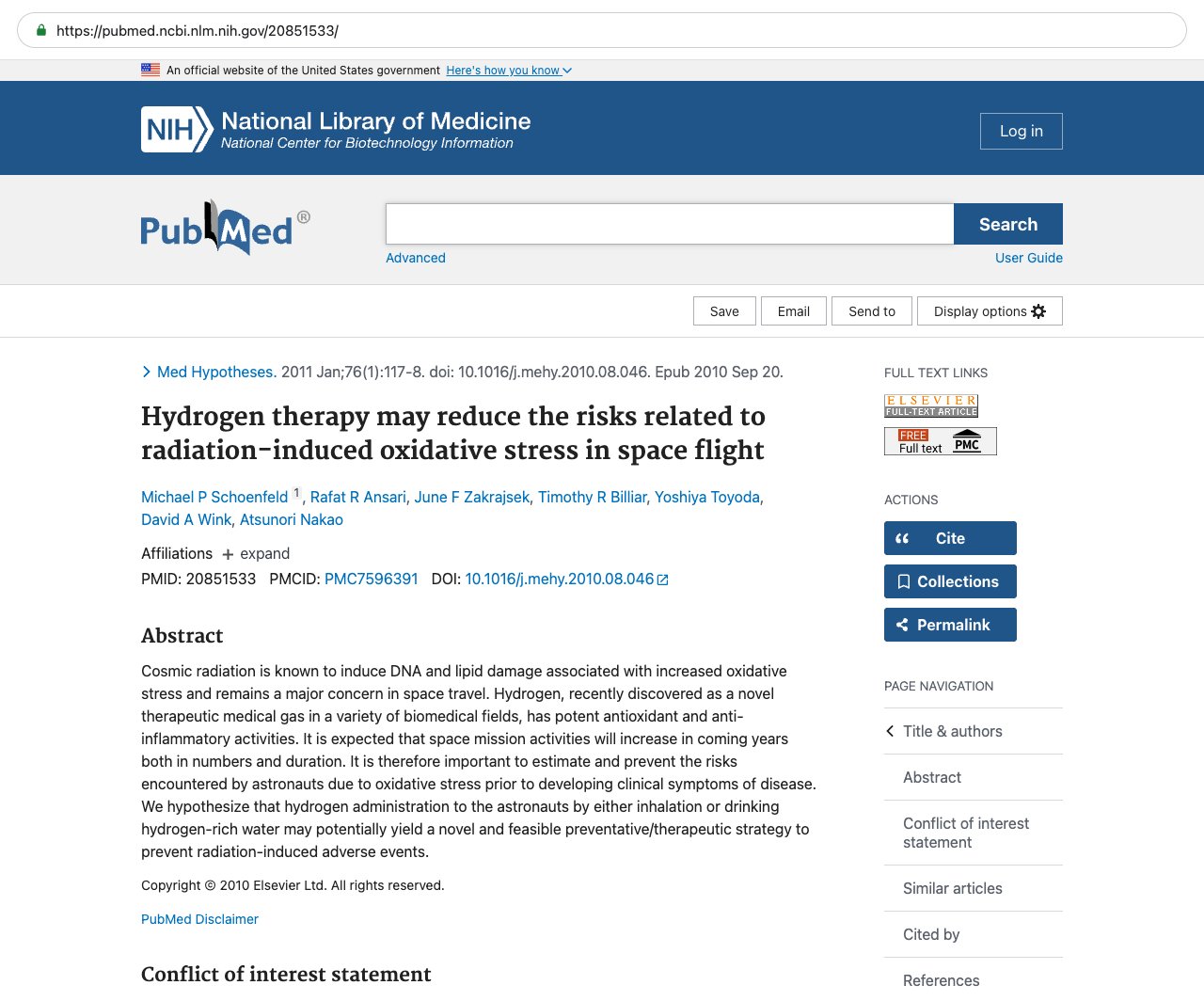
This page mirrors the published abstract (© the authors / publisher) for reference and citation. The canonical source is the PubMed record linked above. This is not medical advice.