2010 Nephrology, dialysis, transplantation : official publication of the European Dialysis and Transplant Association - European Renal Association Pilot / Observational Human H₂ therapy Inhalation
2010 · Nakayama et al. — A Novel Bioactive Haemodialysis System Using Dissolved Dihydrogen (H₂) Produced by Water Electrolysis: A Clinical Trial
Super-Abstract
Adding dissolved molecular hydrogen to dialysis solution significantly reduced blood pressure and inflammatory markers in hemodialysis patients. In this 6-month clinical trial with 21 chronic kidney disease patients, H₂-enriched dialysis fluid lowered systolic blood pressure, reduced monocyte chemoattractant protein-1 (MCP-1), and reduced myeloperoxidase — with no adverse effects. (Nephrology, Dialysis, Transplantation, 2010.)
Commentary
Hemodialysis patients carry a chronically elevated inflammatory burden — systemic inflammation driven by the dialysis process itself, residual uremic toxins, and oxidative stress. This team from Japan developed a novel approach: enriching the dialysis solution with molecular hydrogen generated by water electrolysis (average 48 ppb H₂). The idea is that H₂ dissolved in the dialysate would cross into the bloodstream during the dialysis session and exert its selective antioxidant and anti-inflammatory effects. The 6-month results are clinically meaningful: a sharp improvement in blood pressure control (only 21% at target at baseline vs. 62% after 6 months) and reductions in two key inflammatory mediators. This is an early but important proof-of-concept for a delivery route — H₂ via dialysis fluid — that is practical and potentially scalable for a population that has limited therapeutic options for managing chronic inflammation.
Key quotes
- „A significant decrease in systolic blood pressure (SBP) before and after dialysis was observed during the study, and a significant number of patients achieved SBP <140 mmHg after HD (baseline, 21%; 6 months, 62%; P < 0.05).“ — the most clinically impactful finding: blood pressure control nearly tripled
- „significant decreases in levels of plasma monocyte chemoattractant protein 1 (P < 0.01) and myeloperoxidase (P < 0.05) were identified.“ — anti-inflammatory signal: reduced MCP-1 and myeloperoxidase
- „Adding H(2) to haemodialysis solutions ameliorated inflammatory reactions and improved BP control.“ — the authors' summary — two distinct beneficial effects in a high-risk population
Our assessment
This is an early but substantive clinical trial for H₂ delivery via dialysis. The BP and inflammatory findings are statistically significant and clinically relevant for a population with poor treatment options. Limitations: No randomized control group — all 21 patients were switched to H₂-HD, so there is no concurrent control arm. This design cannot rule out regression to the mean or temporal confounds. The H₂ concentration (48 ppb) is relatively low compared to some other H₂ studies. The study is from a single center (Japan) and the sample is small. Despite these limitations, the safety profile and the magnitude of the BP response make this a meaningful proof-of-concept that warranted further investigation. The paper was published in a reputable nephrology journal.
Study design
- Type: uncontrolled before-after clinical trial · n: 21 stable hemodialysis patients · H₂ delivery: H₂-enriched dialysis solution (avg. 48 ppb H₂), 3 sessions/week for 6 months
- Result: systolic BP target achievement increased from 21% to 62% (p < 0.05); plasma MCP-1 decreased (p < 0.01); myeloperoxidase decreased (p < 0.05); no adverse effects observed
Abstract
BACKGROUND: Chronic inflammation in haemodialysis (HD) patients indicates a poor prognosis. However, therapeutic approaches are limited. Hydrogen gas (H(2)) ameliorates oxidative and inflammatory injuries to organs in animal models. We developed an HD system using a dialysis solution with high levels of dissolved H(2) and examined the clinical effects. METHODS: Dialysis solution with H(2) (average of 48 ppb) was produced by mixing dialysate concentrates and reverse osmosis water containing dissolved H(2) generated by a water electrolysis technique. Subjects comprised 21 stable patients on standard HD who were switched to the test HD for 6 months at three sessions a week. RESULTS: During the study period, no adverse clinical signs or symptoms were observed. A significant decrease in systolic blood pressure (SBP) before and after dialysis was observed during the study, and a significant number of patients achieved SBP <140 mmHg after HD (baseline, 21%; 6 months, 62%; P < 0.05). Changes in dialysis parameters were minimal, while significant decreases in levels of plasma monocyte chemoattractant protein 1 (P < 0.01) and myeloperoxidase (P < 0.05) were identified. CONCLUSIONS: Adding H(2) to haemodialysis solutions ameliorated inflammatory reactions and improved BP control. This system could offer a novel therapeutic option for control of uraemia.
Source & links
Screenshot of the PubMed page
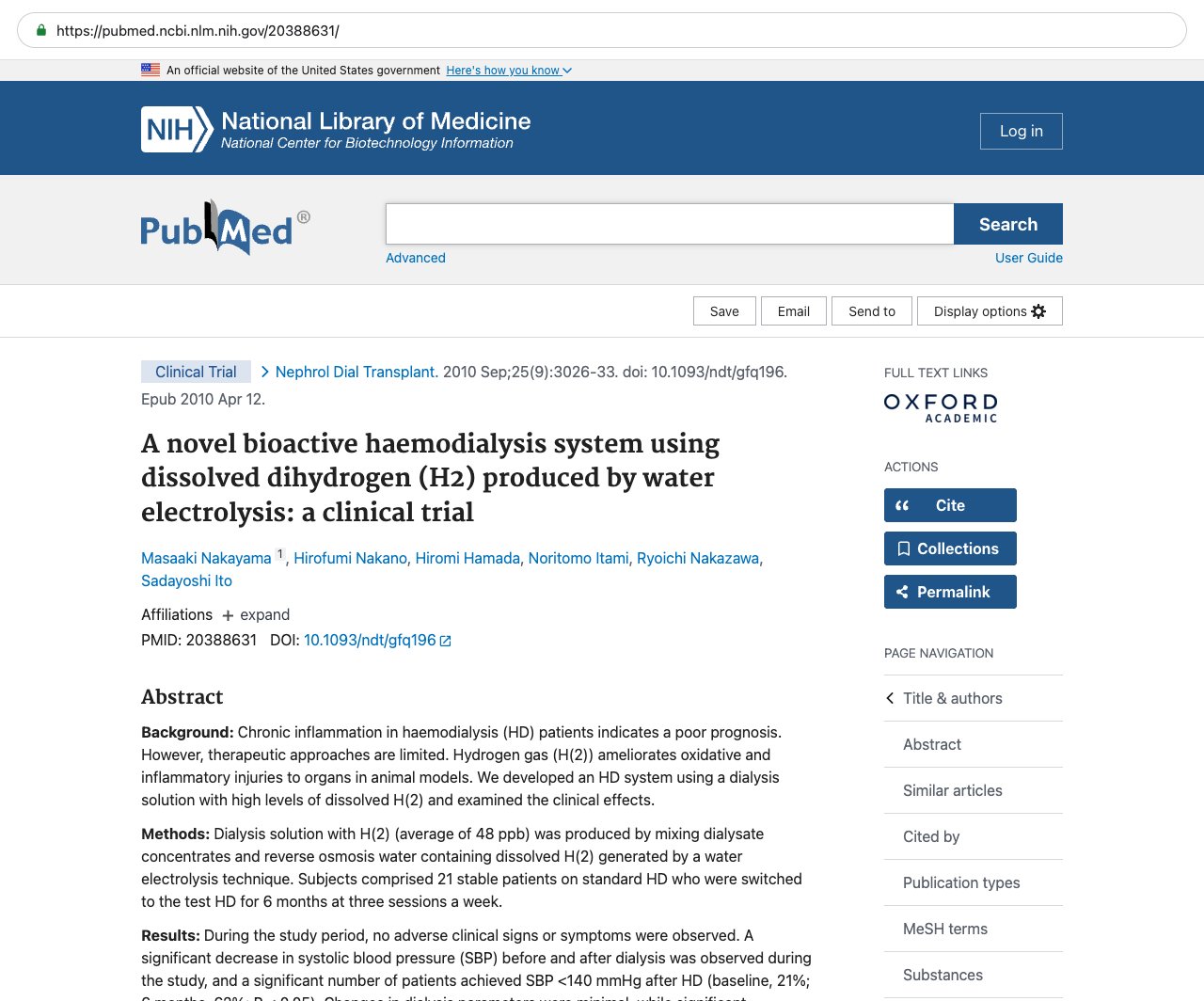
This page mirrors the published abstract (© the authors / publisher) for reference and citation. The canonical source is the PubMed record linked above. This is not medical advice.