2025 Journal of controlled release : official journal of the Controlled Release Society Mechanism / Preclinical Inhalation
2025 · Wang — Hierarchical ROS-scavenging platform breaks vicious cycle of stem cell senescence, angiogenesis arrest, and immune dysregulation in diabetic wounds.
Super-Abstract
Diabetic chronic wounds are driven by a self-reinforcing cycle of oxidative stress, stem cell ageing, impaired blood-vessel growth, and immune imbalance. Researchers embedded calcium hydride (CaH₂) nanoparticles in a microneedle patch: upon contact with wound fluid, the particles release sustained molecular hydrogen (H₂) and calcium ions (Ca²⁺), breaking this destructive cascade. In diabetic mice, the system accelerated wound closure, promoted new vessel formation, and reduced inflammatory infiltration. (Journal of Controlled Release, 2025.)
Commentary
This is a materials-engineering study combining two therapeutic agents — H₂ gas and Ca²⁺ — delivered locally through a dissolvable microneedle patch. The design is elegant: CaH₂ reacts with water in the wound exudate and simultaneously produces H₂ (antioxidant, anti-senescence) and Ca²⁺ (pro-angiogenic co-factor). The paper demonstrates mechanistic plausibility across several pathways — macrophage polarisation toward M2, reversal of stem cell senescence, endothelial tubulogenesis — all in murine models. This is an animal study only; the delivery device has not been tested in humans, and the jump from mouse skin biology to human diabetic wound healing is substantial. The use of CaH₂ as an in-situ H₂ source is a relatively novel approach compared to inhalation or hydrogen-rich water, raising additional questions about safety, dose control, and manufacturability for clinical translation.
Key quotes
- „The liberated H₂ directly neutralizes cytotoxic ROS, thereby reversing stem cell senescence and restoring their paracrine secretion of pro-angiogenic factors, while concomitantly reprogramming macrophages toward pro-regenerative M2 phenotypes.“ — central mechanism: H₂ clears ROS to rescue stem cell function and shift immune response
- „Ca2+ synergizes with H₂ to activate endothelial cell migration and tubulogenesis, fostering robust vascular network formation.“ — dual-agent synergy: calcium ions amplify the pro-angiogenic effect
- „In diabetic murine models, this approach accelerated wound closure, enhanced neovascularization, and reduced inflammatory infiltration.“ — key in-vivo outcome — exclusively in mice
Our assessment
An innovative preclinical proof-of-concept for a combined H₂/Ca²⁺ microneedle device targeting the complex pathology of diabetic wounds. The multi-pathway rationale is well-reasoned and the mouse data are encouraging. Critical limitation: this is an animal study — results cannot be directly extrapolated to humans. Diabetic wound healing in rodents differs substantially from the human clinical situation (skin anatomy, wound chronicity, co-morbidity burden). No toxicity or immune-response data in humans exist. Clinical translation requires safety studies, stable manufacturing of CaH₂ nanomaterials, and ultimately randomised controlled trials. Promising direction, but not yet evidence for human benefit.
Study design
- Type: animal study (preclinical) · Model: diabetic murine wound model · H₂ delivery: CaH₂ nanoparticles embedded in a dissolvable microneedle (MN) patch — releases H₂ + Ca²⁺ upon contact with wound exudate
- Result: accelerated wound closure, enhanced neovascularisation, reduced inflammatory infiltration vs. controls; mechanistic data show M2 macrophage polarisation, reversed stem cell senescence, endothelial tubulogenesis
- Limitation: mouse model only; no human data; CaH₂ nanoparticle safety profile not characterised in depth
Abstract
Diabetic chronic wounds represent a formidable clinical challenge, driven by a pathological vicious cycle of reactive oxygen species (ROS)-induced oxidative stress, stem cell senescence, angiogenesis arrest, and immune dysregulation. Herein, we developed a hierarchical ROS-scavenging platform integrating nanoscale calcium hydride (CaH₂) within a microneedle (MN) patch to disrupt this degenerative cascade. Upon dissolution in wound exudate, CaH₂ nanoparticles react with water to generate sustained release of hydrogen gas (H₂) and calcium ions (Ca2+). The liberated H₂ directly neutralizes cytotoxic ROS, thereby reversing stem cell senescence and restoring their paracrine secretion of pro-angiogenic factors, while concomitantly reprogramming macrophages toward pro-regenerative M2 phenotypes. Simultaneously, Ca2+ synergizes with H₂ to activate endothelial cell migration and tubulogenesis, fostering robust vascular network formation. By concurrently resolving oxidative stress, stem cell senescence, angiogenesis arrest, and immune dysregulation, the CaH₂-MN system breaks the vicious cycle to reshape the wound microenvironment into a pro-regenerative state. In diabetic murine models, this approach accelerated wound closure, enhanced neovascularization, and reduced inflammatory infiltration. This multiscale intervention paradigm provides a blueprint for intercepting pathological cascades in diabetic wounds.
Source & links
Screenshot of the PubMed page
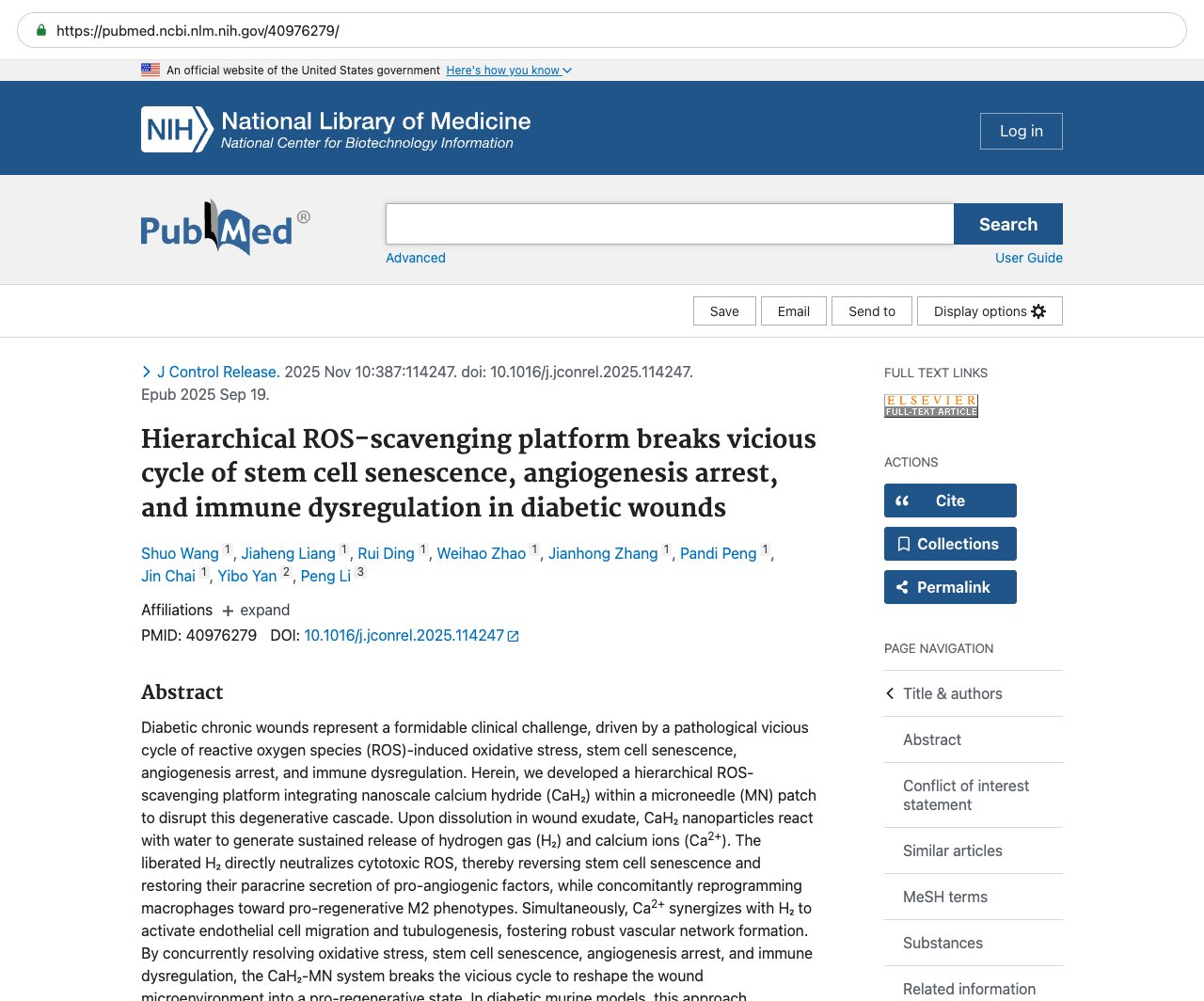
This page mirrors the published abstract (© the authors / publisher) for reference and citation. The canonical source is the PubMed record linked above. This is not medical advice.