2019 · Qian — Medical Application of Hydrogen in Hematological Diseases.
Super-Abstract
This review article surveys the clinical and basic research on molecular hydrogen in haematological diseases, including graft-versus-host disease (GvHD) after stem cell transplantation, and summarises H₂'s established antioxidant, anti-inflammatory, and anti-apoptotic properties. As a literature review, it synthesises findings from others' studies; it does not present new experimental data. The authors themselves have previously studied H₂ in GvHD.
Commentary
This narrative review by Qian and colleagues provides a useful map of where hydrogen research has reached in the context of blood diseases. Haematological applications of H₂ are less well-known than cardiac or neurological ones, making this overview genuinely informative. The authors cover GvHD, radiation injury (relevant after bone marrow transplantation), and conditions involving oxidative stress such as anaemia and leukaemia. The paper's clinical advance section is particularly relevant: the group cites their own previous work demonstrating therapeutic effects of H₂ inhalation in GvHD following stem cell transplantation — one of the more specific clinical niches for H₂. Limitations of a narrative review apply: selective citation possible, no meta-analytic pooling of effects, potential author bias given the group's own H₂ GvHD research.
Key quotes
- „Recent research, both basic and clinical, has proven that hydrogen is an important physiological regulatory factor with antioxidative, anti-inflammatory, and antiapoptotic effects.“ — H₂'s established properties in both lab and clinical research
- „more than 1000 papers have been published on the topic, including organ ischemia-reperfusion injury, radiation injury, diabetes, atherosclerosis, hypertension, or cancer.“ — breadth of H₂ research as context for the haematology-specific focus
- „We have previously hypothesized and proven the therapeutic effects of hydrogen gas in graft-versus-host disease following stem cell transplantation.“ — key clinical application highlighted by authors — GvHD after transplantation
Our assessment
This is a narrative review — not an original experiment. It provides a useful overview of where H₂ medicine intersects with haematology, with a specific focus on GvHD and radiation injury. Limitations of reviews apply: no new data, possible selective citation, and the authors are not neutral (they have their own H₂/GvHD research programme). For the specialised area of GvHD after stem cell transplantation, the claim that H₂ has been „proven“ effective is strong language that requires individual evaluation of the cited primary studies. The review is informative as an orientation but cannot substitute for systematic reviews or meta-analyses.
Study design
- Type: narrative review · Scope: haematological diseases — GvHD, radiation injury, oxidative stress-related blood conditions · H₂ delivery reviewed: primarily inhalation
- Outcome: no pooled effect sizes; synthesis of basic and clinical evidence for H₂ in haematology; authors' own prior work on H₂ in GvHD highlighted as clinical advance
Abstract
Hydrogen gas has been reported to have medical efficacy since the 1880s. Still, medical researchers did not pay much attention to hydrogen gas until the 20th century. Recent research, both basic and clinical, has proven that hydrogen is an important physiological regulatory factor with antioxidative, anti-inflammatory, and antiapoptotic effects. In the past two decades, more than 1000 papers have been published on the topic, including organ ischemia-reperfusion injury, radiation injury, diabetes, atherosclerosis, hypertension, or cancer. We have previously hypothesized and proven the therapeutic effects of hydrogen gas in graft-versus-host disease following stem cell transplantation. In the current manuscript, we present the clinical advances of hydrogen gas in hematological disorders.
Source & links
Screenshot of the PubMed page
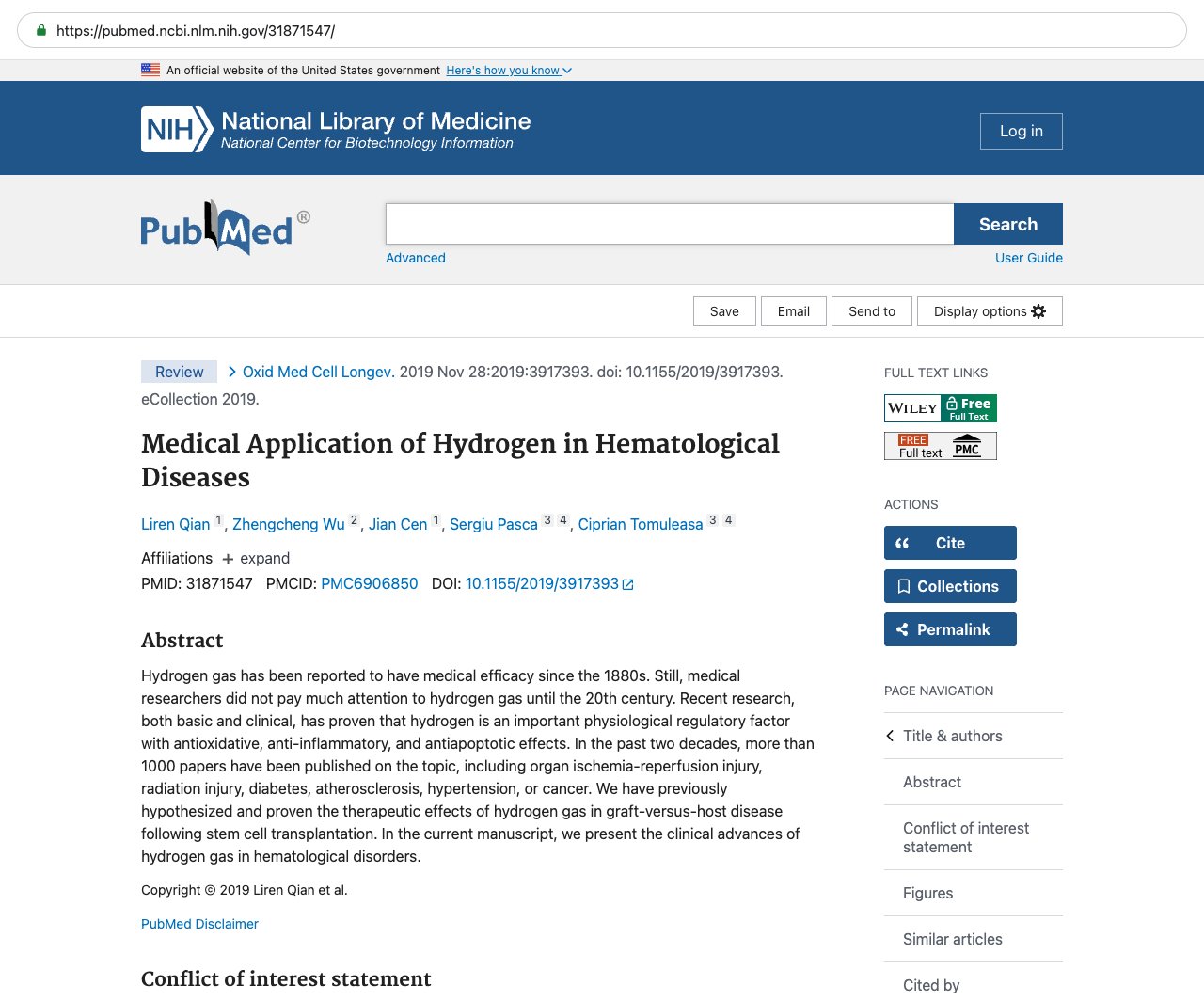
This page mirrors the published abstract (© the authors / publisher) for reference and citation. The canonical source is the PubMed record linked above. This is not medical advice.