2016 Circulation journal : official journal of the Japanese Circulation Society Mechanism / Preclinical InhalationDrinking (HRW)
2016 · Hara — Molecular Hydrogen Alleviates Cellular Senescence in Endothelial Cells
Super-Abstract
In human vascular endothelial cells exposed to a toxic compound (TCDD), hydrogen-rich medium prevented signs of cellular ageing (senescence) even after H₂ had dissipated from the medium — an effect mediated by the antioxidant transcription factor Nrf2. This is a cell culture study; results cannot be directly applied to human ageing or longevity. (Circulation Journal, 2016.)
Commentary
Endothelial cell senescence — the state in which blood vessel lining cells stop dividing and acquire an inflammatory profile — is an established contributor to vascular ageing and cardiovascular disease. This study used human umbilical vein endothelial cells (HUVECs) exposed to TCDD (a dioxin compound with strong pro-oxidant and pro-senescence effects) as a model of accelerated vascular ageing. Treatment with hydrogen-rich medium (baseline H₂ concentration ~0.55 mmol/L) prevented the TCDD-induced increases in oxidative DNA damage markers (8OHdG), acetyl-p53 expression, NAD⁺/NADH ratio disruption, impaired Sirt1 activity, and β-galactosidase-associated senescence markers. A particularly interesting finding was that the protective effects of H₂ persisted even after H₂ became undetectable in the medium (after ~12 hours), and that these effects depended on Nrf2 activation — a master antioxidant regulator. This suggests H₂ may trigger a lasting cellular adaptive response beyond its direct radical-scavenging lifetime. However, the TCDD model is highly artificial, HUVECs are a standard but simplified model, and longevity claims about „hydrogen-rich water” extrapolated from this experiment should be treated with caution.
Key quotes
- „HUVECs incubated in hydrogen-rich medium did not exhibit these TCDD-induced changes accompanying Nrf2 activation, which was observed even after H2 was undetectable in the medium.“ — the key finding: lasting protection via Nrf2, outlasting H₂ presence in the medium
- „H2 has long-lasting antioxidant and anti-aging effects on vascular endothelial cells through the Nrf2 pathway, even after transient exposure to H2.“ — the authors' conclusion: durable anti-senescence effect via transcription factor activation
- „Chrysin, an inhibitor of Nrf2, abolished the protective effects of H2 on HUVECs.“ — mechanistic confirmation: Nrf2 is required for the observed protection
Our assessment
This is an in-vitro cell study — results apply to human umbilical vein endothelial cells under an artificially induced toxic stress, and cannot be extrapolated to human vascular ageing or longevity. The Nrf2-mediated mechanism identified is scientifically plausible and consistent with other H₂ research, and the persistence of effect after H₂ dissipation is a mechanistically interesting observation. However, no conclusions about anti-ageing effects in living humans can be drawn from this experiment. Claims that „hydrogen-rich water increases longevity” (which the authors' discussion touches on) go well beyond what cell culture data can support.
Study design
- Type: in-vitro cell study · Model: HUVECs (human umbilical vein endothelial cells), TCDD-induced senescence · H₂ delivery: hydrogen-rich medium (0.55 ± 0.07 mmol/L H₂, undetectable after ~12 h); also mentions hydrogen-rich water
- Result: H₂ prevented TCDD-induced 8OHdG, acetyl-p53, impaired Sirt1, reduced NAD⁺/NADH ratio, and β-galactosidase senescence markers; Nrf2 activation confirmed as mechanism; protection persisted after H₂ cleared from medium; Nrf2 inhibitor (chrysin) abolished the effect
Abstract
BACKGROUND: Substantial evidence indicates that molecular hydrogen (H2) has beneficial vascular effects because of its antioxidant and/or anti-inflammatory effects. Thus, hydrogen-rich water may prove to be an effective anti-aging drink. This study examined the effects of H2on endothelial senescence and clarified the mechanisms involved. METHODS AND RESULTS: Hydrogen-rich medium was produced by a high-purity hydrogen gas generator. Human umbilical vein endothelial cells (HUVECs) were incubated with 2,3,7,8-tetrachlorodibenzo-p-dioxin (TCDD) for various time periods in normal or hydrogen-rich medium. The baseline H2concentration in hydrogen-rich medium was 0.55±0.07 mmol/L. This concentration gradually decreased, and H2was almost undetectable in medium after 12 h. At 24 h after TCDD exposure, HUVECs treated with TCDD exhibited increased 8OHdG and acetyl-p53 expression, decreased nicotinamide adenine dinucleotide (NAD(+))/NADH ratio, impaired Sirt1 activity, and enhanced senescence-associated β-galactosidase. However, HUVECs incubated in hydrogen-rich medium did not exhibit these TCDD-induced changes accompanying Nrf2 activation, which was observed even after H2was undetectable in the medium. Chrysin, an inhibitor of Nrf2, abolished the protective effects of H2on HUVECs. CONCLUSIONS: H2has long-lasting antioxidant and anti-aging effects on vascular endothelial cells through the Nrf2 pathway, even after transient exposure to H2. Hydrogen-rich water may thus be a functional drink that increases longevity. (Circ J 2016; 80: 2037-2046).
Source & links
Screenshot of the PubMed page
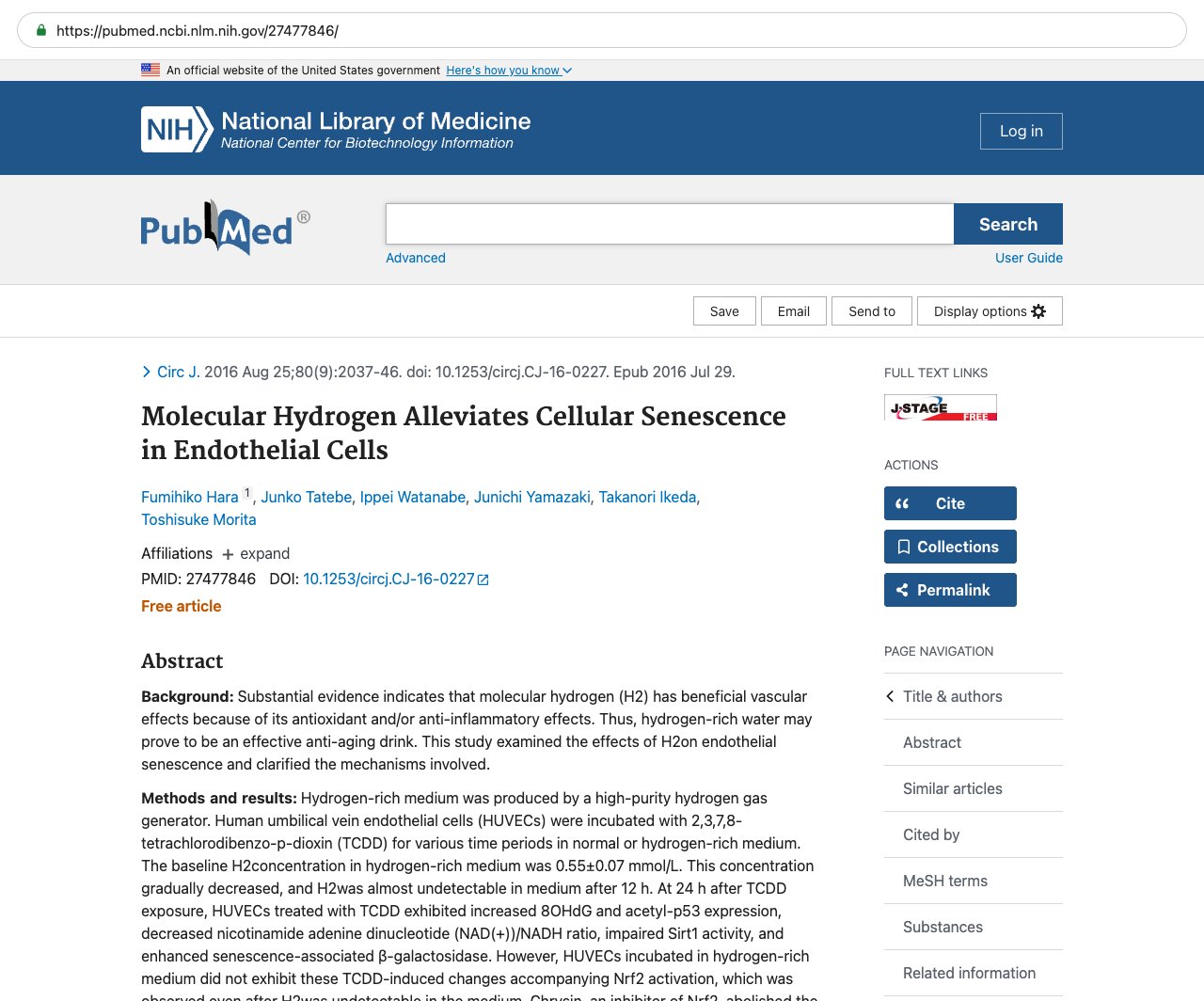
This page mirrors the published abstract (© the authors / publisher) for reference and citation. The canonical source is the PubMed record linked above. This is not medical advice.