1987 · Wong — Deuterium and oxygen-18 measurements on microliter samples of urine, plasma, saliva, and human milk.
Super-Abstract
Improved laboratory methods for measuring stable isotope ratios (deuterium/²H and ¹⁸O) in tiny biological fluid samples — down to 10 microliters — were developed and validated, enabling more precise studies of body composition and energy expenditure in humans. Hydrogen gas generation from microliter samples is a key preparatory step in this isotope measurement methodology. (The American Journal of Clinical Nutrition, 1987.)
Commentary
In this methodological study, hydrogen gas is produced from biological fluid samples via zinc reduction as a preparatory step for isotope ratio mass spectrometry — specifically to measure the deuterium-to-protium (²H:¹H) ratio in water from body fluids. This technique is used in doubly-labelled water studies that estimate total body water and energy expenditure. The H₂ here is purely an analytical intermediate in the laboratory measurement process, not a therapeutic molecule. The paper is a technical advance in isotope methodology with no connection to molecular hydrogen therapy.
Key quotes
- „Hydrogen gas samples are generated from 10 microL of undistilled fluid by zinc reduction in quartz reaction vessels.“ — H₂ production as a preparatory step for isotope measurement — not therapeutic
- „These methodological improvements facilitate and extend the use of 2H and 18O tracers in studies of body composition and energy expenditure.“ — the purpose: enabling stable isotope research in human nutrition
- „Enriched levels of 2H (580%) and 18O (256%) in urine, plasma, saliva, and human milk can be measured with a precision of 3.2% (n = 200) and 0.97% (n = 200).“ — validated analytical precision across multiple biological fluids
Our assessment
This is a methodological in-vitro study developing isotope ratio measurement techniques for nutritional research. Hydrogen gas generation is a sample preparation step, not a therapeutic application. There is no relevance to molecular hydrogen therapy. The paper is primarily of interest to researchers using doubly-labelled water methods for body composition or metabolic studies.
Study design
- Type: in-vitro methods development study · Samples: urine, plasma, saliva, human milk (n=200 measurements each for ²H and ¹⁸O) · H₂ role: generated from 10 µL samples via zinc reduction as preparation for isotope ratio mass spectrometry (not therapeutic)
- Result: precision of 3.2% for ²H and 0.97% for ¹⁸O measurements; accuracy within ±4.4% (²H) and ±0.87% (¹⁸O); ¹⁸O equilibration completed in 10h with modified commercial system
Abstract
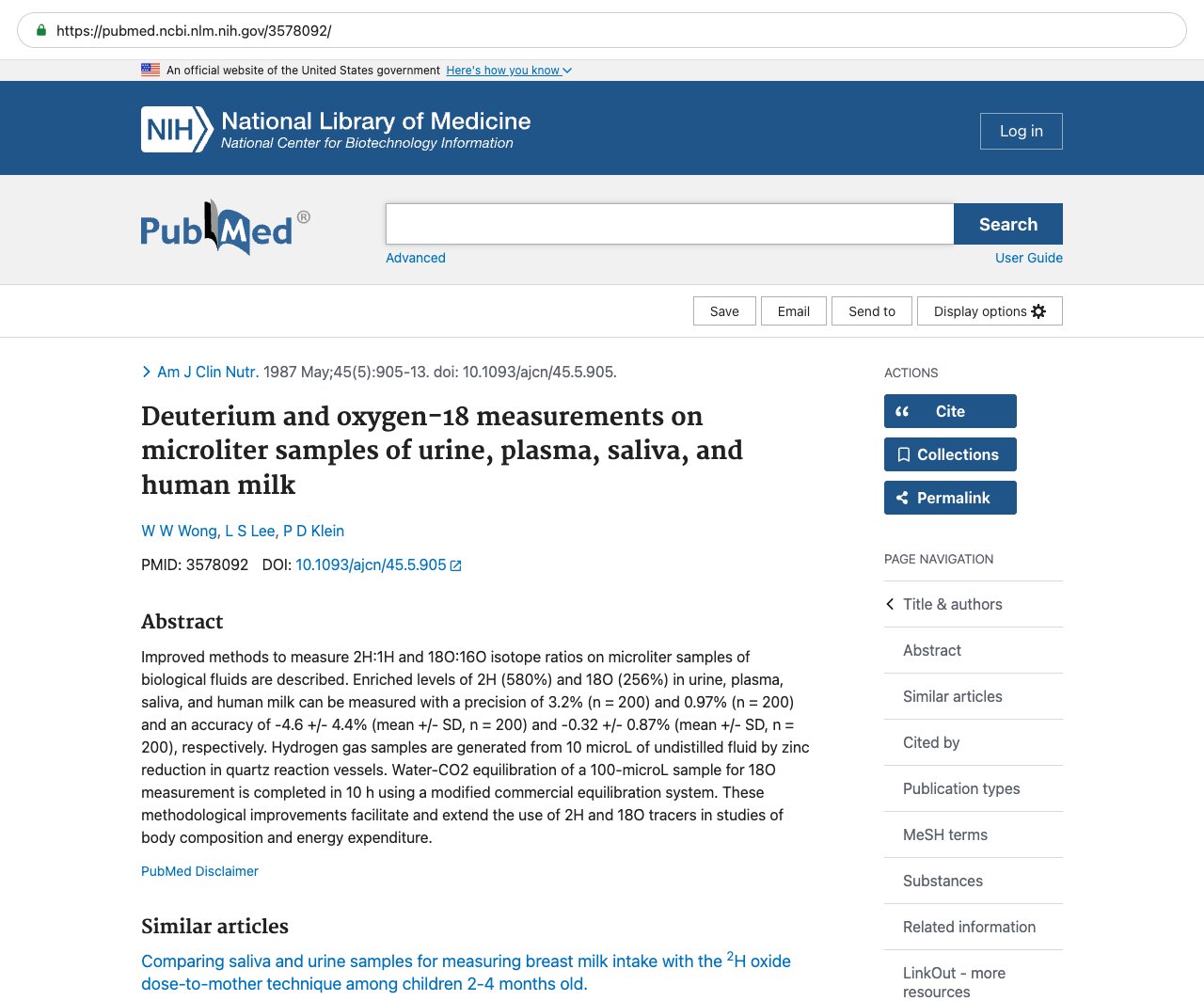
Improved methods to measure 2H:1H and 18O:16O isotope ratios on microliter samples of biological fluids are described. Enriched levels of 2H (580%) and 18O (256%) in urine, plasma, saliva, and human milk can be measured with a precision of 3.2% (n = 200) and 0.97% (n = 200) and an accuracy of -4.6 +/- 4.4% (mean +/- SD, n = 200) and -0.32 +/- 0.87% (mean +/- SD, n = 200), respectively. Hydrogen gas samples are generated from 10 microL of undistilled fluid by zinc reduction in quartz reaction vessels. Water-CO2 equilibration of a 100-microL sample for 18O measurement is completed in 10 h using a modified commercial equilibration system. These methodological improvements facilitate and extend the use of 2H and 18O tracers in studies of body composition and energy expenditure.
Source & links
Screenshot of the PubMed page
This page mirrors the published abstract (© the authors / publisher) for reference and citation. The canonical source is the PubMed record linked above. This is not medical advice.