2025 · Liu — Hydrogen-induced disruption of the airway mucus barrier enhances nebulized RNA delivery to reverse pulmonary fibrosis.
Super-Abstract
Pulmonary fibrosis is difficult to treat because the thick mucus lining of airways blocks inhaled medicines from reaching diseased tissue — and molecular hydrogen gas, when delivered simultaneously with aerosolised RNA therapy, disrupts this mucus barrier through physical shear forces, dramatically improving drug penetration into fibrotic lungs. In mice, the combined approach effectively blocked fibrotic signalling pathways and reversed lung scarring. This is an animal study; no human data are available. (Science Advances, 2025.)
Commentary
Pulmonary fibrosis (PF) is a progressive and often fatal lung disease for which treatment options are limited. RNA-based therapies (particularly siRNA targeting TGFβ1, a key fibrosis driver) are a promising approach, but delivery to lung tissue is hindered by the mucus barrier and the difficulty of reaching deep fibrotic regions. This paper's innovation lies in using H₂ gas not only as a therapeutic agent but as a physical delivery enhancer: the hydrogen gas flow creates shear stress at the liquid-nanoparticle-mucus interface, disrupting the sticky mucus network and allowing lipid nanoparticles (LNPs) carrying TGFβ1 siRNA to penetrate deeper into fibrotic lesions. A „hybrid“ LNP design that exploits pH-dependent charge inversion and apoptotic T cell membranes further enhances macrophage uptake. This is a sophisticated dual-function system. The Science Advances venue reflects high scientific quality. However, all data are from murine models — human pulmonary fibrosis biology, mucus composition, and airway anatomy differ, and a dedicated clinical delivery device is needed before human translation is possible.
Key quotes
- „the hydrogen flow-induced shear stresses disrupt the NP-mucus interaction, enhancing the deposition of aerosolized HNPs/TGFβ1 siRNA within fibrotic lung lesions.“ — the physical mechanism: H₂ gas as a shear-force tool to overcome the mucus barrier
- „We established a nose-only aerosol inhalation device integrated with a hydrogen supplement system. This setup enables the precise administration of lipid nanoparticles (LNPs) at a controlled low dose, while simultaneously delivering the optimal concentration of therapeutic hydrogen gas.“ — the combined delivery device: simultaneous H₂ and RNA nanoparticle aerosol inhalation
- „We further developed a hybrid lipid NP (HNP) by hybridizing a pH-dependent charge-inverting lipid film with apoptotic T cell membranes to enhance endosomal escape and trigger macrophage production of hepatocyte growth factor for lung repair.“ — the nanoparticle engineering innovation: immune-cell-membrane coating to target lung macrophages
Our assessment
A highly innovative and technically sophisticated preclinical study that repositions H₂ from a purely antioxidant role to a physical drug-delivery enhancer — using gas-flow shear stress to overcome the mucus barrier in fibrotic lungs. The dual functionality (H₂ as therapeutic + H₂ as delivery enhancer) is conceptually novel. Critical limitation: this is entirely animal research — no human data exist, and results cannot be extrapolated to patients. The custom aerosol inhalation device and the hybrid LNP design require substantial engineering and safety validation for human use. RNA therapy in PF is itself still in early clinical stages. A compelling mechanistic advance requiring extensive further development before any clinical relevance.
Study design
- Type: animal study (preclinical) · Model: murine pulmonary fibrosis model · H₂ delivery: nose-only aerosol inhalation device integrated with H₂ supplement system — simultaneous H₂ gas and lipid nanoparticle (LNP) aerosol administration
- RNA therapy: TGFβ1 siRNA in hybrid lipid NP (HNP) — pH-dependent charge-inverting + apoptotic T cell membrane coating for macrophage targeting
- Result: H₂ flow-induced shear stress disrupted mucus barrier → enhanced LNP deposition in fibrotic lesions; TGFβ1 siRNA blocked fibrogenic signalling; lung repair via macrophage-produced HGF confirmed in murine model
Abstract
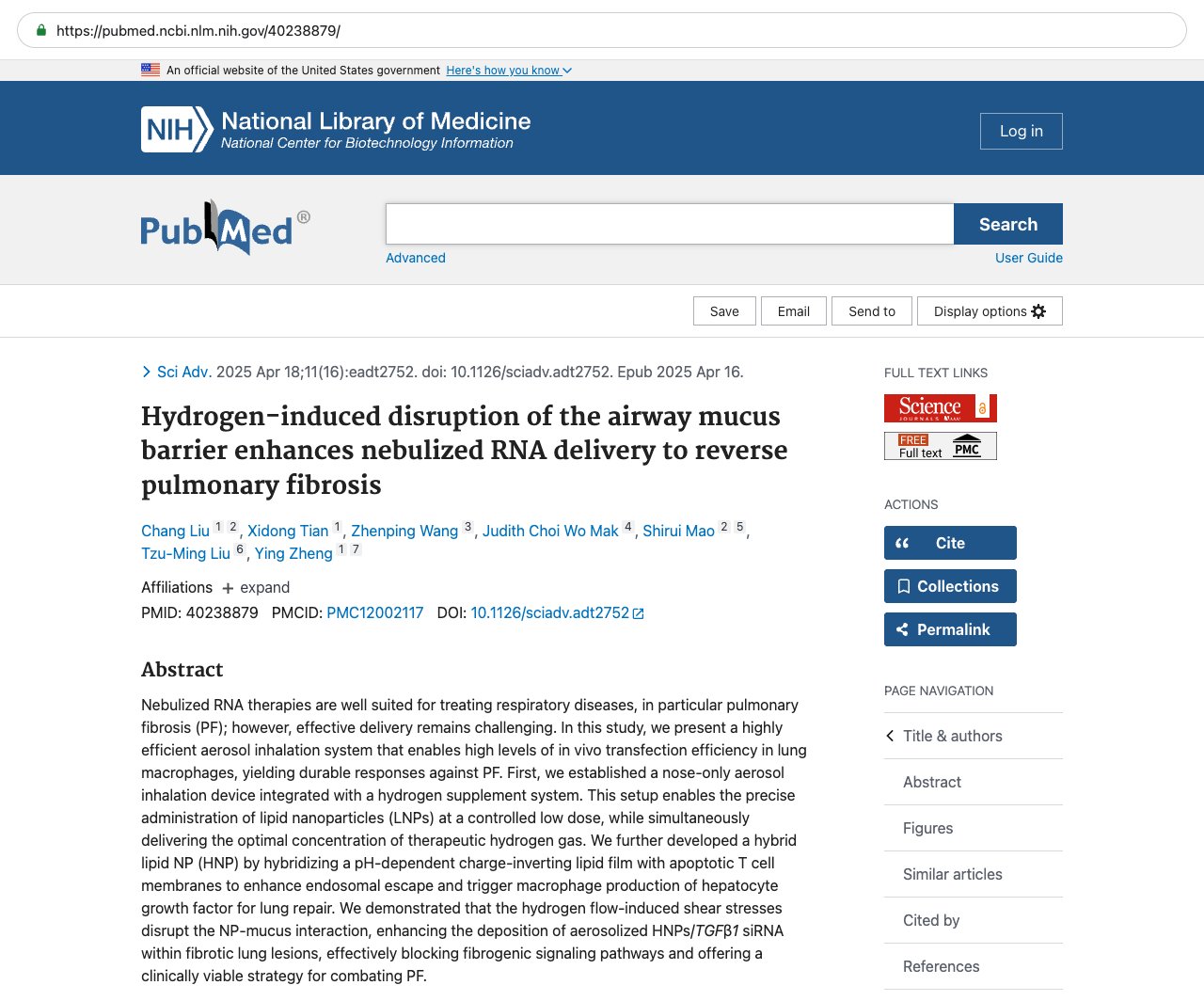
Nebulized RNA therapies are well suited for treating respiratory diseases, in particular pulmonary fibrosis (PF); however, effective delivery remains challenging. In this study, we present a highly efficient aerosol inhalation system that enables high levels of in vivo transfection efficiency in lung macrophages, yielding durable responses against PF. First, we established a nose-only aerosol inhalation device integrated with a hydrogen supplement system. This setup enables the precise administration of lipid nanoparticles (LNPs) at a controlled low dose, while simultaneously delivering the optimal concentration of therapeutic hydrogen gas. We further developed a hybrid lipid NP (HNP) by hybridizing a pH-dependent charge-inverting lipid film with apoptotic T cell membranes to enhance endosomal escape and trigger macrophage production of hepatocyte growth factor for lung repair. We demonstrated that the hydrogen flow-induced shear stresses disrupt the NP-mucus interaction, enhancing the deposition of aerosolized HNPs/TGFβ1 siRNA within fibrotic lung lesions, effectively blocking fibrogenic signaling pathways and offering a clinically viable strategy for combating PF.
Source & links
Screenshot of the PubMed page
This page mirrors the published abstract (© the authors / publisher) for reference and citation. The canonical source is the PubMed record linked above. This is not medical advice.