2016 · Yang — Effects of hydrogen-rich medium on lipopolysaccharide-induced intestinal epithelial barrier dysfunction of human colon carcinoma cells
Super-Abstract
In a cell culture model of the intestinal epithelial barrier, hydrogen-rich medium protected Caco2 cells from lipopolysaccharide (LPS)-induced barrier disruption by improving cell viability, reducing cell injury, and partially restoring the expression and structure of tight-junction proteins claudin-1 and occludin. This is a laboratory study in colon cancer-derived cells; results cannot be directly applied to human intestinal health. (Zhonghua Wei Zhong Bing Ji Jiu Yi Xue, 2016.)
Commentary
The intestinal epithelial barrier — formed by tight junctions between enterocytes — controls permeability between the gut lumen and the body. Its disruption by bacterial products such as LPS (lipopolysaccharide, a component of gram-negative bacterial cell walls) is implicated in conditions ranging from sepsis to inflammatory bowel disease. This study used Caco2 cells (a human colon adenocarcinoma cell line widely used as an intestinal permeability model) arranged in a monolayer filter system to measure transepithelial electrical resistance (TEER), a proxy for barrier integrity. LPS treatment significantly reduced TEER, decreased cell viability, increased lactate dehydrogenase (LDH) release (a cell damage marker), and downregulated the tight-junction proteins claudin-1 and occludin. Hydrogen-rich medium significantly attenuated all these effects: TEER was partially restored, cell viability improved from 67% to 89%, LDH release was halved, and claudin-1/occludin expression and structure were partially recovered. This is mechanistically consistent with the proposed anti-inflammatory and cytoprotective effects of molecular hydrogen. However, Caco2 cells are a cancer cell line and this model does not replicate the complexity of the human gut in vivo.
Key quotes
- „Hydrogen-rich medium can effectively attenuate LPS-induced dysfunction of intestinal epithelial barrier in human Caco2 cells by ameliorating cell viability as well as regulating claudin-1 and occludin expression and structure.“ — the authors' main conclusion: H₂ protects tight-junction integrity under LPS stress
- „Compared with group C, TEER in group D was increased after 6 hours.“ — barrier integrity (TEER) was partially restored by hydrogen-rich medium
- „The cell viability was significantly increased in group D [(88.8±7.4)% vs. (67.2±7.9)%, P < 0.05] and cell injury was significantly abated [LDH release rate: (16.4±4.3)% vs. (38.5±2.1)%, P < 0.05].“ — quantitative viability and injury improvement with hydrogen-rich medium vs. LPS alone
Our assessment
This is an in-vitro cell study using a colon adenocarcinoma cell line (Caco2) as a model of intestinal permeability. The observed protective effects of hydrogen-rich medium on LPS-induced barrier dysfunction are consistent with the known anti-inflammatory profile of H₂, and the use of TEER and tight-junction protein expression provides a mechanistically relevant readout. However, Caco2 cells are derived from cancer and represent a simplified, artificial model — results cannot be extrapolated to human gut health or intestinal disease. This study contributes to the mechanistic evidence base but requires follow-up in animal and eventually human models.
Study design
- Type: in-vitro cell study · Model: Caco2 human colon adenocarcinoma cells, LPS (1 g/L)-induced barrier disruption, monolayer filter TEER model · H₂ delivery: hydrogen-rich medium (prepared in vitro)
- Result: hydrogen-rich medium vs. LPS alone: TEER partially restored from 6 h; cell viability 89% vs. 67%; LDH release 16% vs. 39%; claudin-1 and occludin expression upregulated at 24 h; disrupted tight-junction structure partially recovered
Abstract
OBJECTIVE: To investigate the effects of hydrogen-rich medium on lipopolysaccharide (LPS)-induced intestinal epithelial barrier dysfunction of human intestinal epithelial (Caco2) cells. METHODS: Caco2 cells (passages 28-35) were purchased from the Cell Bank of the Shanghai Institute of Cell Biology, Chinese Academy of Sciences in Shanghai, China, and they were cultured in Dulbecco minimum essential medium (DMEM) containing 20% fetal bovine serum. These cells were randomly divided into four groups: control group (group A), hydrogen-rich medium group (group B), LPS group (group C) and LPS + hydrogen-rich medium group (group D). Cells were cultured with normal medium in group A and group C or with hydrogen-rich medium in group B and group D. Meanwhile, 1 g/L LPS was simultaneously added into group C and group D, while an equivalent volume of normal saline was added into group A and group B instead. In vitro intestinal epithelial models were reproduced with monolayer filter-grown Caco2 and intestinal epithelium. The trans-epithelial electrical resistance (TEER) in models of each group was measured at different incubation times (0, 3, 6, 12, 24 and 48 hours). Cell viability and cytotoxicity were assessed with 3-(4,5-dimethylthiazol-2-yl)-2,5-diphenyltetrazolium bromide (MTT) assay and lactate dehydrogenase (LDH) release assay, respectively, after incubation for 24 hours. The expression levels of claudin-1 and occludin were respectively determined at 6, 12 and 24 hours of incubation by Western Blot assay. The morphological structure of claudin-1 and occludin was respectively observed after incubation for 24 hours with immunofluorescence staining. RESULTS: There was no statistical significance in variables between group A and group B. Compared with group A, it was shown that TEER was time-dependently decreased in groups C and D after 6 hours. Compared with group C, TEER in group D was increased after 6 hours. Compared with group A, the cell viability was significantly reduced in group C [(67.2±7.9)% vs. (100.0±0.0)%, P < 0.05] and cell injury was obvious [LDH release rate: (38.5±2.1)% vs. (1.2±0.3)%, P < 0.05]; the expression levels of claudin-1 and occludin at 6, 12, 24 hours were significantly down-regulated [claudin-1 (gray value): 0.351±0.079, 0.272±0.075, 0.190±0.049 vs. 0.518±0.030; occludin (gray value): 0.416±0.044, 0.290±0.062, 0.226±0.019 vs. 0.602±0.038, all P < 0.05], and the structure of claudin-1 and occludin were profoundly disrupted. Compared with group C, it was shown that the cell viability was significantly increased in group D [(88.8±7.4)% vs. (67.2±7.9)%, P < 0.05] and cell injury was significantly abated [LDH release rate: (16.4±4.3)% vs. (38.5±2.1)%, P < 0.05]; the expression levels of claudin-1 and occludin were significantly up-regulated at 24 hours [claudin-1 (gray value): 0.428±0.046 vs. 0.190±0.049, occludin (gray value): 0.466±0.071 vs. 0.226±0.019, both P < 0.05]; the disrupted structures of claudin-1 and occludin were partially recovered. CONCLUSION: Hydrogen-rich medium can effectively attenuate LPS-induced dysfunction of intestinal epithelial barrier in human Caco2 cells by ameliorating cell viability as well as regulating claudin-1 and occludin expression and structure.
Source & links
Screenshot of the PubMed page
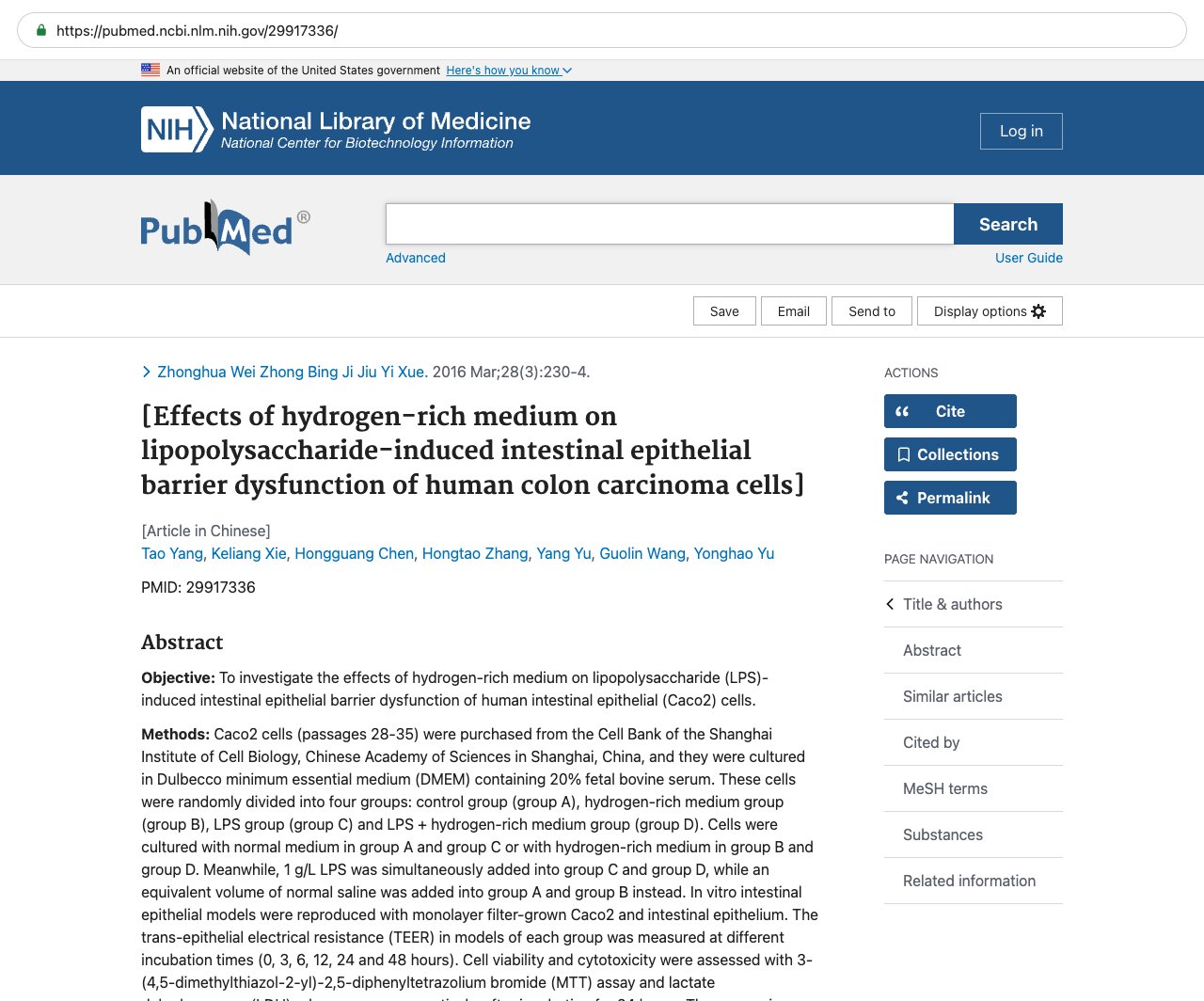
This page mirrors the published abstract (© the authors / publisher) for reference and citation. The canonical source is the PubMed record linked above. This is not medical advice.