2019 · Fan — Acid-Responsive H₂-Releasing 2D MgB₂ Nanosheet for Therapeutic Synergy and Side Effect Attenuation of Gastric Cancer Chemotherapy.
Super-Abstract
Researchers engineered a magnesium boride (MgB₂) nanosheet that releases molecular hydrogen in acidic environments (such as the stomach) and combined it with the chemotherapy drug doxorubicin in a gastric-tumor mouse model. The combined „hydrogenochemotherapy” significantly prolonged survival compared to chemotherapy alone, while reducing toxic side effects to bone marrow, heart, liver, and spleen. The proposed mechanism is that H₂ selectively inhibits aerobic respiration in cancer cells while protecting normal tissue. (Advanced Healthcare Materials, 2019.)
Commentary
This preclinical study pursues an elegant engineering concept: a nano-material that passively targets the acidic tumour microenvironment and locally releases H₂ as a chemo-sensitizer and cytoprotector simultaneously. The MgB₂ nanosheet design is novel and the in-vitro selectivity data are intriguing — H₂ appears to selectively impair cancer-cell aerobic metabolism while leaving normal-cell respiration intact. In the mouse xenograft model, the DOX + MgB₂@PVP arm outperformed DOX alone on survival. However, the translation barriers are significant: this is a mouse xenograft study, the nanosheet system has not been tested for long-term toxicity or biodistribution in humans, the proposed metabolic selectivity mechanism requires independent confirmation, and oral nanoparticle delivery faces substantial regulatory and pharmacokinetic hurdles in humans. The paper is best understood as a proof-of-concept for H₂-releasing nanomaterials rather than a near-clinical therapy.
Key quotes
- „Hydrogenochemotherapy with DOX+MBN@PVP has remarkably prolonged the survival time of gastric tumor-bearing mice by reducing the toxic side effects of chemotherapy.“ — central in-vivo result: improved survival and reduced chemo toxicity in mice
- „The MBN@PVP pill has high stability in normal tissues/blood environments as well as high gastric acid-responsiveness with sustained release behavior.“ — the nanosheet's key engineering property: pH-triggered H₂ release in the stomach
- „The mechanism … is discovered to be derived from the selectivity of hydrogen molecules in inhibiting aerobic respiration of gastric cells but activating aerobic respiration of normal cells.“ — proposed mechanism: differential metabolic effects on cancer vs. normal cells
Our assessment
A preclinical proof-of-concept study — not a clinical finding. All results are from a mouse gastric-cancer xenograft model; no human patients were involved. The nano-delivery system is inventive, but its clinical feasibility — manufacturing, regulatory approval, long-term safety, bioavailability — remains entirely unproven. The proposed mechanism of selective inhibition of cancer-cell aerobic respiration by H₂ is a fascinating hypothesis that requires much further validation. This paper contributes to the mechanistic understanding of H₂ in oncology but should not be interpreted as evidence of efficacy in human cancer treatment.
Study design
- Type: preclinical in-vitro + in-vivo animal study · Model: gastric tumor-bearing mice (xenograft); in-vitro cancer cell lines · H₂ delivery: oral MgB₂@PVP nanosheets (acid-responsive H₂ release in stomach) combined with intravenous doxorubicin
- Result: significantly prolonged survival in DOX+MBN@PVP group vs. DOX-alone; reduced markers of doxorubicin toxicity in bone marrow, cardiac, hepatic, and splenic cells; in-vitro selectivity: H₂ inhibited cancer-cell aerobic respiration while activating normal-cell respiration
Abstract
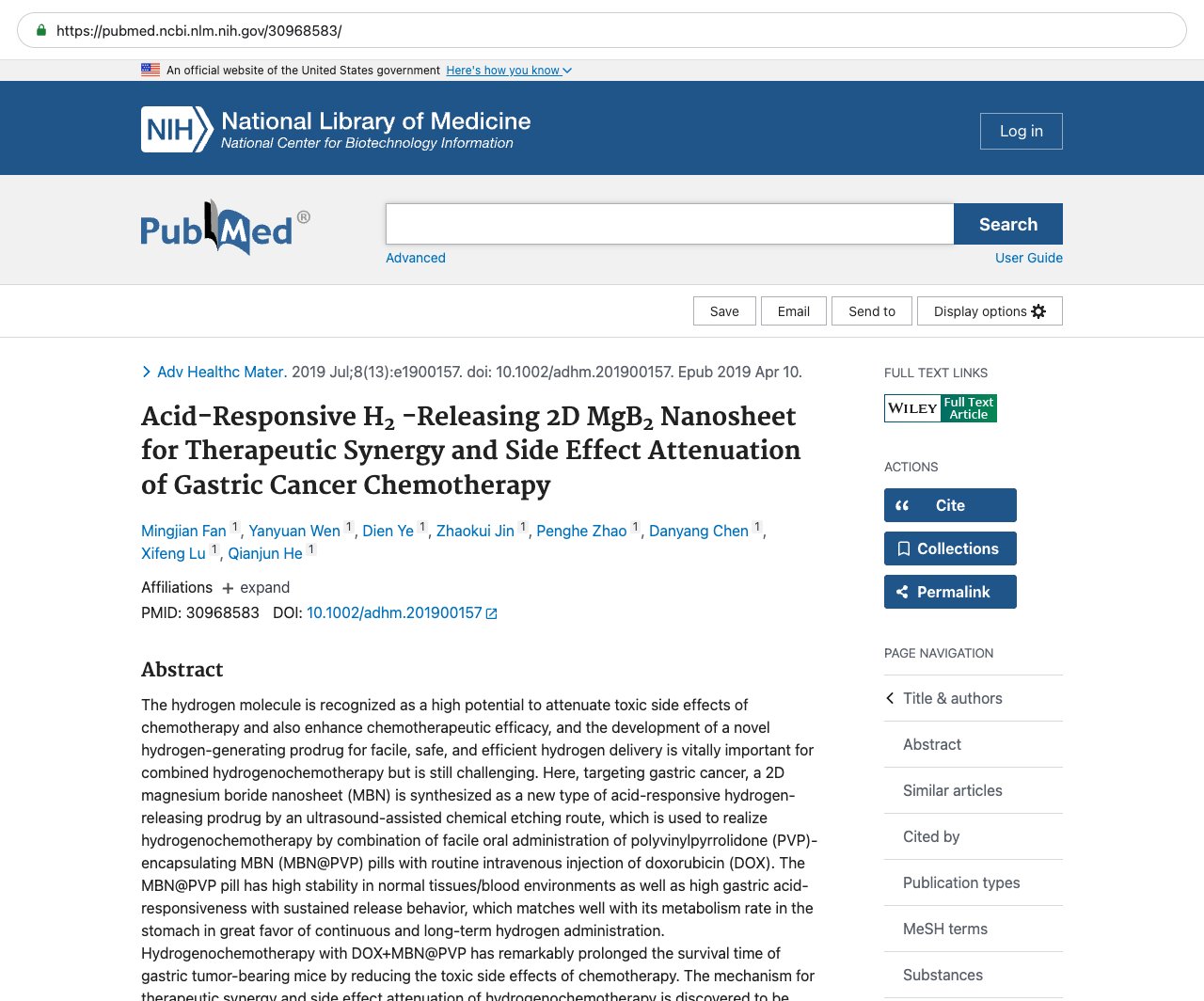
The hydrogen molecule is recognized as a high potential to attenuate toxic side effects of chemotherapy and also enhance chemotherapeutic efficacy, and the development of a novel hydrogen-generating prodrug for facile, safe, and efficient hydrogen delivery is vitally important for combined hydrogenochemotherapy but is still challenging. Here, targeting gastric cancer, a 2D magnesium boride nanosheet (MBN) is synthesized as a new type of acid-responsive hydrogen-releasing prodrug by an ultrasound-assisted chemical etching route, which is used to realize hydrogenochemotherapy by combination of facile oral administration of polyvinylpyrrolidone (PVP)-encapsulating MBN (MBN@PVP) pills with routine intravenous injection of doxorubicin (DOX). The MBN@PVP pill has high stability in normal tissues/blood environments as well as high gastric acid-responsiveness with sustained release behavior, which matches well with its metabolism rate in the stomach in great favor of continuous and long-term hydrogen administration. Hydrogenochemotherapy with DOX+MBN@PVP has remarkably prolonged the survival time of gastric tumor-bearing mice by reducing the toxic side effects of chemotherapy. The mechanism for therapeutic synergy and side effect attenuation of hydrogenochemotherapy is discovered to be derived from the selectivity of hydrogen molecules in inhibiting aerobic respiration of gastric cells but activating aerobic respiration of normal cells including marrow mesenchymal stem cells and cardiac, hepatic, and splenic cells.
Source & links
Screenshot of the PubMed page
This page mirrors the published abstract (© the authors / publisher) for reference and citation. The canonical source is the PubMed record linked above. This is not medical advice.