2025 Journal of traditional Chinese medicine = Chung i tsa chih ying wen pan Mechanism / Preclinical Saline / IVDrinking (HRW)
2025 · Jingxuan — Four-dimensional Data Independent Acquisition Proteomics and Metabolomics Reveal Mechanisms of Hydrogen-rich Water at Zusanli (ST36) Point against Triple-negative Breast Cancer in Mice
Super-Abstract
Injecting hydrogen-rich water into the Zusanli acupuncture point (ST36) significantly inhibited tumour growth and enhanced cancer-cell apoptosis in a mouse model of triple-negative breast cancer, according to this animal study combining proteomics and metabolomics. The approach modulated immune-related signalling pathways — including T helper cell differentiation — and metabolic routes involving galactose and fructose. (Journal of Traditional Chinese Medicine, 2025.)
Commentary
Triple-negative breast cancer (TNBC) is the most aggressive and therapeutically difficult breast cancer subtype, lacking the hormonal and HER2 receptors targeted by standard drugs. This study explores an unconventional combination: acupuncture-point injection of hydrogen-rich water, blending concepts from traditional Chinese medicine with modern H₂ biology. The multi-omics approach (4D-DIA proteomics plus untargeted metabolomics) is methodologically sophisticated and generates a rich dataset identifying differential proteins and metabolites. However, this is an <strong>animal study in mice</strong> using a xenograft model — results cannot be extrapolated to human patients. The mechanism proposed (C-type lectin receptor signalling, Th1/Th2 rebalancing) is plausible but requires independent replication. The specific route of administration — acupoint injection — adds variables that make mechanistic attribution to H₂ alone difficult.
Key quotes
- „Injecting hydrogen-rich water into acupoints significantly inhibited tumor growth (P < 0.05).“ — primary efficacy finding in the mouse model
- „4D-DIA proteomics and Kyoto Encyclopedia of Genes and Genomes (KEGG) enrichment analyses uncovered pathways such as T helper 1 cell (Th1) and T helper 2 cell (Th2) cell differentiation.“ — the immunological pathways identified by the multi-omics analysis
- „The injection of hydrogen-rich water into the Zusanli (ST36) acupoint effectively inhibited the hyperplasia of 4T1 BC cells and enhanced their apoptosis, potentially exerting a therapeutic effect through multiple pathways and targeting various sites.“ — authors' conclusion: multi-target mechanism of action
Our assessment
This is a mouse study — results cannot be transferred to humans. The multi-omics methodology is rigorous, but the combination of H₂ and acupoint injection as a treatment makes it impossible to attribute effects to H₂ alone. Triple-negative breast cancer is a serious condition; no conclusions about human treatment can be drawn from this preclinical work. The study is scientifically interesting as a mechanistic exploration, but clinical relevance is speculative at this stage.
Study design
- Type: animal study (xenograft mouse model) · Model: 4T1 mouse breast cancer cells in mice · H₂ delivery: hydrogen-rich water injected at the Zusanli (ST36) acupuncture point · n: not specified in abstract
- Result: significant inhibition of tumour growth (P < 0.05); enhanced apoptosis of cancer cells; modulation of Th1/Th2 differentiation, C-type lectin receptor signalling, and galactose/fructose metabolic pathways identified by 4D-DIA proteomics and metabolomics; validated by immunofluorescence, Western blot, and qRT-PCR
Abstract
OBJECTIVE: To develop a safe and effective green therapy for triple-negative breast cancer, this study combines hydrogen-rich water with acupuncture point injection, and finds that it can prevent tumor growth and minimize cancer metastasis. METHODS: After 21 d of hydrogen rich water injection treatment on 4T1 (mouse breast cancer cells) xenograft mice, in order to systematically identify differentially expressed proteins in tumor samples between the model group and the Zusanli (ST36) group injected with hydrogen rich water at acupoints, with a focus on functional proteins or signaling pathways related to tumor occurrence and development, researchers conducted four-dimensional data independent acquisition (4D-DIA) proteomic analysis on tumor tissues. In order to further investigate the dynamic changes of metabolites after therapeutic intervention, researchers conducted liquid chromatography-tandem mass spectrometry untargeted metabolomics identification and analysis on mouse serum. The results of the joint proteomics-metabolomics analysis were validated using experimental methods such as immunofluorescence, Western blotting, and quantitative reverse transcription polymerase chain reaction detection. RESULTS: Injecting hydrogen-rich water into acupoints significantly inhibited tumor growth (P < 0.05). 4D-DIA proteomics and Kyoto Encyclopedia of Genes and Genomes (KEGG) enrichment analyses uncovered pathways such as T helper 1 cell (Th1) and T helper 2 cell (Th2) cell differentiation. The KEGG metabolic pathways identified in the metabolomics analysis included galactose metabolism along with fructose and mannose metabolism. Based on the combined proteomics and metabolomics analysis, the key pathways included the C-type lectin receptor signaling pathway. The major cancer-related differential proteins detected in Th1 and Th2 cell differentiation [interleukin 6 signal transducer, nuclear factor of activated T cells 4, recombinant mitogen activated protein kinase 10 (MAPK10), and MAPK11] were upregulated after the injection of hydrogen-rich water into the Zusanli (ST36) acupoint, whereas Linker for activation of T cells (Lat), signal transducer and activator of transcription 1, and protein kinase C, theta were downregulated. CONCLUSION: The injection of hydrogen-rich water into the Zusanli (ST36) acupoint effectively inhibited the hyperplasia of 4T1 BC cells and enhanced their apoptosis, potentially exerting a therapeutic effect through multiple pathways and targeting various sites.
Source & links
Screenshot of the PubMed page
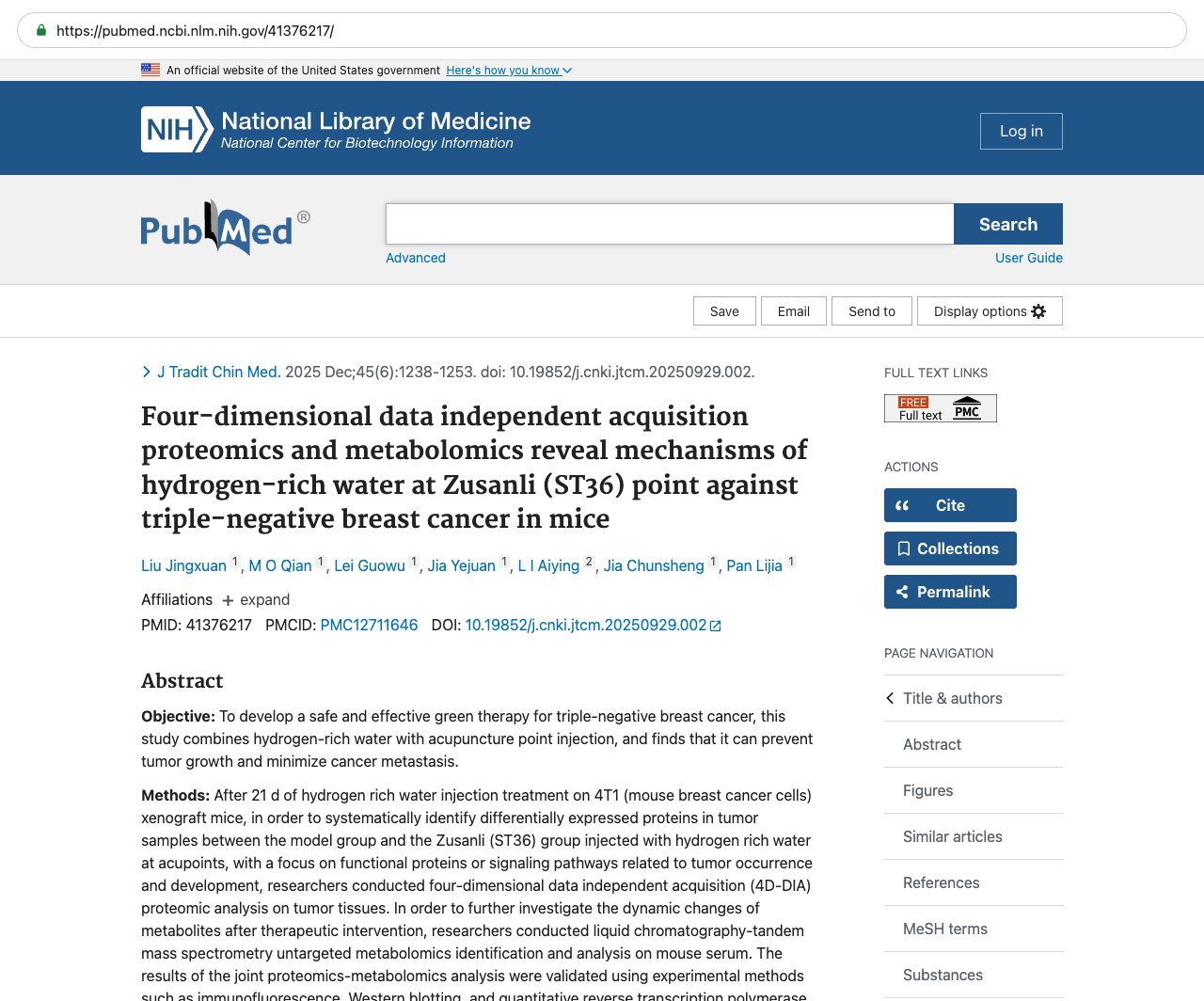
This page mirrors the published abstract (© the authors / publisher) for reference and citation. The canonical source is the PubMed record linked above. This is not medical advice.