2021 · Zanini — The effects of 6-month hydrogen-rich water intake on molecular and phenotypic biomarkers of aging in older adults aged 70 years and over: A randomized controlled pilot trial
Super-Abstract
6 months of hydrogen water (0.5 L/day, 15 ppm) in 40 people over 70 lengthened the telomeres (a marker of cell aging) and improved brain metabolism as well as leg strength (chair-stand test, P = 0.01) — while telomeres shortened in the control group. (Randomized pilot RCT, Experimental Gerontology, 2021.)
Commentary
This is a randomized controlled pilot trial — the higher-quality study form with a control group, but deliberately small (40 older people, 20 of them women, average age 76). One group drank 0.5 liters of hydrogen water with 15 ppm H₂ daily for 6 months, the other inert water (0 ppm). The most exciting result: for the telomeres — the protective caps of the chromosomes that shrink with age — there was a significant interaction (P = 0.049). In the H₂ group they grew longer (0.99 → 1.02), in the control group shorter (0.92 → 0.79). In addition, the DNA-methylation marker TET2 rose more strongly in the H₂ group (P = 0.040), and in the brain choline, NAA and creatine levels increased measurably (P < 0.05). Functionally, leg strength when standing up from a chair improved (P = 0.01). Very important for honesty: it is a pilot study with a very small sample, many other endpoints showed no difference, and the effect sizes are small. The authors themselves cautiously describe H₂ as a „possible anti-aging agent“.
Key quotes
- „A significant treatment vs. time interaction was found for telomere length (P = 0.049), with the length increased after HRW intervention ... and decreased after drinking control water.“ — the central finding: telomere lengthening instead of shortening
- „HRW was superior to control water to increase brain choline and NAA levels in the left frontal grey matter, brain creatine at the right parietal white matter, and brain NAA at the right parietal mesial grey matter (P < 0.05).“ — measurable improvements in brain metabolism
- „this simple biomedical gas could be recognized as a possible anti-aging agent that tackles several hallmarks of aging, including loss of function and telomere length shortening.“ — the cautious conclusion of the authors
Our assessment
This study is directly relevant for us because it tests exactly the product used in everyday life: hydrogen water for drinking (15 ppm, 0.5 L/day) — and over half a year in a real control group. The telomere and brain data are a strong narrative argument for „healthy aging“. Limitations, stated honestly: it is a pilot RCT with only 40 participants (evidence level 2, not 3) — the authors call it „pilot“ themselves. Many endpoints were not significant (P > 0.05), some P-values lie just under 0.05 (multiple testing increases the risk of chance), and the telomere changes are small. No proof of life extension — rather a promising signal that needs larger studies. Registered under NCT04430803.
Study design
- Type: randomized controlled pilot RCT (parallel groups) · n: 40 (20 women), mean 76.0 ± 5.6 years · Duration: 6 months · H₂ delivery: hydrogen water 0.5 L/day, 15 ppm (control: 0 ppm)
- Result: telomere length ↑ in HRW vs. ↓ control (P = 0.049); TET2 expression more strongly ↑ in HRW (P = 0.040); brain choline/NAA/creatine ↑ (P < 0.05); chair-stand performance ↑ (P = 0.01); remaining endpoints n.s. (P > 0.05)
Abstract
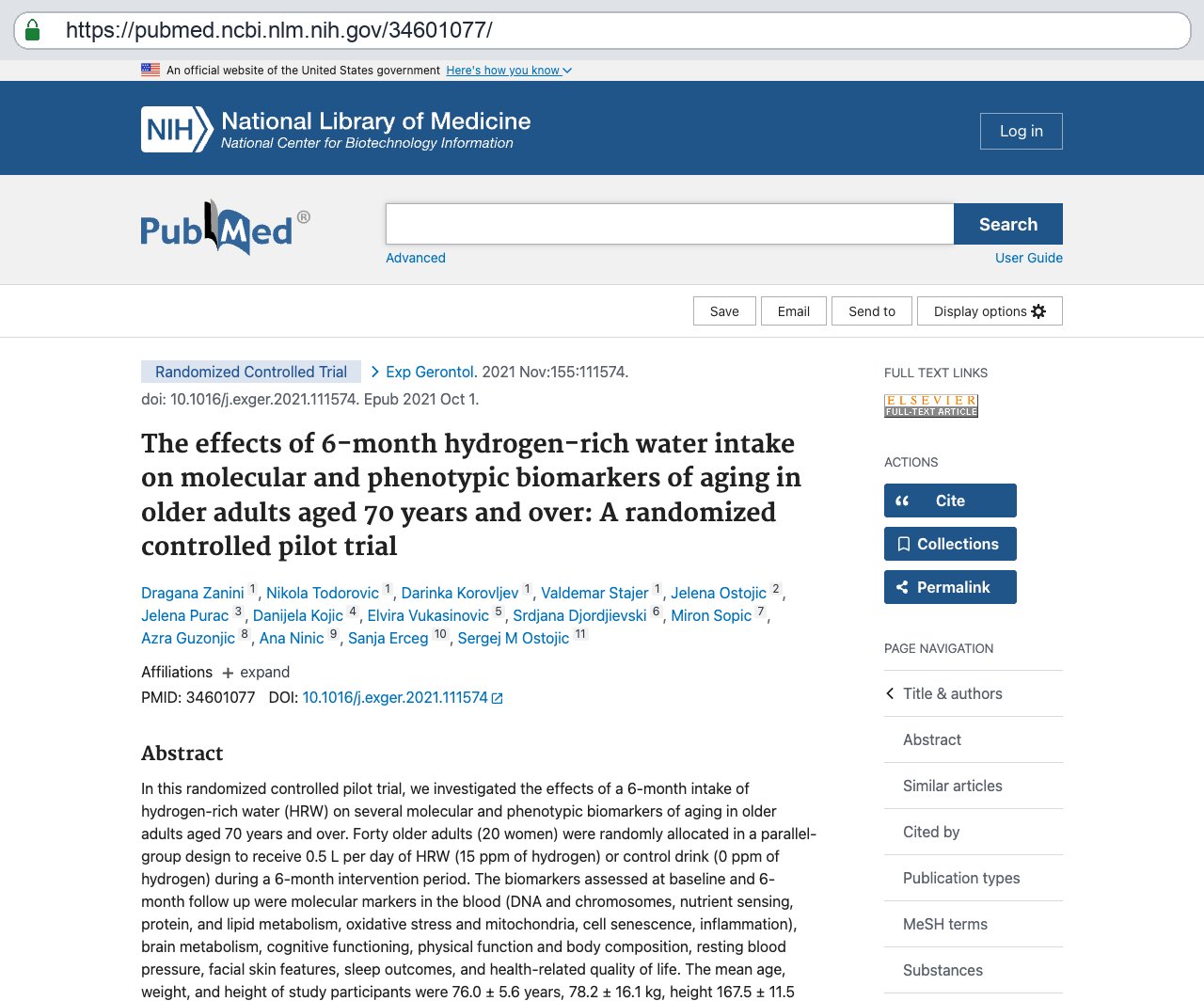
In this randomized controlled pilot trial, we investigated the effects of a 6-month intake of hydrogen-rich water (HRW) on several molecular and phenotypic biomarkers of aging in older adults aged 70 years and over. Forty older adults (20 women) were randomly allocated in a parallel-group design to receive 0.5 L per day of HRW (15 ppm of hydrogen) or control drink (0 ppm of hydrogen) during a 6-month intervention period. The biomarkers assessed at baseline and 6-month follow up were molecular markers in the blood (DNA and chromosomes, nutrient sensing, protein, and lipid metabolism, oxidative stress and mitochondria, cell senescence, inflammation), brain metabolism, cognitive functioning, physical function and body composition, resting blood pressure, facial skin features, sleep outcomes, and health-related quality of life. The mean age, weight, and height of study participants were 76.0 ± 5.6 years, 78.2 ± 16.1 kg, height 167.5 ± 11.5 cm, respectively. A significant treatment vs. time interaction was found for telomere length (P = 0.049), with the length increased after HRW intervention (from 0.99 ± 0.15 at baseline to 1.02 ± 0.26 at follow up) and decreased after drinking control water (from 0.92 ± 0.27 to 0.79 ± 0.15). A marker of DNA methylation (Tet methylcytosine dioxygenase 2, TET2) expression at 6-month follow-up increased in both groups, yet the degree of elevation was significantly higher in HRW (from 0.81 ± 0.52 at baseline to 1.62 ± 0.66 at follow up) comparing to the control water (from 1.13 ± 0.82 to 1.76 ± 0.87) (P = 0.040). A strong trend for treatment vs. time interaction was found for a degree of DNA methylation (P = 0.166), with the methylation increased in the HRW group (from 120.6 ± 39.8 ng at baseline to 126.6 ± 33.8 ng at follow up) and decreased after taking control water (from 133.6 ± 52.9 ng to 121.2 ± 38.4 ng). HRW was superior to control water to increase brain choline and NAA levels in the left frontal grey matter, brain creatine at the right parietal white matter, and brain NAA at the right parietal mesial grey matter (P < 0.05). No significant differences were found between interventions for other outcomes (P > 0.05), except for a significantly improved chair stand performance after HRW intervention compared to the control water (P = 0.01). Owing to pleiotropic mechanisms of hydrogen action, this simple biomedical gas could be recognized as a possible anti-aging agent that tackles several hallmarks of aging, including loss of function and telomere length shortening. The study was registered at ClinicalTrials.gov (NCT04430803).
Source & links
Screenshot of the PubMed page
This page mirrors the published abstract (© the authors / publisher) for reference and citation. The canonical source is the PubMed record linked above. This is not medical advice.