2025 · Alaqel — Aging, vascular dysfunction, and the blood-brain barrier: unveiling the pathophysiology of stroke in older adults
Super-Abstract
Stroke risk rises sharply with age because aging progressively damages the blood-brain barrier (BBB) through endothelial senescence, oxidative stress, and tight junction protein loss — this review maps these mechanisms and surveys emerging therapeutic approaches, including hydrogen-rich water therapy, aimed at restoring BBB integrity. (Biogerontology, 2025.)
Commentary
The blood-brain barrier is not a passive membrane — it is an active gatekeeper maintained by a dynamic interplay of endothelial cells, pericytes, astrocytes, and extracellular matrix proteins. Aging erodes all of these components: endothelial cells undergo senescence and produce fewer tight junction proteins (claudin-5, occludin), NLRP3 inflammasome activity rises in microglia and endothelium, and matrix metalloproteinases (MMPs) degrade structural proteins. When stroke occurs in this already-compromised BBB, the resulting neuroinflammation, cerebral oedema, and neurotoxicity are significantly worse. This review covers advanced imaging techniques for BBB permeability assessment (DCE-MRI, PET) and a range of emerging therapeutic strategies. Hydrogen-rich water is included as one agent proposed to counteract oxidative stress-induced BBB damage — alongside sirtuin modulators, iPSC-derived extracellular vesicles, MCC950 (NLRP3 inhibitor), and cortistatin. H₂ is one item in a multi-agent landscape, not the central focus.
Key quotes
- „hydrogen-rich water therapy (to counteract oxidative stress-induced BBB damage)“ — H₂'s proposed role: specifically countering oxidative-stress-driven blood-brain barrier breakdown in stroke/aging
- „Stroke severity and recovery are exacerbated by BBB breakdown, leading to neuroinflammation, neurotoxicity, and cerebral oedema“ — why BBB integrity is critical in stroke outcomes — the clinical stakes
- „endothelial cell senescence, oxidative stress, and degradation of tight junction proteins“ — the three core aging-related mechanisms that progressively weaken the BBB
Our assessment
This is a narrative review covering aging-related BBB dysfunction and stroke pathophysiology. Hydrogen-rich water therapy is mentioned briefly as one of five or more candidate approaches — it is not the focus of the paper, and no clinical trial data on H₂ specifically for BBB protection or stroke recovery are presented. The mechanistic coverage of BBB biology and stroke is thorough and well-cited. The therapeutic landscape section, which includes H₂, is largely preclinical and forward-looking. Findings cannot be directly extrapolated to clinical recommendations.
Study design
- Type: narrative review (aging, vascular biology, stroke) · n: n/a (literature synthesis) · H₂ delivery: hydrogen-rich water (mentioned as one of several emerging approaches; no dedicated H₂ stroke trials cited)
- Result: BBB dysfunction in aging described via endothelial senescence, oxidative stress, MMP activation, NLRP3 inflammasome; hydrogen-rich water listed among emerging interventions targeting oxidative BBB damage; predominantly preclinical evidence for all novel strategies reviewed
Abstract
The progressive decline of vascular integrity and blood-brain barrier (BBB) function is associated with aging, a major risk factor for stroke. This review describes the cellular and molecular changes in the brain microvasculature of the neurovascular unit (NVU) that contribute to the development of BBB dysfunction in aging, such as endothelial cell senescence, oxidative stress, and degradation of tight junction proteins. Stroke severity and recovery are exacerbated by BBB breakdown, leading to neuroinflammation, neurotoxicity, and cerebral oedema while identifying molecular mechanisms such as the NLRP3 inflammasome, matrix metalloproteinases (MMPs), and non-coding RNAs (e.g., miRNAs and circRNAs) that drive BBB disruption in aging and stroke. Real-time assessment of BBB permeability in stroke pathophysiology is made possible using advanced imaging techniques, such as dynamic contrast-enhanced MRI and positron emission tomography. Furthermore, biomarkers, including claudin-5, PDGFRβ, or albumin concentration, serve as markers of BBB integrity and vascular health. Restoration of BBB function and stroke recovery with emerging therapeutic strategies, including sirtuin modulators (SIRT1 and SIRT3 activators to enhance endothelial function and mitochondrial health), stem cell-derived extracellular vesicles (iPSC-sEVs for BBB repair and neuroprotection), NLRP3 inflammasome inhibitors (MCC950 to attenuate endothelial pyroptosis and inflammation), hydrogen-rich water therapy (to counteract oxidative stress-induced BBB damage), and neuropeptides such as cortistatin (to regulate neuroinflammation and BBB stability), is promising. This review explores the pathophysiological mechanisms of BBB dysfunction in aging and stroke, their relation to potential therapeutic targets, and novel approaches to improve vascular health and neuroprotection.
Source & links
Screenshot of the PubMed page
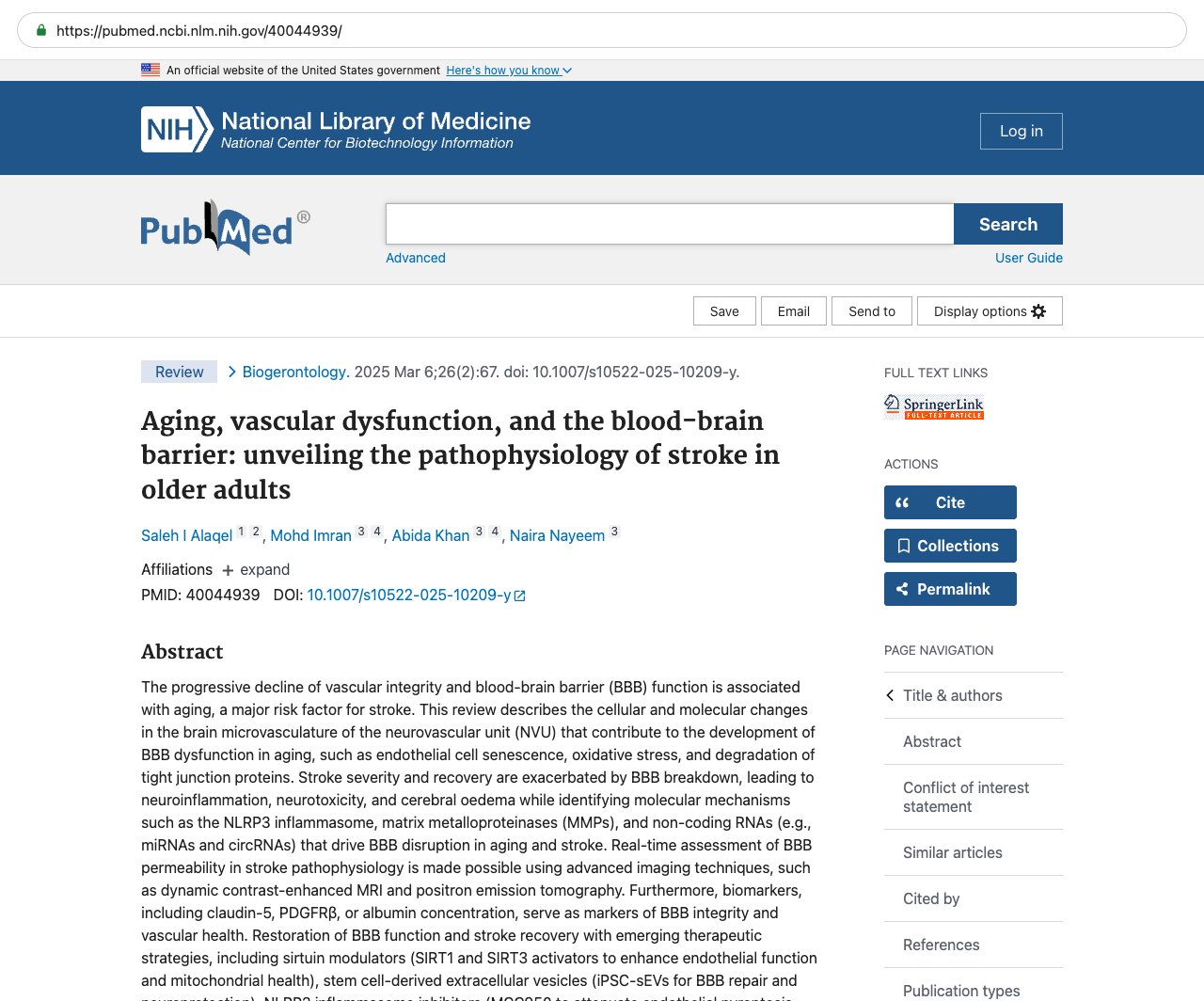
This page mirrors the published abstract (© the authors / publisher) for reference and citation. The canonical source is the PubMed record linked above. This is not medical advice.