2025 · Ren et al. — A Case Report of Adjuvant Molecular Hydrogen Therapy in Refractory Rheumatoid Arthritis With Atlantoaxial Subluxation
Super-Abstract
An 85-year-old woman with long-standing treatment-refractory rheumatoid arthritis — complicated by the rare and neurologically dangerous atlantoaxial subluxation — received molecular hydrogen therapy as an adjuvant, which was associated with notable fatigue reduction and immunological shifts, though her overall disease trajectory remained grave. (In Vivo, 2025.)
Commentary
This case stands apart from others in the series because of its poignancy: the patient was 85, had lived with rheumatoid arthritis since at least 2010, and was forced off methotrexate in 2016 due to pancytopenia — leaving steroids and hydroxychloroquine as her main options. The discovery of atlantoaxial subluxation during her admission added a life-threatening dimension (spinal cord compression risk), and the patient ultimately declined surgery in favour of palliative care, dying during the observation period. Against this difficult background, the authors document that hydrogen therapy initiated in June 2023 was associated with multi-domain fatigue improvement (assessed with a validated instrument, the Taiwan Brief Fatigue Inventory) and immunophenotypic changes. The fatigue data are the most concrete patient-reported outcome in this case, and the improvement across multiple domains is notable even if not conclusive. The immunological changes (T- and B-cell subset dynamics) follow the pattern reported in other cases from this group — consistent, if not yet proven causal.
Key quotes
- „Fatigue, assessed using the Taiwan Brief Fatigue Inventory (BFI-T), improved notably across multiple domains, accompanied by dynamic changes in immune cell populations suggesting immunomodulatory effects.“ — the concrete patient-reported outcome alongside immunological signal
- „Although clinical and immunological improvements were observed, larger studies with longer follow-up are needed.“ — authors' honest limitation statement
- „This case highlights the potential immunomodulatory benefits of molecular hydrogen as an adjuvant therapy in rheumatoid arthritis.“ — the hypothesis this case contributes to
Our assessment
Single case report with validated fatigue outcome measure (BFI-T) — a methodological strength over purely qualitative descriptions. The clinical context (very elderly, multiple comorbidities, concurrent steroids and hydroxychloroquine, fatal outcome from disease complications) makes it impossible to isolate hydrogen's contribution. Limitations: n = 1, terminal disease trajectory, concurrent background medication, no control, atlantoaxial subluxation and subsequent death confound long-term outcome interpretation. The fatigue benefit is the most patient-relevant finding and deserves follow-up in a controlled fatigue-focused trial in RA.
Study design
- Type: case report · n: 1 (85-year-old Taiwanese woman, long-standing RA + multiple comorbidities) · H₂ delivery: hydrogen-rich water (drinking), initiated June 2023
- Result: multi-domain fatigue improvement on Taiwan Brief Fatigue Inventory (BFI-T); immunophenotypic changes in T- and B-cell subsets consistent with immunomodulation
- Context: concurrent atlantoaxial subluxation diagnosed during admission; patient declined surgery, received palliative care; outcome fatal (disease course, not attributed to H₂)
Abstract
BACKGROUND/AIM: Rheumatoid arthritis (RA) is a chronic autoimmune disease affecting synovial joints, often causing to joint destruction and systemic comorbidities. Cervical spine involvement, especially atlantoaxial subluxation (AAS), can lead to spinal cord compression and neurological deficits. While disease-modifying antirheumatic drugs (DMARDs) are standard therapy, intolerance to agents like methotrexate (MTX) in elderly or comorbid patients limits options. Molecular hydrogen, with antioxidant and anti-inflammatory properties, has emerged as a potential adjuvant in autoimmune diseases. This case report describes an elderly woman with long-standing, treatment-refractory RA and severe cervical spine disease who received molecular hydrogen therapy, highlighting immunological changes, clinical outcomes, and challenges in managing RA with complex comorbidities. CASE REPORT: An 85-year-old Taiwanese woman with long-standing rheumatoid arthritis (2010 American College of Rheumatology/European League Against Rheumatism criteria) and multiple comorbidities discontinued methotrexate in 2016 due to pancytopenia. Her RA was managed with oral steroids and hydroxychloroquine, but she had recurrent hospitalizations for flares with multiple joint pain. Molecular hydrogen therapy was initiated in June 2023 as an adjuvant treatment. Fatigue, assessed using the Taiwan Brief Fatigue Inventory (BFI-T), improved notably across multiple domains, accompanied by dynamic changes in immune cell populations suggesting immunomodulatory effects. During this admission, atlantoaxial subluxation was diagnosed, fulfilling surgical criteria; however, the patient and her family declined surgery due to risk and prognosis, opting for palliative care until her death. CONCLUSION: This case highlights the potential immunomodulatory benefits of molecular hydrogen as an adjuvant therapy in rheumatoid arthritis. Although clinical and immunological improvements were observed, larger studies with longer follow-up are needed. It also illustrates severe cervical spine involvement, atlantoaxial subluxation, underscoring the complexity and neurological risks of advanced RA.
Source & links
Screenshot of the PubMed page
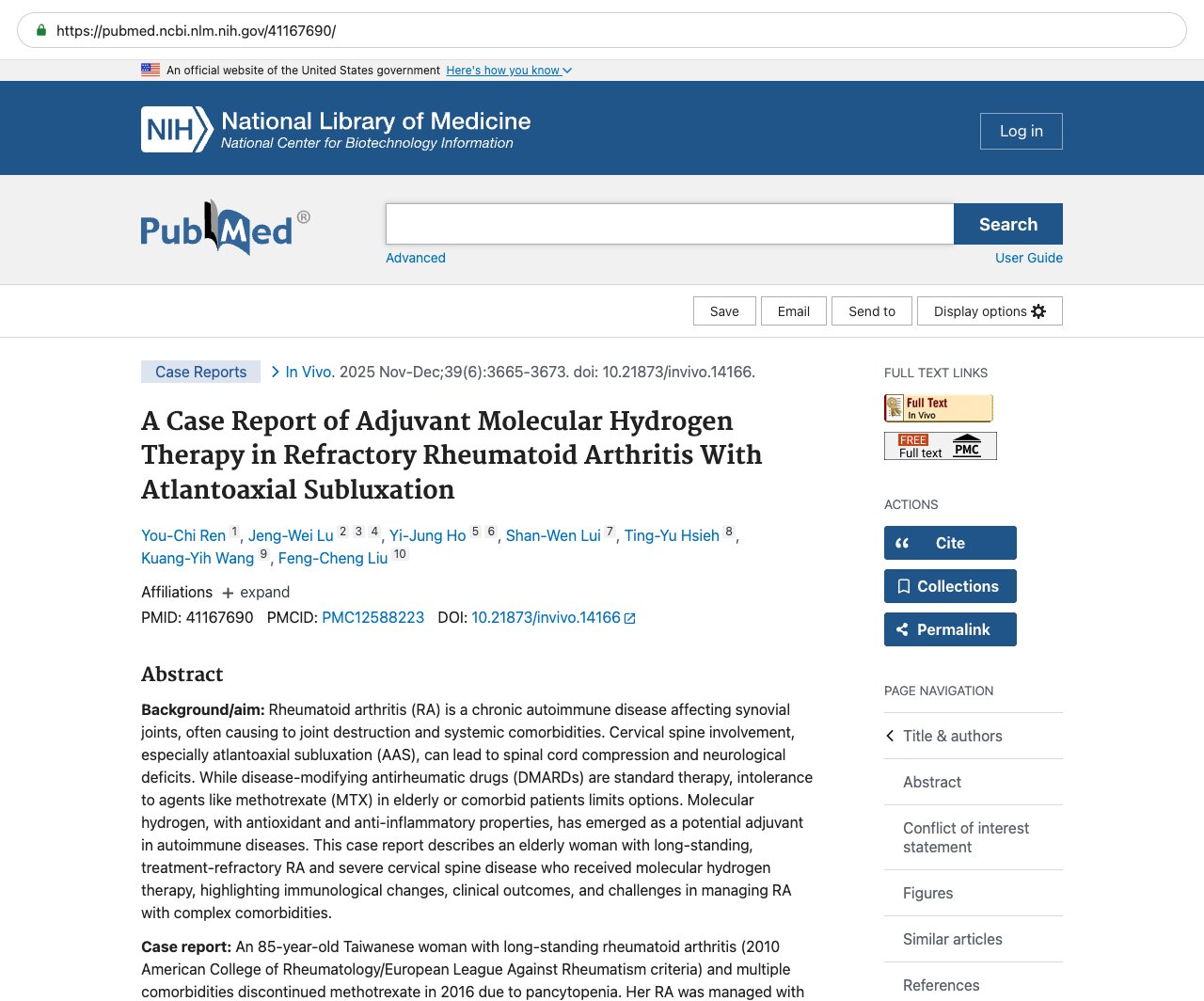
This page mirrors the published abstract (© the authors / publisher) for reference and citation. The canonical source is the PubMed record linked above. This is not medical advice.