2021 · Li et al. — Hydrogen-rich water attenuates the radiotoxicity induced by tritium exposure in vitro and in vivo
Super-Abstract
Hydrogen-rich water (HRW) reduces radioactive damage caused by tritiated water (HTO) — both in cultured human blood cells and in mice. It accelerates urinary tritium elimination, lowers tritium accumulation in tissues, and counteracts oxidative DNA damage and cell death caused by radiation. (Journal of Radiation Research, 2021.)
Commentary
Tritium (radioactive hydrogen, ³H) is a byproduct of nuclear energy production and poses a health risk through incorporation into body water. This study tested whether HRW — which contains dissolved molecular hydrogen (H₂) — can mitigate these effects. In mice given tritiated water, intragastric HRW administration accelerated the excretion of tritium in urine and reduced organ-bound tritium. In human AHH-1 lymphocyte cells, HRW pre-treatment lowered tritium uptake and dampened the oxidative cascade: fewer hydroxyl radicals (·OH), restored glutathione and SOD levels, less lipid peroxidation (MDA), reduced DNA strand breaks, and lower apoptosis rates. The proposed mechanisms are twofold: isotope dilution/exchange (H₂ competes with ³H in the body water pool) and free-radical scavenging. This is a preclinical study — its translational relevance for humans in radiation-exposure scenarios remains to be established.
Key quotes
- „Intragastric administration of HRW effectively promoted the elimination of urinary tritium, decreased the level of serum tritium and tissue-bound tritium (OBT), and attenuated the genetic damage of blood cells in mice exposed to HTO.“ — key in vivo finding in mice
- „The anti-oxidative properties of HRW could attenuate the increased intracellular ROS (such as O2•-, •OH and ONOO-), resulting in reversing the exhaustion of cellular endogenous antioxidants (reduced GSH and SOD), decreasing lipid peroxidation (MDA), relieving DNA oxidative damage, and depressing cell apoptosis and cytotoxicity induced by HTO exposure.“ — mechanistic explanation of the protective effect
- „HRW is expected to be an effective radioactive elimination agent through the competition effect of isotope exchange or a radioprotective agent by scavenging free radicals induced by HTO exposure.“ — conclusion: two possible mechanisms of action
Our assessment
A well-designed preclinical study with a clear mechanistic hypothesis. Important limitation: this is entirely animal and cell-based research — no human data exist. The mouse dose (18.5 MBq/kg HTO) and the cell-culture conditions may not reflect realistic human radiation scenarios. The isotope-exchange mechanism (H₂ diluting ³H in body water) is biologically plausible but requires further quantification. Results cannot be directly transferred to human radioprotection without clinical follow-up studies.
Study design
- Type: preclinical in vitro + in vivo · Model: AHH-1 human B-lymphocyte cells; BALB/c mice (HTO 18.5 MBq/kg) · H₂ delivery: hydrogen-rich water (HRW), intragastric
- Result: HRW reduced urinary/serum/tissue-bound tritium; restored GSH, SOD; decreased MDA, ROS, apoptosis, DNA damage in both cell and mouse models
Abstract
Radionuclide tritium is widely used in the nuclear energy production industry and creates a threat to human health through radiation exposure. Herein, the radioactive elimination and radioprotective effect of hydrogen-rich water (HRW), a potential antioxidant with various medical applications, on tritiated water (HTO) exposure, was studied in vitro and in vivo. Results showed that intragastric administration of HRW effectively promoted the elimination of urinary tritium, decreased the level of serum tritium and tissue-bound tritium (OBT), and attenuated the genetic damage of blood cells in mice exposed to HTO (18.5 MBq/kg). Pretreatment with HRW effectively reduces tritium accumulation in HTO-treated human blood B lymphocyte AHH-1 cells. In addition, the anti-oxidative properties of HRW could attenuate the increased intracellular ROS (such as O2•-, •OH and ONOO-), resulting in reversing the exhaustion of cellular endogenous antioxidants (reduced GSH and SOD), decreasing lipid peroxidation (MDA), relieving DNA oxidative damage, and depressing cell apoptosis and cytotoxicity induced by HTO exposure. In conclusion, HRW is expected to be an effective radioactive elimination agent through the competition effect of isotope exchange or a radioprotective agent by scavenging free radicals induced by HTO exposure.
Source & links
Screenshot of the PubMed page
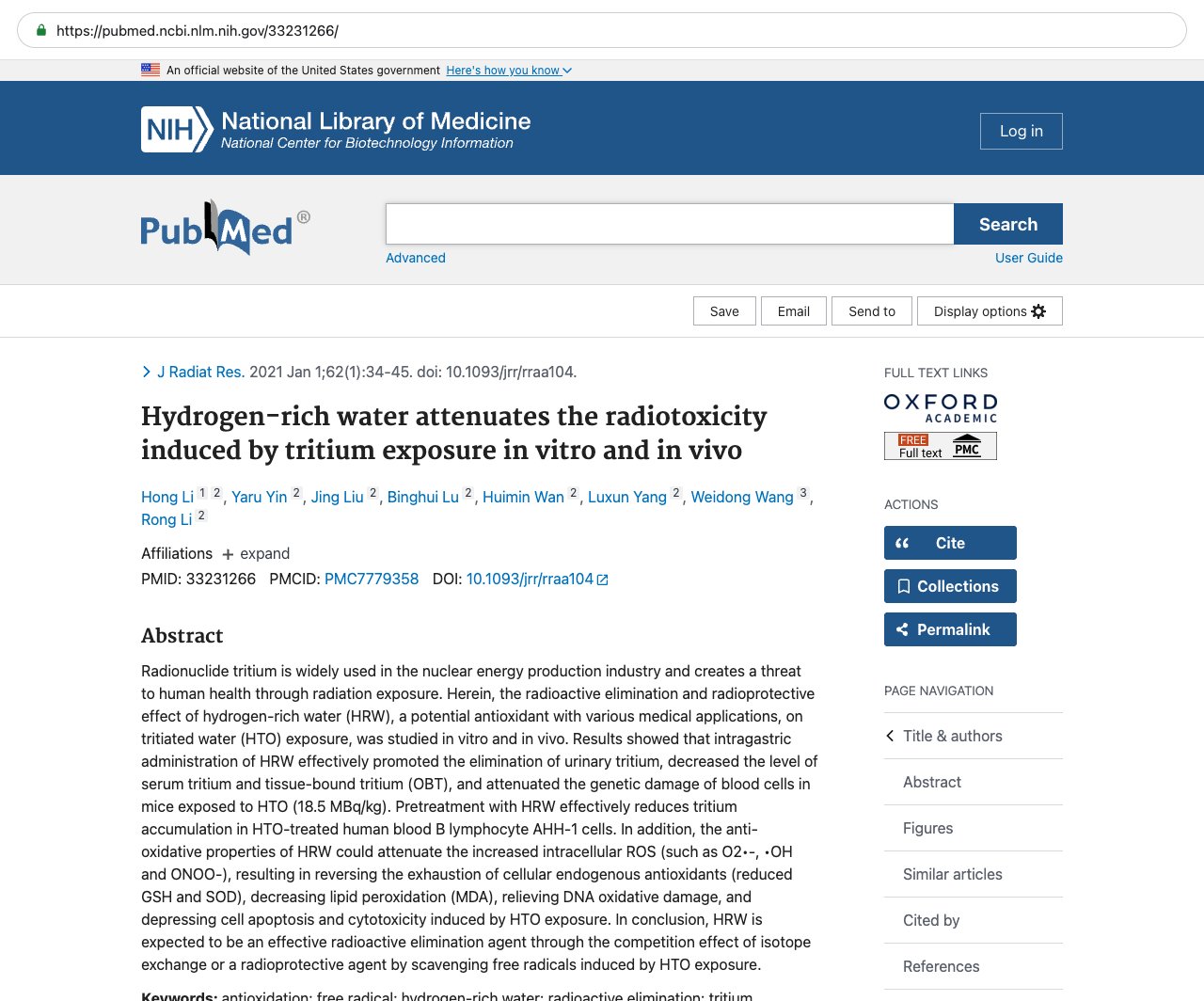
This page mirrors the published abstract (© the authors / publisher) for reference and citation. The canonical source is the PubMed record linked above. This is not medical advice.