2013 · Zheng — Equol: a metabolite of soy isoflavones by intestinal microflora — a review
Super-Abstract
Equol, a metabolite of the soy isoflavone daidzein produced by gut bacteria, may explain the health benefits of soy — but only 33–50 % of humans can produce it. This review summarizes the mechanisms of equol formation, its bioavailability, influencing factors, and — notably — the emerging role of hydrogen gas in microbial equol production by the gut microbiome. (Acta Microbiologica Sinica, 2013.)
Commentary
This is a narrative review of the equol literature from a microbiology perspective. The connection to hydrogen gas (H₂) is indirect but scientifically genuine: gut bacteria that produce equol from daidzein also generate H₂ as a fermentation byproduct, and H₂ appears to play a metabolic role in supporting the equol-producing microbial community. The authors acknowledge that research on the H₂–equol link was only just beginning at the time of publication. This is a literature synthesis rather than an original experiment, and the H₂ connection is preliminary rather than established. Results cannot be extrapolated to direct H₂ therapy in humans.
Key quotes
- „Recently studies indicated that hydrogen gas plays an important role in equol formation.“ — the H₂ connection: H₂ from gut fermentation supports equol-producing bacteria
- „only 33% - 50% of human population can excrete equol.“ — key biological variability limiting equol research
- „researches focus on this area are just started.“ — authors' honest acknowledgment of early-stage evidence
Our assessment
This is a review article summarizing existing literature on equol and gut microbiota, with a preliminary note on the role of H₂ in microbial metabolism. It provides no original experimental data. The H₂–equol connection cited was at a very early research stage (2013) and has limited direct clinical relevance. No conclusions about therapeutic H₂ administration can be drawn from this review. The honest reading is: H₂ produced by gut bacteria may influence equol-producing microbial ecology — an interesting microbiome hypothesis, not a therapeutic claim.
Study design
- Type: narrative review · n: n/a (literature analysis) · H₂ relevance: endogenous H₂ from gut fermentation as potential factor in microbial equol production
- Scope: equol formation mechanisms, bioavailability, individual variability (33–50 % producers), influencing dietary/microbiome factors, early-stage H₂–microbiota connection
Abstract
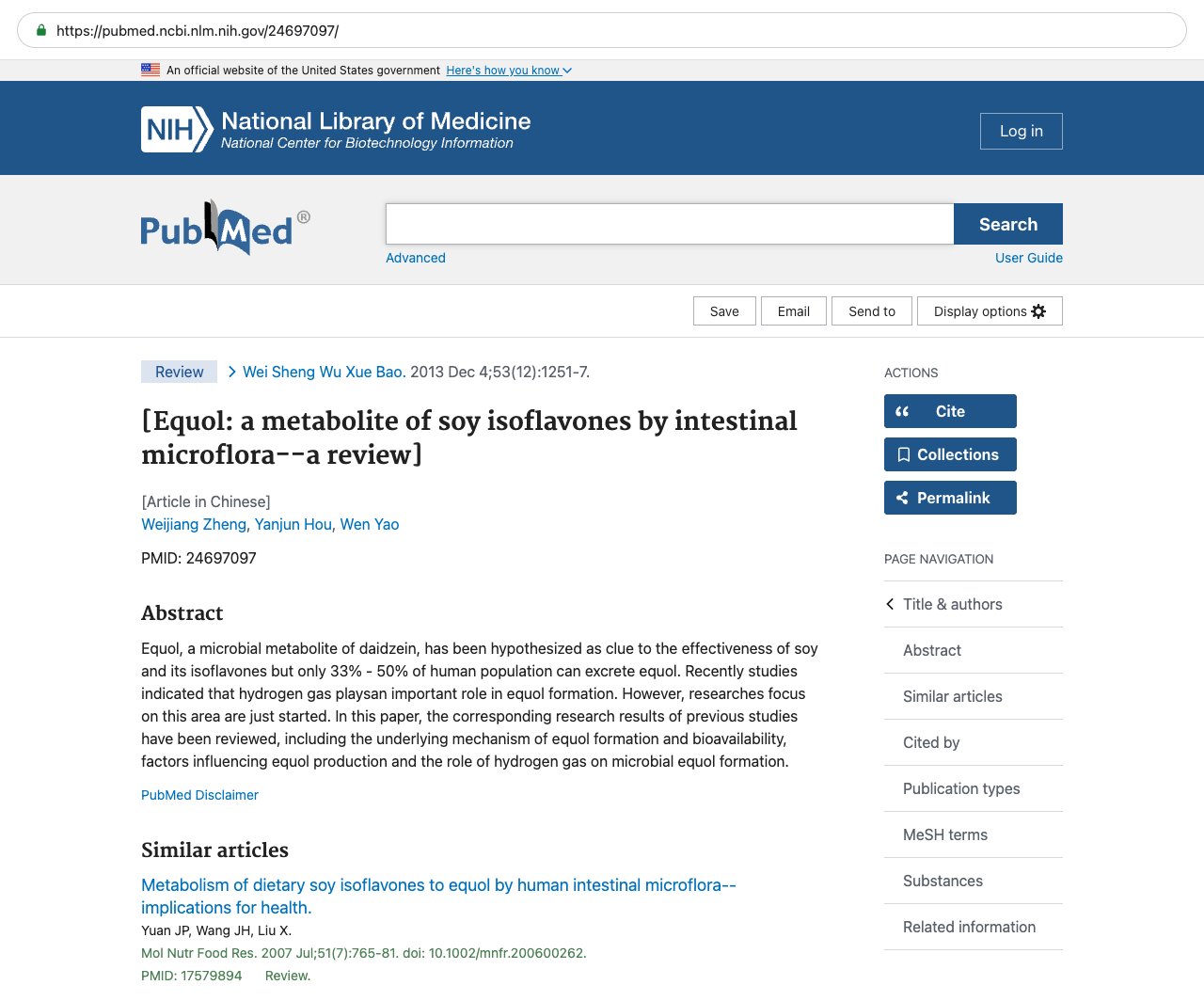
Equol, a microbial metabolite of daidzein, has been hypothesized as clue to the effectiveness of soy and its isoflavones but only 33% - 50% of human population can excrete equol. Recently studies indicated that hydrogen gas playsan important role in equol formation. However, researches focus on this area are just started. In this paper, the corresponding research results of previous studies have been reviewed, including the underlying mechanism of equol formation and bioavailability, factors influencing equol production and the role of hydrogen gas on microbial equol formation.
Source & links
Screenshot of the PubMed page
This page mirrors the published abstract (© the authors / publisher) for reference and citation. The canonical source is the PubMed record linked above. This is not medical advice.