2013 · Alexandrescu — Amide proton solvent protection in amylin fibrils probed by quenched hydrogen exchange NMR.
Super-Abstract
This structural biology study used hydrogen-deuterium exchange NMR spectroscopy to map the secondary structure of amylin (a hormone that forms amyloid plaques in type 2 diabetes) inside protein fibrils. „Hydrogen“ in this study refers to hydrogen atoms in protein bonds used as a structural analysis tool — not to molecular hydrogen (H₂) as a therapeutic agent. This paper is not a hydrogen therapy study.
Commentary
Amylin (also called islet amyloid polypeptide, IAPP) accumulates as amyloid plaques in pancreatic tissue of patients with advanced type 2 diabetes and is implicated in β-cell destruction. Understanding its fibril structure is important for drug design targeting amyloid formation. The author used a quenched hydrogen-deuterium (H/D) exchange technique: fibrils are partially exchanged with deuterium, then dissolved in DMSO to measure residue-level amide proton occupancy by NMR. This is a standard protein structural biology method. The term „hydrogen“ throughout this paper refers to hydrogen atoms within the peptide backbone — not to H₂ gas or dissolved molecular hydrogen as used in H₂ medicine. The structural mapping (β-strands at residues A8–H18 and I26–Y37) is relevant for diabetes research and amyloid biology, not for H₂ therapy.
Key quotes
- „Hydrogen exchange lifetimes at pH 7.6 and 37°C vary between ∼5 h for the unstructured N-terminus to 600 h for amide protons in the two β-strands that form inter-molecular hydrogen bonds between amylin monomers along the length of the fibril.“ — structural result: protection lifetime maps fibril architecture, not H₂ therapy
- „residues A8-H18 and I26-Y37 comprise the two β-strands in amylin fibrils.“ — key structural finding: location of the two β-sheets in the amyloid fibril
- „Differences in protection appear to be due to restrictions on backbone dynamics imposed by the packing of two-layers of C2-symmetry-related β-hairpins in the protofilament structure.“ — structural interpretation of differential proton protection
Our assessment
This is a structural biology / biophysics study entirely unrelated to molecular hydrogen therapy. The word „hydrogen“ refers to hydrogen atoms in protein backbone bonds — a standard NMR spectroscopy technique. Honest note: this paper appears in this database due to keyword overlap (the term „hydrogen exchange“). It has no relevance to H₂ therapy, H₂-rich water, or any clinical hydrogen application. The research itself is of interest for understanding amyloid formation in type 2 diabetes, but readers seeking H₂ therapy evidence will not find it here.
Study design
- Type: in-vitro structural biology study · Method: quenched hydrogen-deuterium (H/D) exchange NMR (DMSO-solubilized monomers after partial fibril exchange) · Subject: amylin (IAPP) fibrils — amyloid-forming peptide in type 2 diabetes
- H₂ relevance: none — „hydrogen“ refers to peptide backbone protons used as structural probes, not to molecular H₂ gas
- Result: β-strand residues A8–H18 and I26–Y37 identified as strongly protected; variation in protection maps protofilament architecture
Abstract
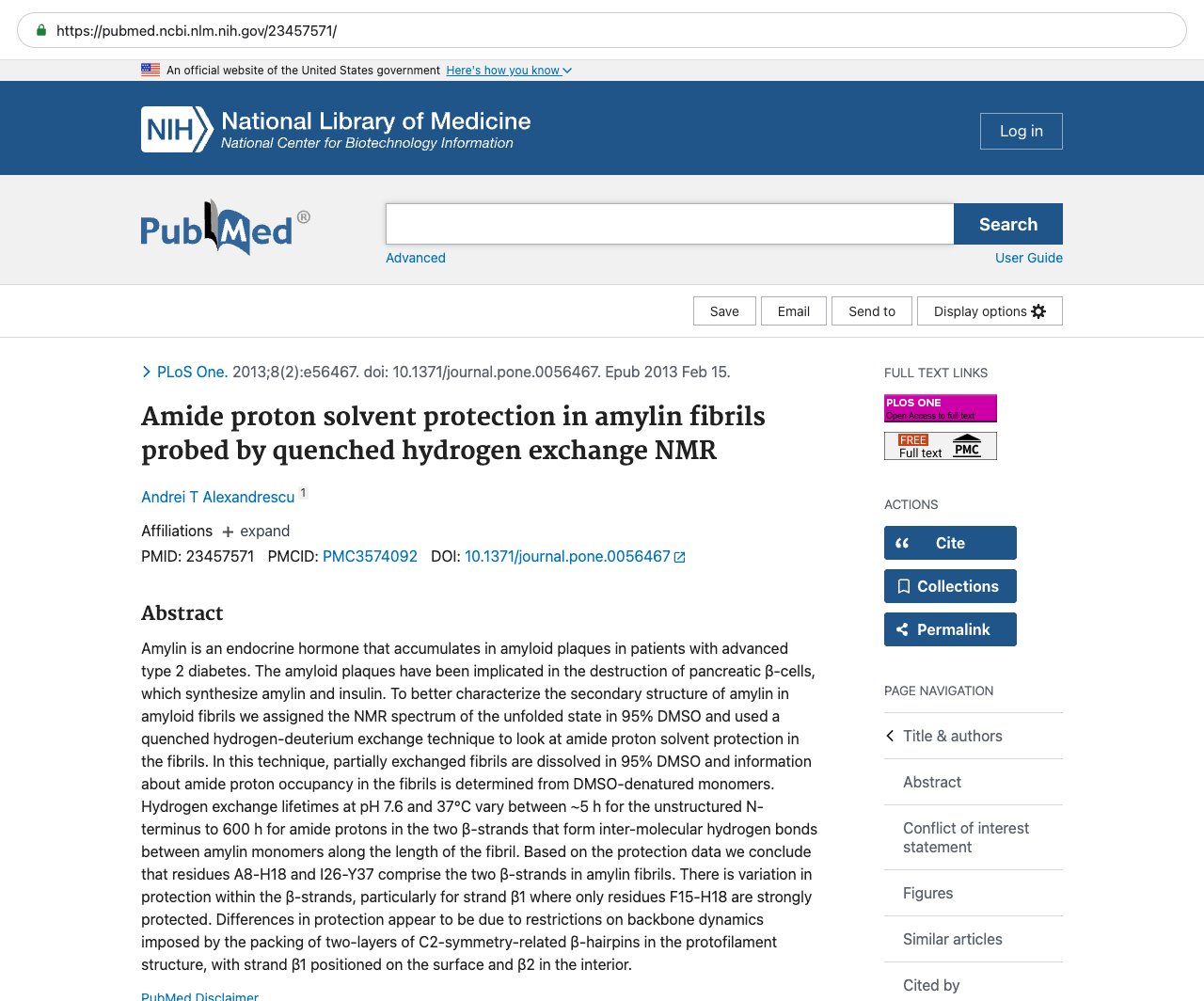
Amylin is an endocrine hormone that accumulates in amyloid plaques in patients with advanced type 2 diabetes. The amyloid plaques have been implicated in the destruction of pancreatic β-cells, which synthesize amylin and insulin. To better characterize the secondary structure of amylin in amyloid fibrils we assigned the NMR spectrum of the unfolded state in 95% DMSO and used a quenched hydrogen-deuterium exchange technique to look at amide proton solvent protection in the fibrils. In this technique, partially exchanged fibrils are dissolved in 95% DMSO and information about amide proton occupancy in the fibrils is determined from DMSO-denatured monomers. Hydrogen exchange lifetimes at pH 7.6 and 37°C vary between ∼5 h for the unstructured N-terminus to 600 h for amide protons in the two β-strands that form inter-molecular hydrogen bonds between amylin monomers along the length of the fibril. Based on the protection data we conclude that residues A8-H18 and I26-Y37 comprise the two β-strands in amylin fibrils. There is variation in protection within the β-strands, particularly for strand β1 where only residues F15-H18 are strongly protected. Differences in protection appear to be due to restrictions on backbone dynamics imposed by the packing of two-layers of C2-symmetry-related β-hairpins in the protofilament structure, with strand β1 positioned on the surface and β2 in the interior.
Source & links
Screenshot of the PubMed page
This page mirrors the published abstract (© the authors / publisher) for reference and citation. The canonical source is the PubMed record linked above. This is not medical advice.