2011 · Yu — Hydrogen-Rich Medium Protects Human Skin Fibroblasts from High Glucose or Mannitol Induced Oxidative Damage
Super-Abstract
In human skin fibroblasts stressed with high glucose or mannitol — models of diabetic oxidative stress — a hydrogen-rich culture medium significantly reduced intracellular superoxide, stabilised mitochondrial membrane potential, and lowered markers of DNA and protein oxidation damage. These are promising cell-culture results suggesting H₂ may protect skin cells under diabetic conditions, but this is in-vitro research that cannot directly confirm benefits in living human patients. (Biochemical and Biophysical Research Communications, 2011.)
Commentary
Diabetic skin lesions are partly driven by excess reactive oxygen species (ROS). Fibroblasts are key structural cells of the skin, responsible for collagen synthesis and wound repair — and they are particularly vulnerable to glucose-induced oxidative damage. This study exposed primary human skin fibroblasts (HSFs) to high glucose (mimicking hyperglycaemia) or mannitol (osmotic control) and then treated them with hydrogen-rich culture medium. H₂ treatment reduced intracellular superoxide anion (O₂⁻), stabilised mitochondrial membrane potential (ΔΨ), and lowered malondialdehyde (MDA), 8-OHdG (DNA oxidation), and 3-nitrotyrosine (protein nitration) levels. Superoxide dismutase (SOD) and glutathione (GSH) were preserved. These results align with H₂'s known selectivity for scavenging hydroxyl radicals and peroxynitrite. The study used confocal microscopy and the CCK-8 viability assay — standard cell biology methods. Whether these effects translate to diabetic skin healing in humans remains to be tested.
Key quotes
- „the use of a hydrogen-rich medium significantly reduced the level of intracellular O(2)(-), stabilized the ΔΨ and attenuated production of MDA, 8-OHdG and 3-NT which efficiently enhanced the antioxidative defense system and protected the HSFs from subsequent oxidative stress damage.“ — the key result: H₂-rich medium protects skin fibroblasts across multiple oxidative stress markers
- „both mannitol and high glucose could cause oxidative stress in HSFs.“ — confirming the validity of the experimental oxidative stress model
- „hydrogen may have applications in the treatment of skin diseases caused by diabetes.“ — the authors' cautious suggestion — still at the hypothesis stage
Our assessment
This is an in-vitro cell culture study using primary human cells, which gives it somewhat more translational relevance than animal studies — but it is still not clinical evidence. The multi-marker oxidative stress assessment is methodologically solid. Limitations: cell culture conditions do not replicate the complex wound environment in diabetic skin; dose-response data for H₂ are not reported; no animal or human wound-healing outcomes are shown. The authors' suggestion of potential applications in diabetic skin disease is a hypothesis, not a demonstrated outcome. These results are scientifically interesting preclinical findings only.
Study design
- Type: in-vitro cell culture study · Model: primary human skin fibroblasts (HSFs) stressed with high glucose or mannitol · H₂ delivery: hydrogen-rich culture medium
- Result: reduced intracellular O₂⁻, stabilised ΔΨ, lower MDA/8-OHdG/3-NT, preserved SOD and GSH; improved cell viability — all consistent with antioxidant protection by H₂
Abstract
Reactive oxygen species (ROS) are an important factor in the development of skin lesions in diabetes. A new antioxidant, hydrogen, can selectively neutralize hydroxyl radicals (()OH) and peroxynitrite (ONOO(-)) in cell-free systems, whereas it seldom reacts with other ROS. Fibroblasts are a key component of skin. In the present study, we investigated the protective effects of hydrogen-rich medium on human skin fibroblasts (HSFs) under oxidative stress. Confocal microscopy was used to assay both the intracellular superoxide anion (O(2)(-)) concentration and the mitochondrial membrane potential (ΔΨ). Cell viability was determined using the Cell Counting Kit-8 (CCK-8). The concentrations of cellular malonaldehyde (MDA), superoxide dismutase (SOD), glutathione (GSH), 8-hydroxy-2'-deoxyguanosine (8-OHdG) and 3-nitrotyrosine (3-NT) were also measured. The results revealed that both mannitol and high glucose could cause oxidative stress in HSFs. Interestingly, the use of a hydrogen-rich medium significantly reduced the level of intracellular O(2)(-), stabilized the ΔΨ and attenuated production of MDA, 8-OHdG and 3-NT which efficiently enhanced the antioxidative defense system and protected the HSFs from subsequent oxidative stress damage. In other words, hydrogen decreased the excessive generation of intracellular O(2)(-) and elevated the cellular antioxidative defense. Based on our results, hydrogen may have applications in the treatment of skin diseases caused by diabetes.
Source & links
Screenshot of the PubMed page
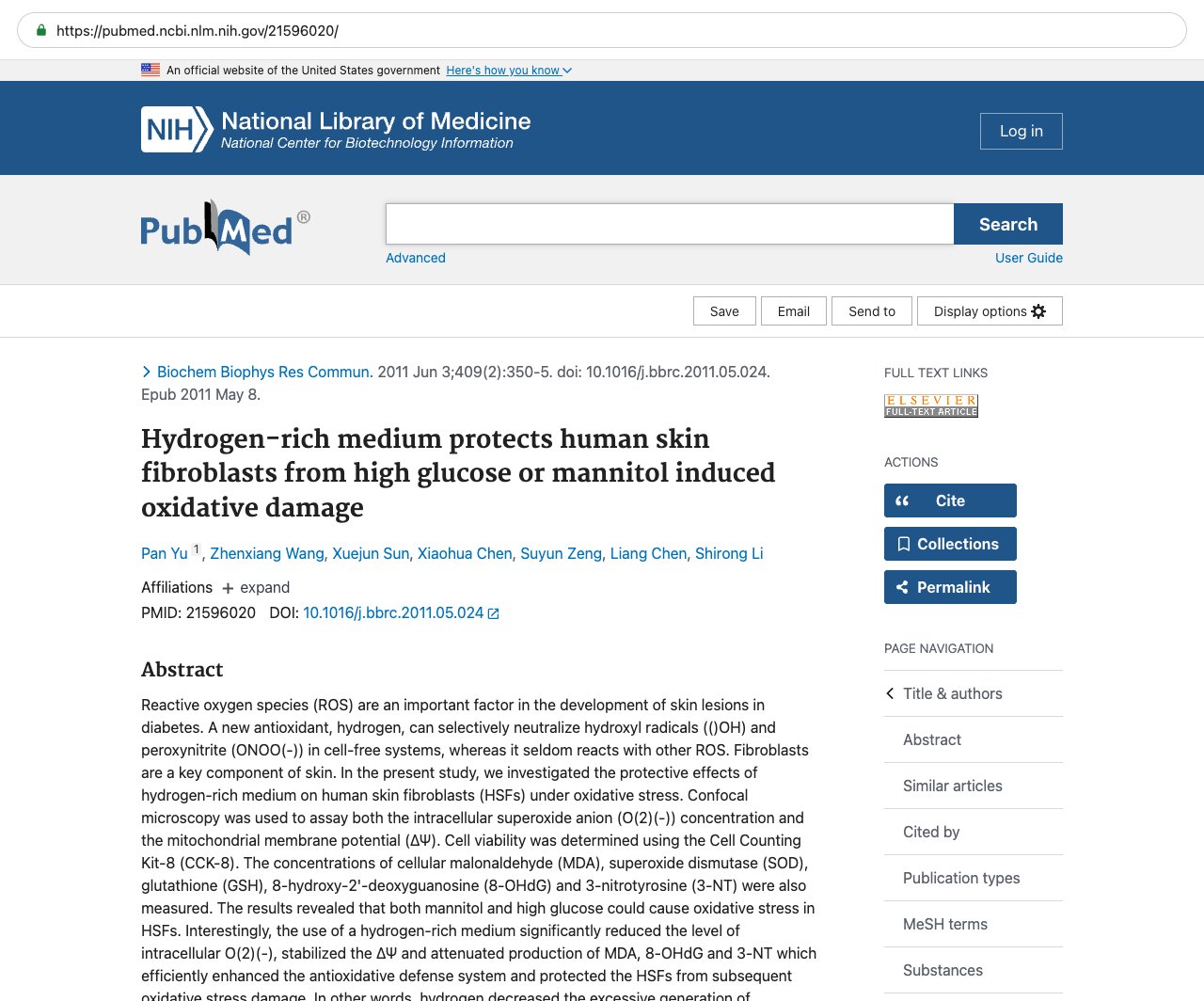
This page mirrors the published abstract (© the authors / publisher) for reference and citation. The canonical source is the PubMed record linked above. This is not medical advice.