2021 · Marzullo et al. — Ammonium Formate-Pd/C as a New Reducing System for 1,2,4-Oxadiazoles: Synthesis of Guanidine Derivatives and Reductive Rearrangement to Quinazolin-4-Ones with Potential Anti-Diabetic Activity
Super-Abstract
This is an organic chemistry study describing a new laboratory synthesis method for heterocyclic compounds with potential anti-diabetic activity. Molecular hydrogen (H₂) is used here exclusively as a chemical reagent in the synthesis process — not as a therapeutic agent. The study has no direct relevance to hydrogen water, H₂ inhalation therapy, or biomedical hydrogen applications.
Commentary
This paper from the field of medicinal chemistry explores ammonium formate with palladium on carbon (Pd/C) as a catalytic hydrogen-transfer system to reduce 1,2,4-oxadiazole rings — a common laboratory technique that uses H₂ as a chemical reducing agent. The synthesized guanidine and quinazolin-4-one derivatives are then tested in vitro for cytotoxicity, oxidative stress induction, and inhibition of α-glucosidase and DPP4 (enzymes relevant to blood glucose regulation). The study contributes to medicinal chemistry methodology but falls entirely outside the biomedical hydrogen therapy literature. H₂ here is a synthesis tool, not a biological intervention. Any connection to therapeutic hydrogen science is incidental at best.
Key quotes
- „NH4CO2H-Pd/C is here demonstrated as a new system for the O-N reduction, allowing us to obtain differently substituted acylamidine, acylguanidine and diacylguanidine derivatives.“ — the core contribution: a new catalytic H₂-transfer reduction method in organic synthesis
- „The obtained compounds were preliminarily tested for their biological activity in terms of their cytotoxicity, induced oxidative stress, α-glucosidase and DPP4 inhibition, showing potential application as anti-diabetics.“ — preliminary in-vitro biological testing only — no animal or human data
- „The alkaloid glycosine was also obtained with this method.“ — a secondary synthesis outcome; no therapeutic significance for H₂ research
Our assessment
This paper is not relevant to biomedical hydrogen therapy. Molecular hydrogen is used solely as a reducing agent in organic chemistry synthesis. The biological testing is preliminary and in-vitro only. There are no findings regarding therapeutic hydrogen (hydrogen water, H₂ inhalation) and no implications for human health applications of molecular hydrogen. This study should not be cited as evidence for any H₂ health benefit.
Study design
- Type: in-vitro organic chemistry study · n: cell-based assays only · H₂ use: catalytic transfer hydrogenation (chemical synthesis reagent — not therapeutic)
- Compounds tested: guanidine and quinazolin-4-one derivatives · Endpoints: cytotoxicity, oxidative stress, α-glucosidase and DPP4 inhibition · Result: preliminary anti-diabetic potential of synthesized compounds; no relevance to H₂ therapy
Abstract
1,2,4-Oxadiazole is a heterocycle with wide reactivity and many useful applications. The reactive O-N bond is usually reduced using molecular hydrogen to obtain amidine derivatives. NH4CO2H-Pd/C is here demonstrated as a new system for the O-N reduction, allowing us to obtain differently substituted acylamidine, acylguanidine and diacylguanidine derivatives. The proposed system is also effective for the achievement of a reductive rearrangement of 5-(2'-aminophenyl)-1,2,4-oxadiazoles into 1-alkylquinazolin-4(1H)-ones. The alkaloid glycosine was also obtained with this method. The obtained compounds were preliminarily tested for their biological activity in terms of their cytotoxicity, induced oxidative stress, α-glucosidase and DPP4 inhibition, showing potential application as anti-diabetics.
Source & links
Screenshot of the PubMed page
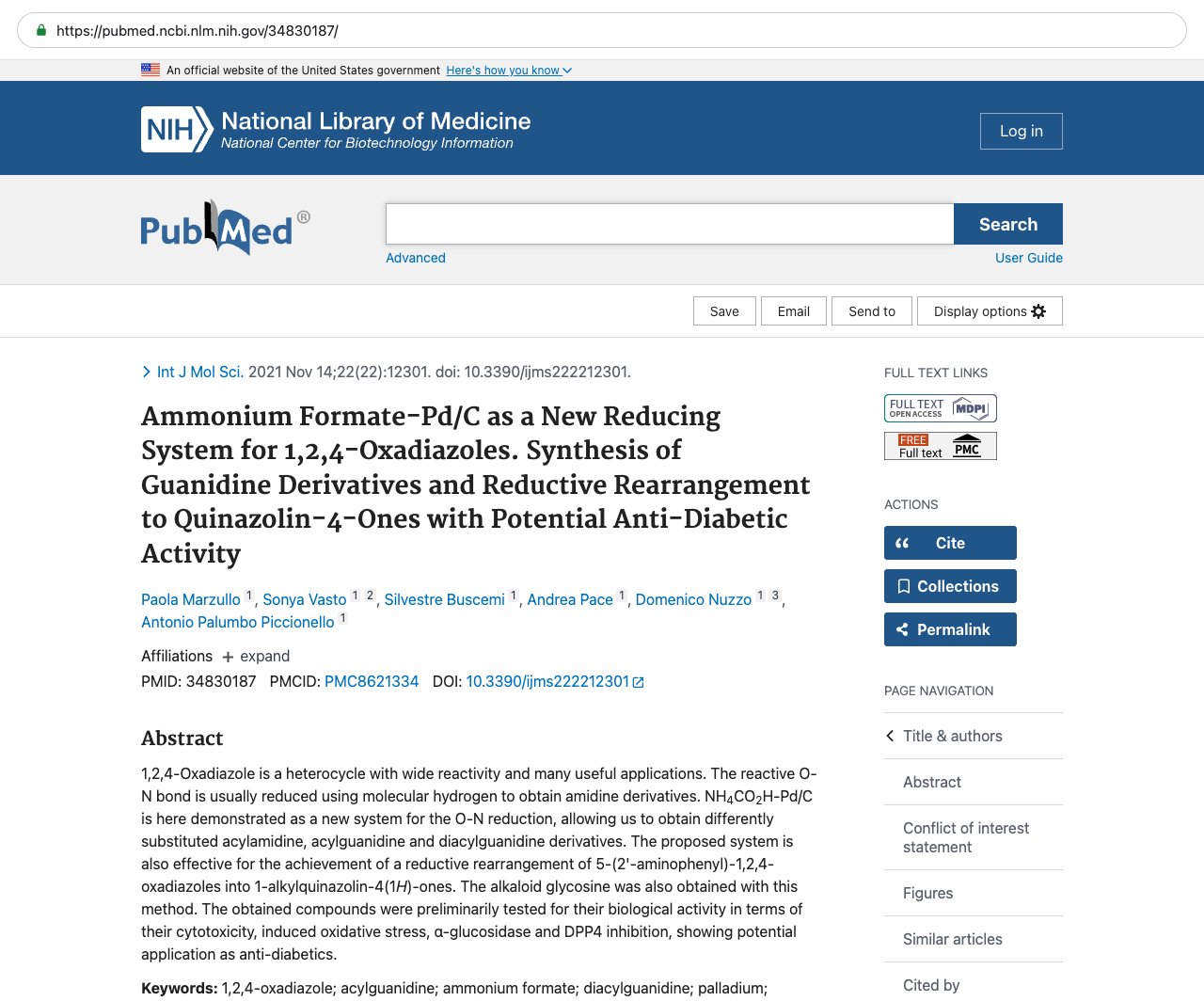
This page mirrors the published abstract (© the authors / publisher) for reference and citation. The canonical source is the PubMed record linked above. This is not medical advice.