2020 · Liu — Effect of thermal treatments on in vitro starch digestibility of sorghum dried noodles.
Super-Abstract
This food science study investigates how roasting, microwave treatment, stir-frying, and heat-moisture treatment (HMT) of sorghum grains affect the starch digestibility and glycemic index of dried sorghum noodles. HMT-treated noodles showed the highest resistant starch content and the lowest estimated glycemic index. This study does not investigate molecular hydrogen (H₂) as a therapeutic agent.
Commentary
This paper addresses sorghum noodle processing — a food technology topic with potential relevance to diabetes nutrition research via glycemic index reduction. The connection to H₂ medicine is not established within this study: hydrogen bonding is mentioned in the context of starch structure (intra-molecular hydrogen bonds stabilising short-range order), but this refers to the chemical bonds within polysaccharide molecules, not to molecular hydrogen (H₂) as a biomedical gas. The findings on resistant starch and glycemic index are interesting for dietary research but cannot be extrapolated to H₂ supplementation.
Key quotes
- „HMT treated noodles contained the highest amount of resistant starch (RS) and the lowest amount of rapidly digestible starch (RDS).“ — heat-moisture treatment most effectively reduces starch digestibility
- „Fourier transform infrared (FTIR) analysis revealed that the short-range ordered degree and intra-molecular hydrogen bond intensity were both enhanced by thermal treatments.“ — hydrogen bonds in starch structure — not therapeutic H₂
- „The hydrolysis kinetic parameters and estimated glycemic index (eGI) decreased in all of the treated samples.“ — all thermal treatments reduced the glycemic response
Our assessment
This is a food science / in-vitro starch digestion study, not an H₂ medicine study. It provides useful data on how thermal processing of sorghum can lower the glycemic index of noodles — relevant to nutritional research for diabetes prevention. No H₂ therapeutic conclusions can be drawn. The mention of „hydrogen bonds“ in FTIR analysis refers to structural chemistry of polysaccharides, entirely distinct from molecular hydrogen (H₂) as a medical gas.
Study design
- Type: in-vitro food science study · Model: sorghum dried noodles from pretreated sorghum grains (roasting, microwave, stir-frying, heat-moisture treatment) · H₂ delivery: not applicable
- Outcome: HMT produced the highest resistant starch (RS) and lowest rapidly digestible starch (RDS); estimated glycemic index (eGI) reduced across all treatments; structural changes confirmed by X-ray diffraction, FTIR, and SEM
Abstract
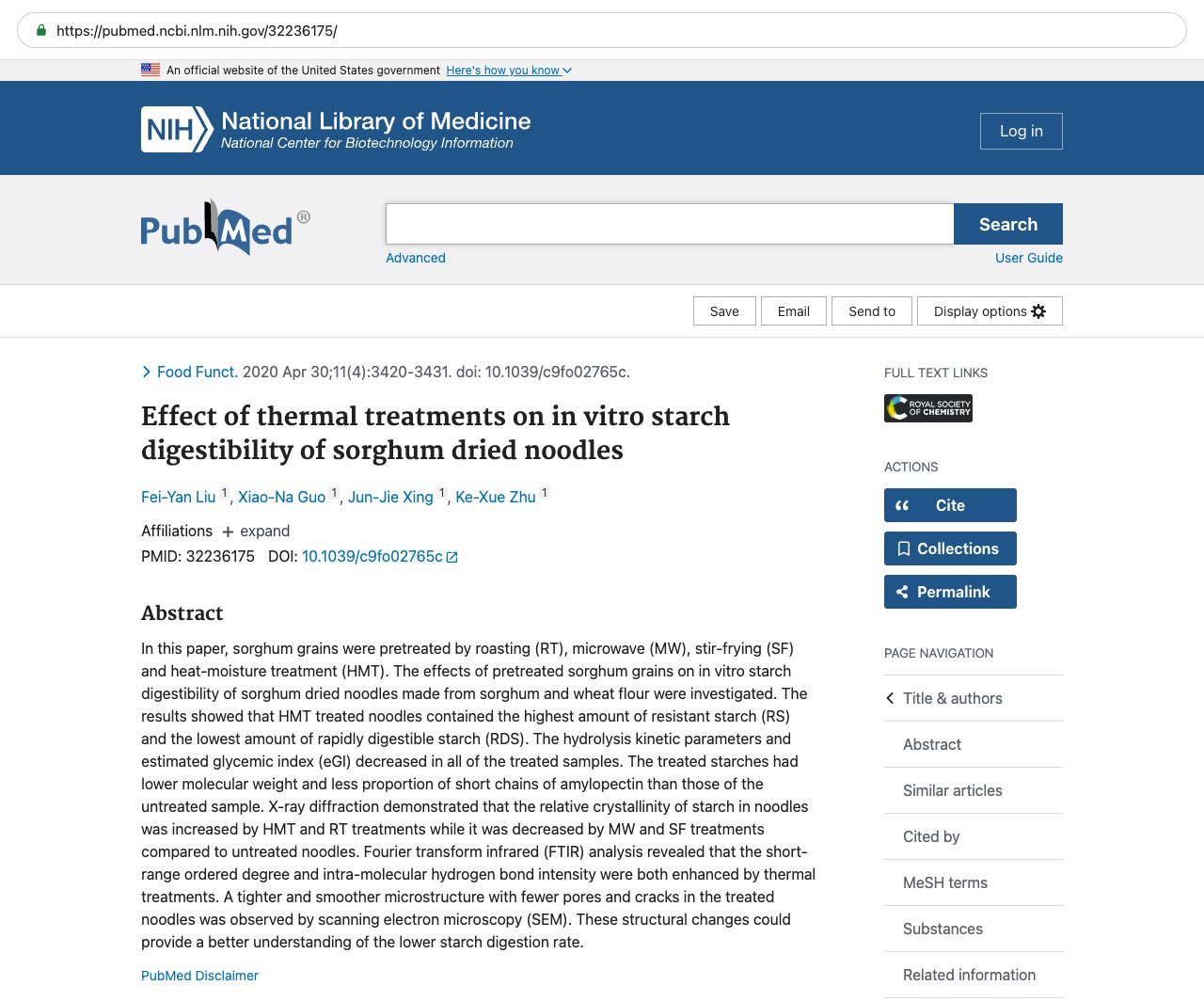
In this paper, sorghum grains were pretreated by roasting (RT), microwave (MW), stir-frying (SF) and heat-moisture treatment (HMT). The effects of pretreated sorghum grains on in vitro starch digestibility of sorghum dried noodles made from sorghum and wheat flour were investigated. The results showed that HMT treated noodles contained the highest amount of resistant starch (RS) and the lowest amount of rapidly digestible starch (RDS). The hydrolysis kinetic parameters and estimated glycemic index (eGI) decreased in all of the treated samples. The treated starches had lower molecular weight and less proportion of short chains of amylopectin than those of the untreated sample. X-ray diffraction demonstrated that the relative crystallinity of starch in noodles was increased by HMT and RT treatments while it was decreased by MW and SF treatments compared to untreated noodles. Fourier transform infrared (FTIR) analysis revealed that the short-range ordered degree and intra-molecular hydrogen bond intensity were both enhanced by thermal treatments. A tighter and smoother microstructure with fewer pores and cracks in the treated noodles was observed by scanning electron microscopy (SEM). These structural changes could provide a better understanding of the lower starch digestion rate.
Source & links
Screenshot of the PubMed page
This page mirrors the published abstract (© the authors / publisher) for reference and citation. The canonical source is the PubMed record linked above. This is not medical advice.