2025 · Yu — Protective Effects of Hydrogen Treatment Against High Glucose-Induced Oxidative Stress and Apoptosis via Inhibition of the AGEs/RAGE/NF-κB Signaling Pathway in Skin Cells.
Super-Abstract
In cell culture, molecular hydrogen protected human skin cells (keratinocytes and fibroblasts) against the oxidative stress and cell death caused by high glucose or advanced glycation end-products (AGEs) — compounds that accumulate in diabetic tissue. H₂ treatment reduced inflammatory markers and inhibited the AGEs/RAGE/NF-κB signalling cascade, which is central to chronic inflammation in diabetic wounds. (Endocrine, Metabolic & Immune Disorders Drug Targets, 2025.)
Commentary
This is an in-vitro cell-culture study. Diabetic wound healing is a major unresolved clinical challenge: high glucose drives oxidative stress and inflammation, impairing the wound-repair capacity of keratinocytes and fibroblasts. The study provides mechanistic data showing that H₂ reduces ROS, MDA, and pro-inflammatory cytokines (IL-1β, TNF-α) while boosting antioxidant enzymes (SOD, GSH) — and that this protection runs through the AGEs/RAGE/NF-κB pathway. These findings are mechanistically sound but remain entirely in the petri dish. Whether these cell-level effects translate to clinically meaningful wound-healing acceleration in diabetic patients requires controlled in-vivo and eventually human studies.
Key quotes
- „H2 treatment significantly reduced ROS, MDA, IL-1β, and TNF-α levels, while enhancing SOD and GSH activity.“ — key quantitative antioxidant and anti-inflammatory outcomes
- „It also inhibited AGEs/RAGE/NF-κB signaling and apoptosis.“ — the molecular signalling pathway blocked by H₂
- „Hydrogen therapy protects against oxidative stress and inflammation induced by high glucose or AGEs, offering potential as an adjunctive treatment for diabetic wound healing.“ — authors' cautious conclusion about potential
Our assessment
This is a cell-culture (in-vitro) study — results demonstrate a biologically plausible mechanism for H₂ protection against high-glucose-induced cell damage, but these findings cannot be directly transferred to clinical outcomes in diabetic wound healing. The AGEs/RAGE/NF-κB pathway inhibition is a well-established target, and the data are mechanistically consistent. However, cell viability and cytokine results in a dish do not predict clinical wound-healing outcomes. Animal and human studies are necessary before any clinical conclusions can be drawn.
Study design
- Type: in-vitro cell-culture study · Cell lines: HaCaT keratinocytes and HSF fibroblasts · H₂ delivery: not specified (hydrogen-rich medium or gas — details in full paper)
- Challenge: high glucose or AGEs to simulate diabetic conditions · Endpoints: cell viability, ROS, MDA, IL-1β, TNF-α, SOD, GSH, AGEs/RAGE/NF-κB pathway (Western blot), apoptosis · Result: significant reduction in oxidative stress and inflammatory markers; apoptosis inhibited; pathway suppressed
Abstract
BACKGROUND: Diabetic wounds are major clinical challenges, often complicated by oxidative stress and free radical generation. Hydrogen (H2), a selective antioxidant, offers potential as a therapeutic agent for chronic diabetic wounds. However, its precise mechanisms remain underexplored. OBJECTIVE: This study aimed to investigate the protective effects of H2 on high glucose-induced oxidative damage and apoptosis in human skin cells. METHODS: HaCaT keratinocytes and HSF fibroblasts were treated with high glucose or AGEs. Cell viability, oxidative stress markers, inflammatory cytokines, and apoptosis were analyzed. AGEs/RAGE/NF-κB signaling was evaluated via Western blot. RESULTS: H2 treatment significantly reduced ROS, MDA, IL-1β, and TNF-α levels, while enhancing SOD and GSH activity. It also inhibited AGEs/RAGE/NF-κB signaling and apoptosis. CONCLUSION: Hydrogen therapy protects against oxidative stress and inflammation induced by high glucose or AGEs, offering potential as an adjunctive treatment for diabetic wound healing.
Source & links
Screenshot of the PubMed page
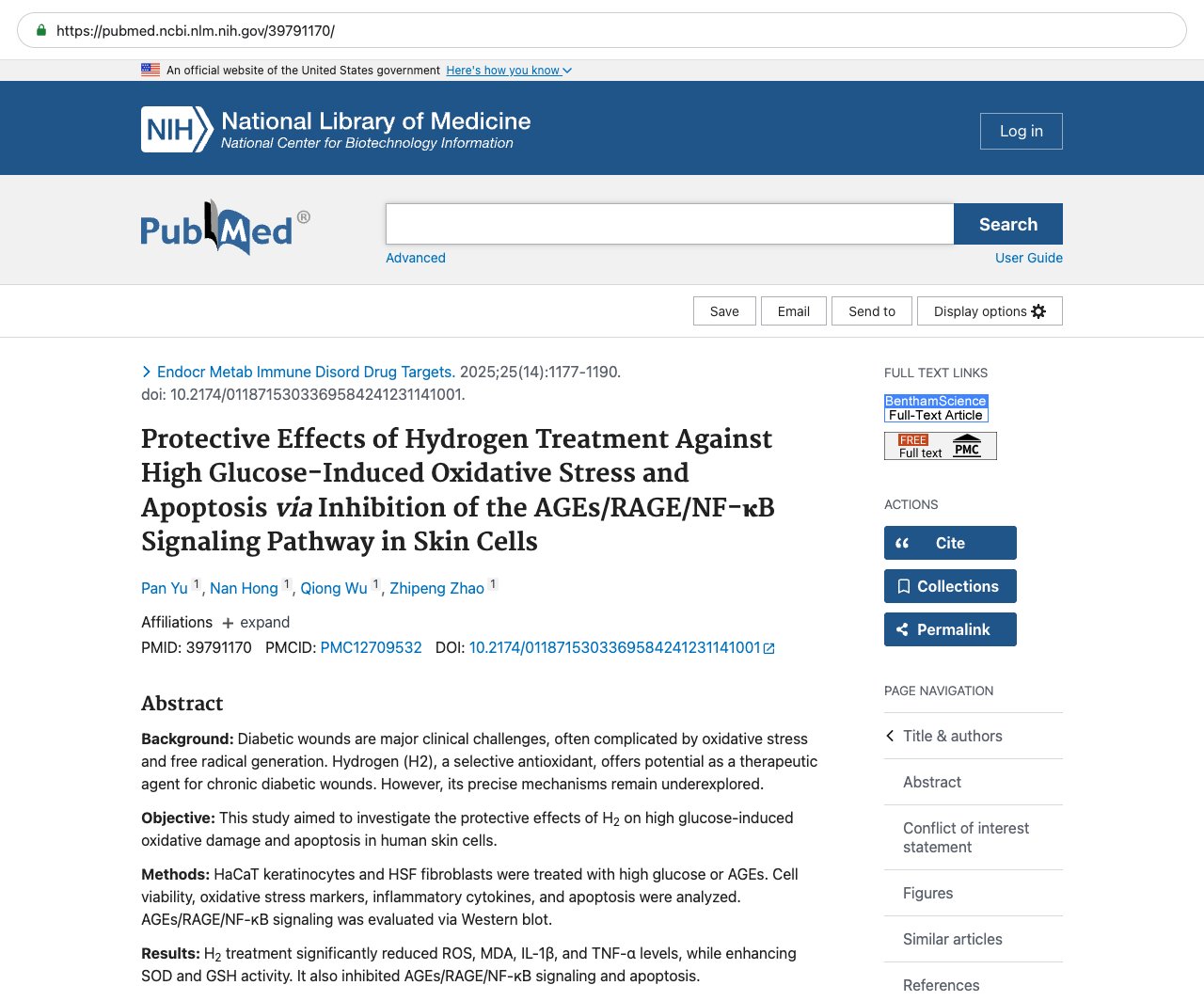
This page mirrors the published abstract (© the authors / publisher) for reference and citation. The canonical source is the PubMed record linked above. This is not medical advice.