2016 · Zhang — How the Imidazole Ring Modulates Amyloid Formation of Islet Amyloid Polypeptide: A Chemical Modification Study
Super-Abstract
This in-vitro biochemistry study investigated the role of a specific amino acid (histidine-18) in the misfolding of islet amyloid polypeptide (hIAPP), a protein linked to type 2 diabetes. The research used chemical modification to probe how the imidazole ring of His(18) influences amyloid fiber formation — but does not involve molecular hydrogen (H₂) as a therapeutic agent. (Biochimica et Biophysica Acta, 2016.)
Commentary
Zhang et al. used diethylpyrocarbonate (DEPC) to chemically modify histidine-18 of hIAPP and studied how this change affected amyloid fibril formation using a battery of biophysical methods including fluorescence, electron microscopy, circular dichroism, infrared spectroscopy, and molecular dynamics simulation. The study's central finding is that His(18)'s imidazole ring governs intramolecular hydrogen bond formation and participates in membrane and ion interactions critical to hIAPP aggregation. Note: the „hydrogen bond“ referred to here is the classical intramolecular bond in protein structure — not molecular hydrogen (H₂) gas or H₂-enriched water. This study appears in the H₂ database likely due to keyword overlap; its actual subject is protein aggregation chemistry relevant to type 2 diabetes. There is no H₂ supplementation, no H₂ therapy, and no direct relevance to hydrogen medicine.
Key quotes
- „The intramolecular hydrogen bond formation by His(18) and the possibility of His(18) participating in the formation of α-helical structures greatly modulated the manner of hIAPP amyloid formation.“ — central finding — concerns protein chemistry, not H₂ therapy
- „The imidazole ring directly participates in the hIAPP-membrane/ion interaction.“ — structural role of His(18) in membrane binding
- „DEPC modification is an alternative approach to investigate the role of the imidazole ring during amyloid formation.“ — methodological contribution of the study
Our assessment
This is an in-vitro protein chemistry study that investigates intramolecular hydrogen bonds within the hIAPP peptide structure — not molecular hydrogen (H₂) as a bioactive substance. Its inclusion in an H₂ database appears to be based on keyword overlap. The science is methodologically solid and relevant to understanding type 2 diabetes-related amyloid pathology, but it has no direct connection to hydrogen medicine or H₂ therapy. Findings should not be interpreted as supporting the therapeutic use of H₂ water or H₂ gas in diabetes.
Study design
- Type: in-vitro biochemistry study · Model: recombinant hIAPP peptide, DEPC-modified; cell-free chemical system · Methods: ThT fluorescence, TEM, circular dichroism, FTIR, REMD molecular dynamics simulation
- Result: DEPC modification of His(18) reversed pH-dependent fibrillation order, decreased intramolecular hydrogen bond count, increased α-helix propensity, and impaired membrane and ion interactions — all in a cell-free peptide system with no H₂ therapy component
Abstract
BACKGROUND: The misfolding of human islet amyloid polypeptide (hIAPP) is an important pathological factor on the onset of type 2 diabetes. A number of studies have been focused on His(18), the only histidine of hIAPP, whose imidazole ring and the protonation state might impact hIAPP amyloid formation, but the exact mechanism remains unclear. METHODS: We used diethylpyrocarbonate (DEPC) to specifically modify His(18) and obtained mono-ethyloxyformylated hIAPP (DMI). Thioflavin T based fluorescence, transmission electronic microscopy, circular dichroism spectroscopy, fluorescence dye leakage, Fourier transform infrared spectroscopy and replica-exchange molecular dynamics (REMD) simulation were applied to study the impact of DEPC-modification on hIAPP amyloid formation. RESULTS: After an ethyl-acetate group was introduced to the His(18) of hIAPP by diethylpyrocarbonate (DEPC) modification, the pH dependent hIAPP fibrillation went to the opposite order and the number of intra-molecular hydrogen bonds decreased, while the possibility of His(18) participating in the formation of α-helical structures increased. Furthermore, the membrane-peptide interaction and ion-peptide interaction were both impaired. CONCLUSIONS: The intramolecular hydrogen bond formation by His(18) and the possibility of His(18) participating in the formation of α-helical structures greatly modulated the manner of hIAPP amyloid formation. The imidazole ring directly participates in the hIAPP-membrane/ion interaction. GENERAL SIGNIFICANCE: DEPC modification is an alternative approach to investigate the role of the imidazole ring during amyloid formation.
Source & links
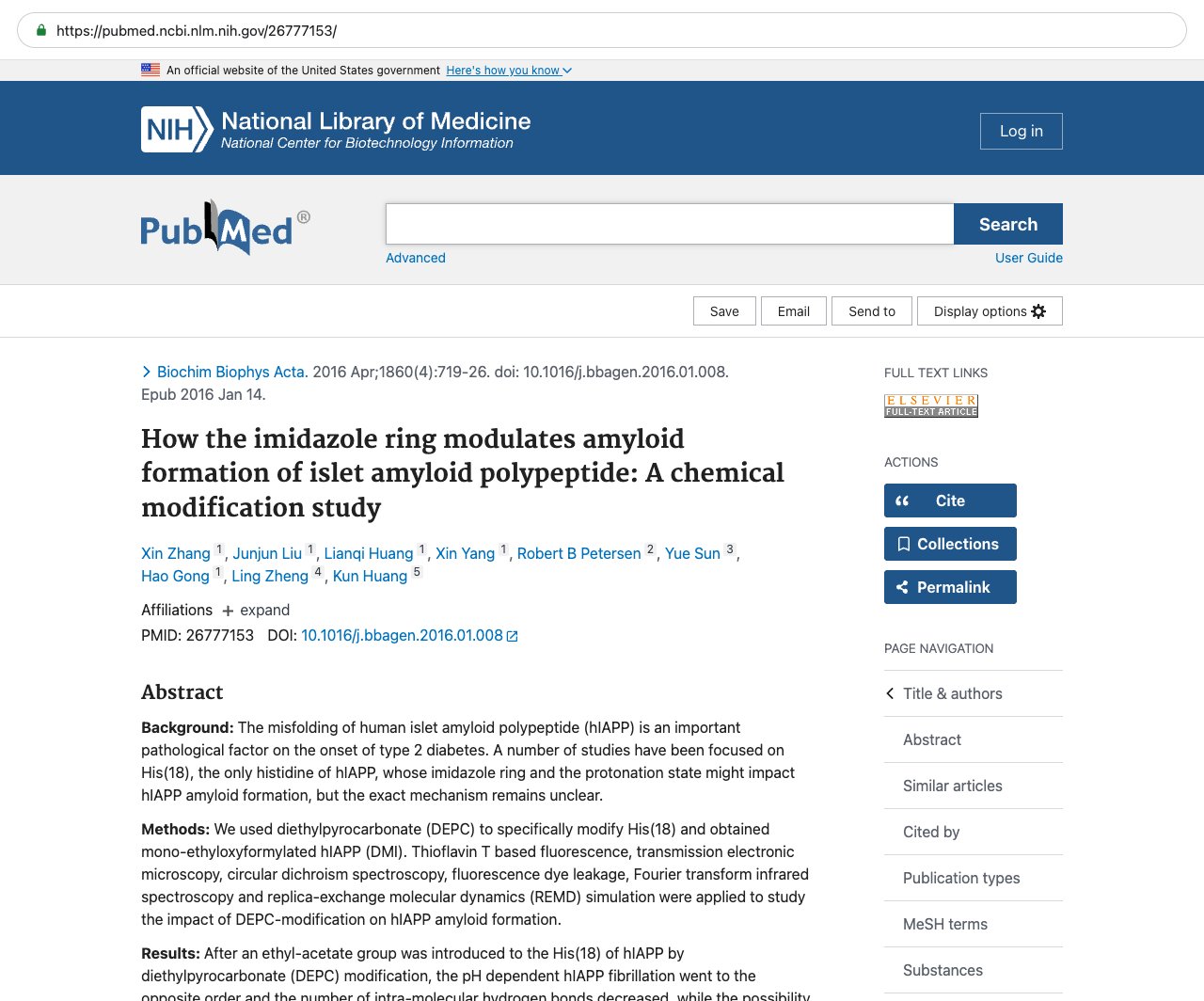
Screenshot of the PubMed page
This page mirrors the published abstract (© the authors / publisher) for reference and citation. The canonical source is the PubMed record linked above. This is not medical advice.