2021 · Alwazeer — Combating Oxidative Stress and Inflammation in COVID-19 by Molecular Hydrogen Therapy: Mechanisms and Perspectives.
Super-Abstract
This review systematically examines how molecular hydrogen (H₂) could theoretically address the oxidative stress and uncontrolled inflammation at the heart of severe COVID-19 — including its ability to suppress NF-κB signaling and activate the Nrf2 antioxidant pathway. The authors stress that exact mechanisms and clinical efficacy still require verification. (Oxidative Medicine and Cellular Longevity, 2021.)
Commentary
COVID-19 can progress to life-threatening disease when the initial viral infection triggers a disproportionate immune response — a „cytokine storm“ characterized by unchecked inflammation and oxidative damage to the alveolar epithelium. Alwazeer et al. survey the preclinical and early clinical evidence for H₂ and systematically map its known mechanisms — radical scavenging (·OH selectivity), NF-κB inhibition, Nrf2/Keap1 pathway induction, mitochondrial function improvement — onto the pathophysiology of COVID-19. The logic is compelling as a mechanistic argument: H₂ targets several processes simultaneously that standard therapies address only partially. However, this is a review article written during the acute pandemic phase, when controlled clinical trial data for H₂ in COVID-19 were very sparse. The authors are appropriately candid that clinical proof is lacking and that further mechanistic and clinical research is needed. The paper should be read as a well-structured hypothesis piece, not as evidence of clinical efficacy.
Key quotes
- „H2 has been demonstrated to suppress NF-κB inflammatory signaling and induce the Nrf2/Keap1 antioxidant pathway, as well as to improve mitochondrial function and enhance cellular bioenergetics.“ — summary of H₂'s key molecular mechanisms relevant to COVID-19 pathology
- „the exact mechanisms, primary modes of action, and its true clinical effects remain to be delineated and verified.“ — honest caveat from the authors — this is hypothesis and preliminary data, not proven therapy
- „additional mechanistic and clinical research into this novel medical gas to combat COVID-19 complications is warranted.“ — call to action: more trials needed before clinical conclusions can be drawn
Our assessment
This is a review article, not a clinical trial. It provides a well-reasoned mechanistic framework for why H₂ could be beneficial in COVID-19, and cites preclinical and some early clinical studies. The authors are honest that clinical efficacy has not been firmly established. At the time of writing, COVID-19 was still very new, and the evidence landscape has shifted since 2021. This paper is valuable as background on H₂ mechanisms in cytokine-driven lung injury, but should not be interpreted as proof that H₂ therapy works against COVID-19 in practice.
Study design
- Type: systematic narrative review · Scope: preclinical and early clinical H₂ studies mapped onto COVID-19 pathophysiology · H₂ delivery: multiple modalities discussed (inhalation, oral, IV)
- Conclusion: mechanistic rationale for H₂ in COVID-19 is strong; clinical evidence at time of writing was preliminary; controlled trials called for
Abstract
COVID-19 is a widespread global pandemic with nearly 185 million confirmed cases and about four million deaths. It is caused by an infection with the severe acute respiratory syndrome coronavirus-2 (SARS-CoV-2), which primarily affects the alveolar type II pneumocytes. The infection induces pathological responses including increased inflammation, oxidative stress, and apoptosis. This situation results in impaired gas exchange, hypoxia, and other sequelae that lead to multisystem organ failure and death. As summarized in this article, many interventions and therapeutics have been proposed and investigated to combat the viral infection-induced inflammation and oxidative stress that contributes to the etiology and pathogenesis of COVID-19. However, these methods have not significantly improved treatment outcomes. This may partly be attributable to their inability at restoring redox and inflammatory homeostasis, for which molecular hydrogen (H2), an emerging novel medical gas, may complement. Herein, we systematically review the antioxidative, anti-inflammatory, and antiapoptotic mechanisms of H2. Its small molecular size and nonpolarity allow H2 to rapidly diffuse through cell membranes and penetrate cellular organelles. H2 has been demonstrated to suppress NF-κB inflammatory signaling and induce the Nrf2/Keap1 antioxidant pathway, as well as to improve mitochondrial function and enhance cellular bioenergetics. Many preclinical and clinical studies have demonstrated the beneficial effects of H2 in varying diseases, including COVID-19. However, the exact mechanisms, primary modes of action, and its true clinical effects remain to be delineated and verified. Accordingly, additional mechanistic and clinical research into this novel medical gas to combat COVID-19 complications is warranted.
Source & links
Screenshot of the PubMed page
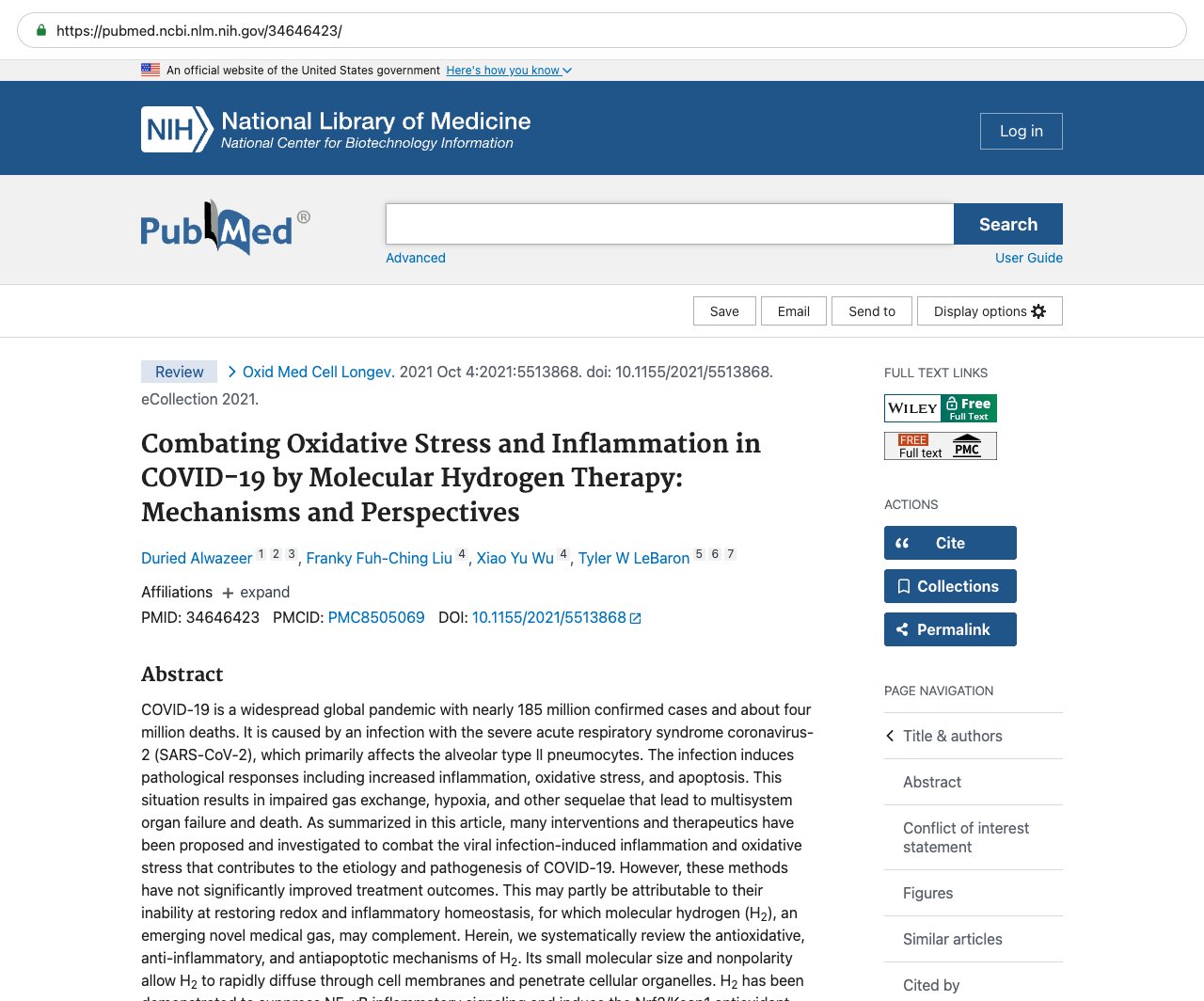
This page mirrors the published abstract (© the authors / publisher) for reference and citation. The canonical source is the PubMed record linked above. This is not medical advice.