2026 · Liu et al. — Adjuvant Molecular Hydrogen Therapy in SLE-associated Pulmonary Arterial Hypertension: A Case Report on Immunomodulatory Effects on Regulatory and Effector Lymphocytes
Super-Abstract
A 42-year-old woman with systemic lupus erythematosus complicated by pulmonary arterial hypertension (a severe, progressive condition) received hydrogen capsule therapy, after which serial immunophenotyping showed dynamic suppression of memory B-cell populations and changes in PD1 and Fas markers — patterns interpreted as evidence of immune tolerance induction. (In Vivo, 2026.)
Commentary
SLE-associated pulmonary arterial hypertension carries a poor prognosis and limited therapeutic options. This report is one of two published simultaneously by the same group (see also PMID 41167678) examining hydrogen in SLE-PAH — the two cases appear to document different patients. The immunophenotyping approach is unusually detailed for a case report: serial measurements of PD1, Fas, regulatory T cells, and memory B-cell subsets provide a longitudinal window into immune dynamics. The finding that double-negative and class-switched memory B-cell populations declined during therapy is mechanistically interesting — these subsets are implicated in autoantibody production. The authors interpret this as „durable immune suppression“, but without a control condition or larger sample, the biological interpretation remains speculative. The clinical outcomes (symptom improvement, disease stability) are reported qualitatively but quantitative measures (e.g., right heart catheterisation pressures) are not mentioned.
Key quotes
- „the populations of double negative and class-switched memory B-cells decreased during therapy, suggesting durable immune suppression.“ — the key immunological finding — relevant to autoantibody-producing B-cell control
- „serial immunophenotyping revealed dynamic changes in suppressive markers including programmed cell death protein 1 (PD1) and Fas cell surface death receptor (FAS), as well as regulatory T- and B-cell subsets.“ — the breadth of immunological monitoring applied
- „This case study suggests that molecular hydrogen therapy may be a promising treatment for patients with SLE-PAH, particularly due to its immunomodulatory effects.“ — cautious overall conclusion
Our assessment
Single case report with detailed immunological documentation. The mechanistic data are the primary contribution — clinical benefit is described qualitatively without haemodynamic endpoints (e.g., pulmonary artery pressure). Limitations: n = 1, unspecified H₂ delivery method (listed as „unspecified“ in the study metadata), no control condition, no quantitative clinical outcomes for PAH severity, concurrent standard SLE therapy. Taken together with the companion report (41167678), this group's work provides a coherent mechanistic hypothesis for H₂ in autoimmune disease that deserves investigation in a formal trial.
Study design
- Type: case report · n: 1 (42-year-old Taiwanese woman with SLE-PAH) · H₂ delivery: hydrogen capsule therapy (route unspecified)
- Result: decreased double-negative and class-switched memory B-cells; dynamic changes in PD1 and Fas markers; regulatory T- and B-cell subset modulation
- Clinical outcome: qualitative improvement described; no quantitative haemodynamic data reported
Abstract
BACKGROUND/AIM: Pulmonary arterial hypertension (PAH) is a significant and challenging complication for patients with systemic lupus erythematosus (SLE). It is thought to arise from immune dysregulation and vascular remodeling, ultimately leading to progressive right heart failure. Molecular hydrogen therapy, a selective antioxidant and anti-inflammatory agent, may modulate the immune responses seen in autoimmune diseases. This case report details the use of adjuvant hydrogen capsule therapy in a patient with SLE with PAH, suggesting its potential as a novel approach for this difficult clinical condition. CASE REPORT: A 42-year-old Taiwanese woman with SLE-PAH received hydrogen capsule therapy, during which serial immunophenotyping revealed dynamic changes in suppressive markers including programmed cell death protein 1 (PD1) and Fas cell surface death receptor (FAS), as well as regulatory T- and B-cell subsets. Notably, the populations of double negative and class-switched memory B-cells decreased during therapy, suggesting durable immune suppression. These results support the effect of hydrogen capsule therapy in achieving immune tolerance and inflammation modulation. CONCLUSION: This case study suggests that molecular hydrogen therapy may be a promising treatment for patients with SLE-PAH, particularly due to its immunomodulatory effects.
Source & links
Screenshot of the PubMed page
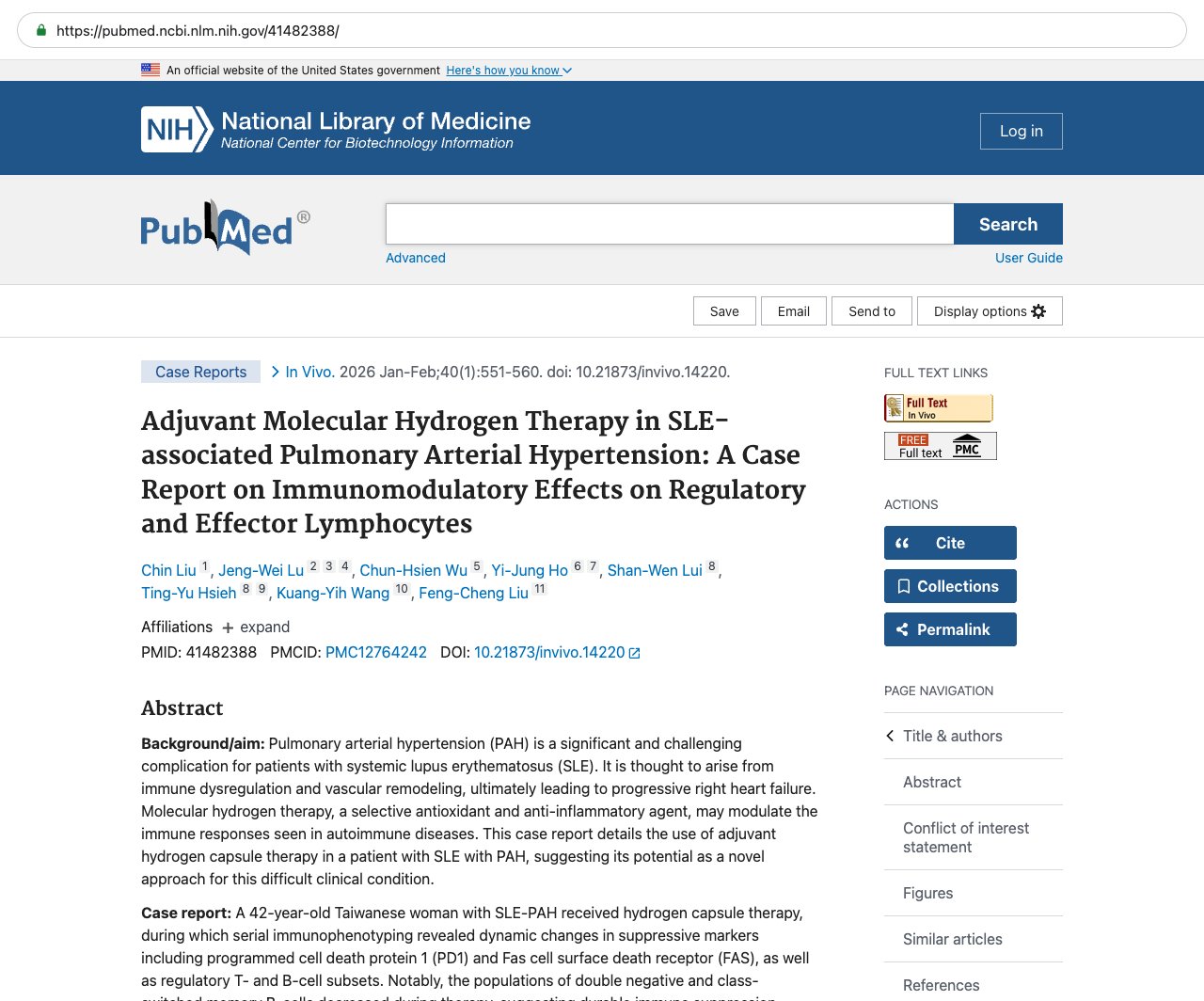
This page mirrors the published abstract (© the authors / publisher) for reference and citation. The canonical source is the PubMed record linked above. This is not medical advice.