2025 · Liu et al. — Dynamic Immunomodulation by Hydrogen Capsule Therapy in SLE-associated Pulmonary Arterial Hypertension: A Case Report
Super-Abstract
A 45-year-old woman with SLE-associated pulmonary arterial hypertension showed a striking biphasic immunological response to hydrogen capsule therapy: immune activation markers (KLRG1+ T cells, CD39+Helios- regulatory T cells, regulatory B cells) were suppressed during therapy but rebounded after stopping — suggesting a transient immunosuppressive effect followed by regulatory rebalancing. (In Vivo, 2025.)
Commentary
This case report and the companion report (PMID 41482388) from the same group form a two-patient dataset in SLE-PAH — a disease context where any immunological signal is potentially meaningful given the severity and limited options. The conceptually most interesting finding here is the biphasic pattern: suppression during hydrogen therapy, rebound after cessation. This kind of on-off dynamic is more informative than a simple before-after comparison because it suggests a pharmacologically reversible mechanism rather than spontaneous disease fluctuation. KLRG1 is a marker of T-cell senescence/exhaustion; its suppression could mean that H₂ temporarily reverses or delays a pro-inflammatory exhaustion state. CD39+Helios- Tregs are a suppressive subset whose modulation has implications for autoimmune disease control. Whether this immunological pattern translates into durable clinical benefit is not yet established. The clinical improvement is reported qualitatively.
Key quotes
- „KLRG1+ T cells and CD39+Helios- Tregs were suppressed during therapy but rebounded after cessation, suggesting transient immune suppressing followed by regulatory rebalancing.“ — the biphasic finding — key to understanding H₂ as a pharmacologically active immune modulator
- „Bregs also showed a similar pattern, declining during therapy and recovering after discontinuation.“ — regulatory B cells follow the same biphasic course
- „These findings suggest a biphasic immunomodulatory effect of hydrogen therapy, that is, initially dampening immune activation, followed by a regulatory rebound after hydrogen therapy.“ — the authors' mechanistic interpretation
Our assessment
Single case report, but with an unusually informative longitudinal immunophenotyping design that captures a before-during-after time course. The biphasic pattern is the genuinely novel contribution and generates a testable hypothesis for future pharmacodynamic studies. Limitations: n = 1, SLE-PAH is a rare and severe condition making generalisation difficult, H₂ delivery route unspecified, no haemodynamic endpoints reported, clinical improvement qualitative only. See also companion report PMID 41482388 from the same group for context.
Study design
- Type: case report with serial immunophenotyping · n: 1 (45-year-old Taiwanese woman, SLE-PAH) · H₂ delivery: hydrogen capsule therapy (route unspecified)
- Key finding: biphasic immunological pattern — KLRG1+ T cells, CD39+Helios- Tregs, and regulatory B cells suppressed during therapy; rebound after cessation
- Clinical outcome: qualitative improvement reported; no quantitative haemodynamic or pulmonary function data
Abstract
BACKGROUND/AIM: Pulmonary arterial hypertension (PAH) is a severe complication of systemic lupus erythematosus (SLE), marked by vascular remodeling, immune dysregulation, and progressive right heart failure. Molecular hydrogen therapy, a selective antioxidant and anti-inflammatory agent, has the capacity to modulate immune responses in these autoimmune disease patients. This case report details the clinical improvement in an SLE patient with PAH after starting adjunctive hydrogen capsule therapy, highlighting its potential as a novel approach for this challenging complication. CASE REPORT: A 45-year-old Taiwanese woman with SLE-PAH who received hydrogen capsule therapy, during which serial immunophenotyping revealed dynamic changes in T cell exhaustion markers, regulatory T cell (Treg) subsets, and regulatory B cells (Breg). Notably, KLRG1+ T cells and CD39+Helios- Tregs were suppressed during therapy but rebounded after cessation, suggesting transient immune suppressing followed by regulatory rebalancing. Bregs also showed a similar pattern, declining during therapy and recovering after discontinuation. CONCLUSION: These findings suggest a biphasic immunomodulatory effect of hydrogen therapy, that is, initially dampening immune activation, followed by a regulatory rebound after hydrogen therapy.
Source & links
Screenshot of the PubMed page
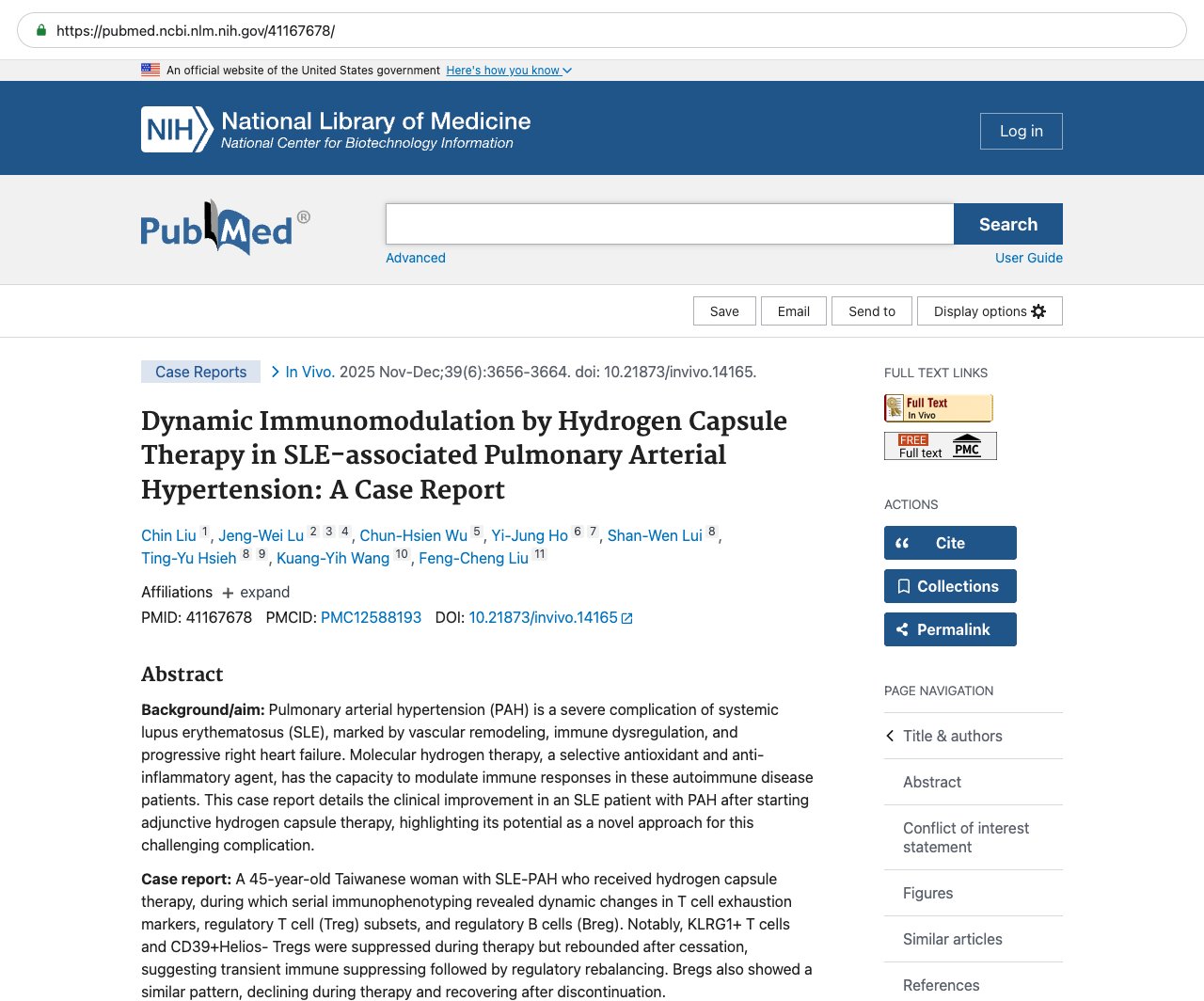
This page mirrors the published abstract (© the authors / publisher) for reference and citation. The canonical source is the PubMed record linked above. This is not medical advice.