2025 · Su — Multifaceted Immunomodulatory Nanocomplexes Target Neutrophilic-ROS Inflammation in Acute Lung Injury.
Super-Abstract
A two-pronged nanoparticle system combining a neutrophil-inhibiting drug with hydrogen-releasing silicon nanoparticles significantly reduced lung injury in mouse models of sepsis-induced acute lung injury (ALI). The SiH nanosheets provided sustained hydrogen release to scavenge reactive oxygen species, while the co-delivered drug blocked the key inflammatory neutrophil-signalling cascade, together suppressing both blood and lung immune-cell overactivation. (Advanced Science, 2025.)
Commentary
This is a preclinical animal study. Sepsis-induced acute lung injury (ALI) is a critical-care emergency with high mortality and limited therapeutic options. The strategy here layers two complementary mechanisms: neutrophil de-activation via S100A8/9 inhibitor (ABR2575) blocking the TLR-inflammasome axis, and hydrogen-mediated ROS scavenging with simultaneous M2 macrophage polarisation. The PLGA nanosponge platform enables co-encapsulation and sustained release of both agents. Results in murine ALI models show reduced neutrophil infiltration, decreased pro-inflammatory cytokines, and improved lung histology. Limitations include mouse-only data, no quantification of achieved H₂ concentrations in lung tissue, and unknowns around PLGA/SiH nanoparticle safety profiles at therapeutic doses.
Key quotes
- „The SiH nanosheets are encapsulated together with ABR2575 into the core of poly(lactic-co-glycolic acid) (PLGA) nanosponges, to achieve sustainable hydrogen release for the alleviation of ROS-induced lung tissue injury, and also promote the M2 polarization of macrophages.“ — design of the nanocomplex and H₂ delivery mechanism
- „This novel combination strategy is proven to significantly suppress the infiltration of neutrophils and pro-inflammatory macrophages into the lungs.“ — primary anti-inflammatory outcome in the animal model
- „The current investigations offer a novel nanomedicine for the treatment of ALI with great potential in clinical invention.“ — authors' cautious forward-looking statement
Our assessment
This is a preclinical animal study (mouse) — results cannot be directly transferred to humans. The nanocomplex approach addresses a well-defined pathophysiological mechanism in ALI, and the dual-agent design is well-reasoned. However, translating nanoparticle-based therapies into the sepsis-ALI clinical setting is notoriously difficult: rapid disease progression, patient heterogeneity, and nanoparticle biodistribution in inflamed lungs create substantial barriers. No human safety or efficacy data exist for this platform.
Study design
- Type: preclinical animal study · Model: murine sepsis-induced ALI (LPS and CLP models) · H₂ delivery: SiH (silicon hydride) nanosheets in PLGA nanosponges — sustained hydrolytic H₂ release
- Co-agent: ABR2575 (S100A8/9 inhibitor, neutrophil signalling blocker) · Endpoints: neutrophil/macrophage infiltration, cytokine levels (lung + blood), macrophage polarisation (M2), lung histopathology · Result: significant reduction in inflammation, neutrophil infiltration, and lung injury scores
Abstract
The sepsis-induced acute lung injury (ALI) still represents one of the leading causes of death in critically ill patients, underscoring the need for novel therapies. Excessive activation of immune cells and damage of reactive oxygen species (ROS) are the main factors that exacerbate lung injury. Here, the multifaceted immunomodulatory nanocomplexes targeting the proinflammatory neutrophilic activation and ROS damage are established. The S100A8/9 inhibitor, ABR2575, is loaded in the nanocomplexes, which effectively blocks the neutrophils-S100A8/A9- toll-like receptors (TLRS)-Inflammasome signaling in ALI. Synergically, the SiH nanosheets are encapsulated together with ABR2575 into the core of poly(lactic-co-glycolic acid) (PLGA) nanosponges, to achieve sustainable hydrogen release for the alleviation of ROS-induced lung tissue injury, and also promote the M2 polarization of macrophages. This novel combination strategy is proven to significantly suppress the infiltration of neutrophils and pro-inflammatory macrophages into the lungs, decrease the activation of neutrophils and pro-inflammatory monocytes in the blood, facilitate the anti-inflammatory polarization of macrophages and monocytes, and reduce the expression of pro-inflammatory cytokines in both the lung and blood circulation, all of which alleviate the lung injuries in preclinical murine ALI models. The current investigations offer a novel nanomedicine for the treatment of ALI with great potential in clinical invention.
Source & links
Screenshot of the PubMed page
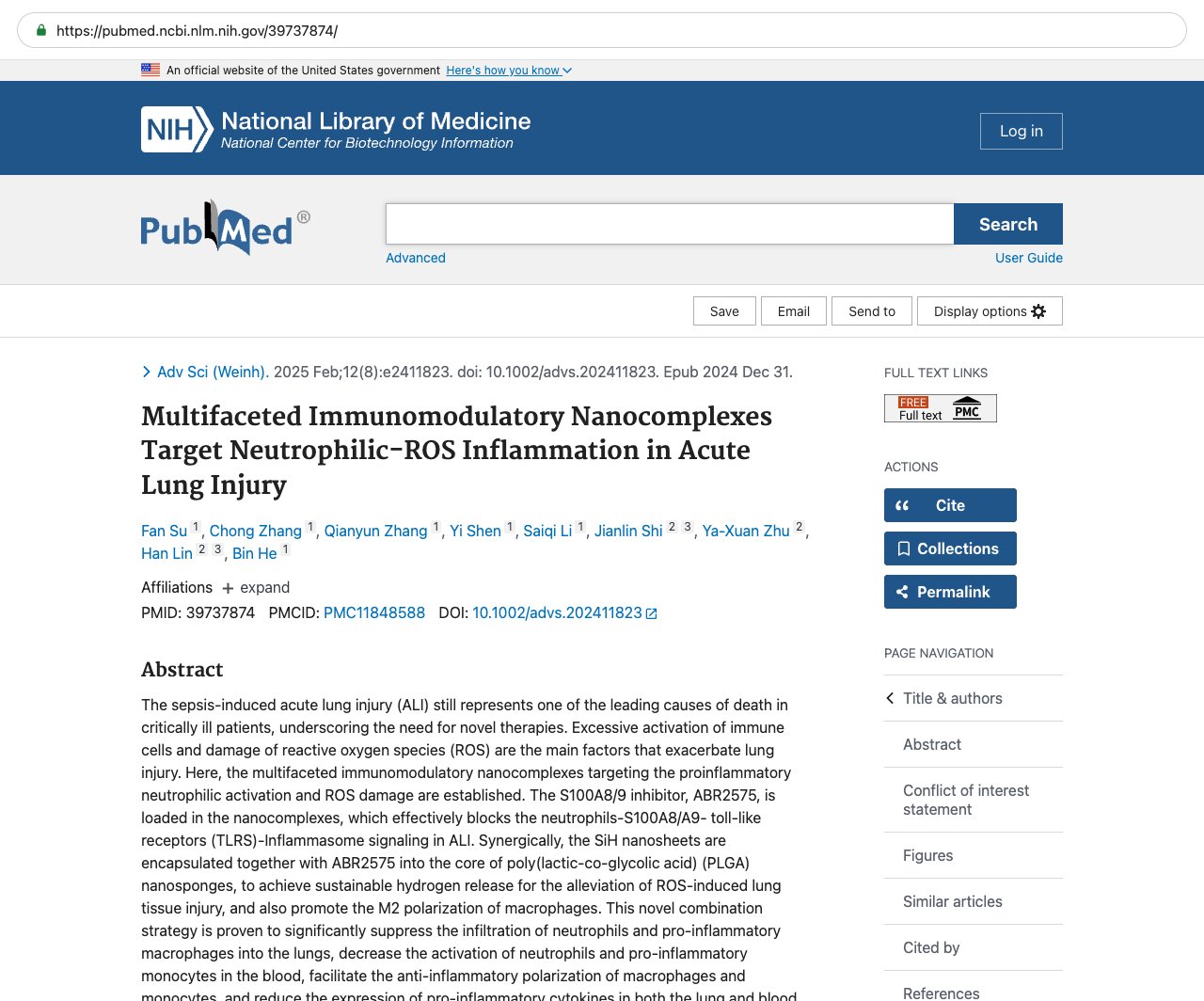
This page mirrors the published abstract (© the authors / publisher) for reference and citation. The canonical source is the PubMed record linked above. This is not medical advice.