2025 · Tsai et al. — Molecular Hydrogen as an Adjuvant Therapy in Comorbid Sjögren's Syndrome, SLE, and ILD: A Case Report on Immune Modulation and Fatigue Reduction
Super-Abstract
A 69-year-old woman with overlapping Sjögren's syndrome, systemic lupus erythematosus (SLE), and interstitial lung disease (ILD) — a difficult-to-treat triad — showed notable clinical improvements after adding molecular hydrogen therapy to her regimen. Symptoms including dry mouth, insomnia, breathlessness, and chest pain resolved over several months. Corticosteroids were tapered, and nighttime oxygen dependency was reduced. (In Vivo, 2025.)
Commentary
Overlapping autoimmune conditions are a clinical nightmare: each disease pushes immunosuppression requirements in a direction that may worsen the others, and long-term corticosteroid use itself creates organ damage. This case is compelling precisely because the patient had been unresponsive to standard treatments before H₂ therapy was added. The reported improvements span multiple domains — subjective symptom relief, objective immunological shifts (T and B cell subsets), pulmonary imaging improvement, and reduced inflammatory markers — which would be unusual for placebo effect alone, though this cannot be ruled out in a case report. The co-administration of high-dose vitamin C complicates attribution: vitamin C itself has antioxidant and immunomodulatory properties. The case, however, illustrates the clinical concept of H₂ as a safe add-on with minimal toxicity in a population for whom adding more immunosuppression is not an option.
Key quotes
- „The patient experienced notable clinical improvements, including resolution of xerostomia, insomnia, dyspnea, chest pain, and dizziness.“ — breadth of symptomatic improvement across multiple disease domains
- „These symptomatic improvements correlated with favorable immunological shifts in T and B cell subsets, enhanced pulmonary imaging findings, and a reduction in inflammatory markers.“ — objective correlates accompanying symptom improvement
- „H2 therapy improved immune profiles and stabilized symptoms in a patient unresponsive to standard treatments.“ — authors' conclusion for a treatment-refractory patient
Our assessment
A single case report with multiple confounders: concurrent high-dose vitamin C, ongoing corticosteroid therapy being tapered (itself a dynamic confounder), and no control or washout period. The multi-system improvement is clinically interesting but cannot be attributed to H₂ alone. Pulmonary imaging improvement in ILD is a meaningful endpoint, but details about imaging methodology and comparison criteria are limited. The honest take: this case is useful as a safety signal and hypothesis generator, but it proves nothing about H₂ efficacy in isolation. The combination with vitamin C and corticosteroid taper must be disentangled in future controlled work.
Study design
- Type: single case report · n: 1 (69-year-old female, Sjögren's syndrome + SLE + ILD) · H₂ delivery: method not specified; concurrent high-dose vitamin C
- Endpoints: symptom resolution, flow cytometry of T/B cell subsets, pulmonary imaging, inflammatory markers, fatigue, corticosteroid dose
- Result: resolution of xerostomia, insomnia, dyspnea, chest pain, dizziness; favorable immune profile shifts; pulmonary imaging improved; steroid taper achieved; nighttime oxygen dependency reduced
Abstract
BACKGROUND/AIM: Systemic lupus erythematosus (SLE) and Sjögren's syndrome (SS) are chronic autoimmune diseases that often coexist. They share features such as systemic inflammation and multi-organ involvement and typically require long-term immunosuppressive treatment. However, long-term use of immunosuppressants can cause serious side effects, highlighting the need for adjunct therapies. Molecular hydrogen (H2) therapy shows anti-inflammatory, antioxidant, and immunomodulatory properties, with potential benefits in liver, lung, and metabolic diseases. This case report examines a patient with overlapping SLE, SS, and interstitial lung disease (ILD), evaluating the effects of molecular hydrogen therapy on fatigue, immune modulation, and cardiac function. CASE REPORT: We present the case of a 69-year-old female diagnosed with Sjögren's syndrome, SLE, and ILD. The patient exhibited chronic symptoms, including xerostomia, xerophthalmia, and respiratory distress, for which she had been receiving corticosteroids and immunomodulatory therapy. Given the persistent disease burden and concerns regarding long-term immunosuppressive therapy, molecular hydrogen therapy was introduced as an adjunctive treatment. Over several months, the patient experienced notable clinical improvements, including resolution of xerostomia, insomnia, dyspnea, chest pain, and dizziness. These symptomatic improvements correlated with favorable immunological shifts in T and B cell subsets, enhanced pulmonary imaging findings, and a reduction in inflammatory markers. Additionally, the patient reported a significant decrease in fatigue, allowing corticosteroid tapering and less reliance on nighttime oxygen. Ongoing hydrogen therapy with high-dose vitamin C maintained disease stability and improved quality of life. CONCLUSION: This case highlights the potential of molecular hydrogen (H2) therapy as a safe, effective adjunct in managing overlapping Sjögren's syndrome, SLE, and ILD. H2 therapy improved immune profiles and stabilized symptoms in a patient unresponsive to standard treatments.
Source & links
Screenshot of the PubMed page
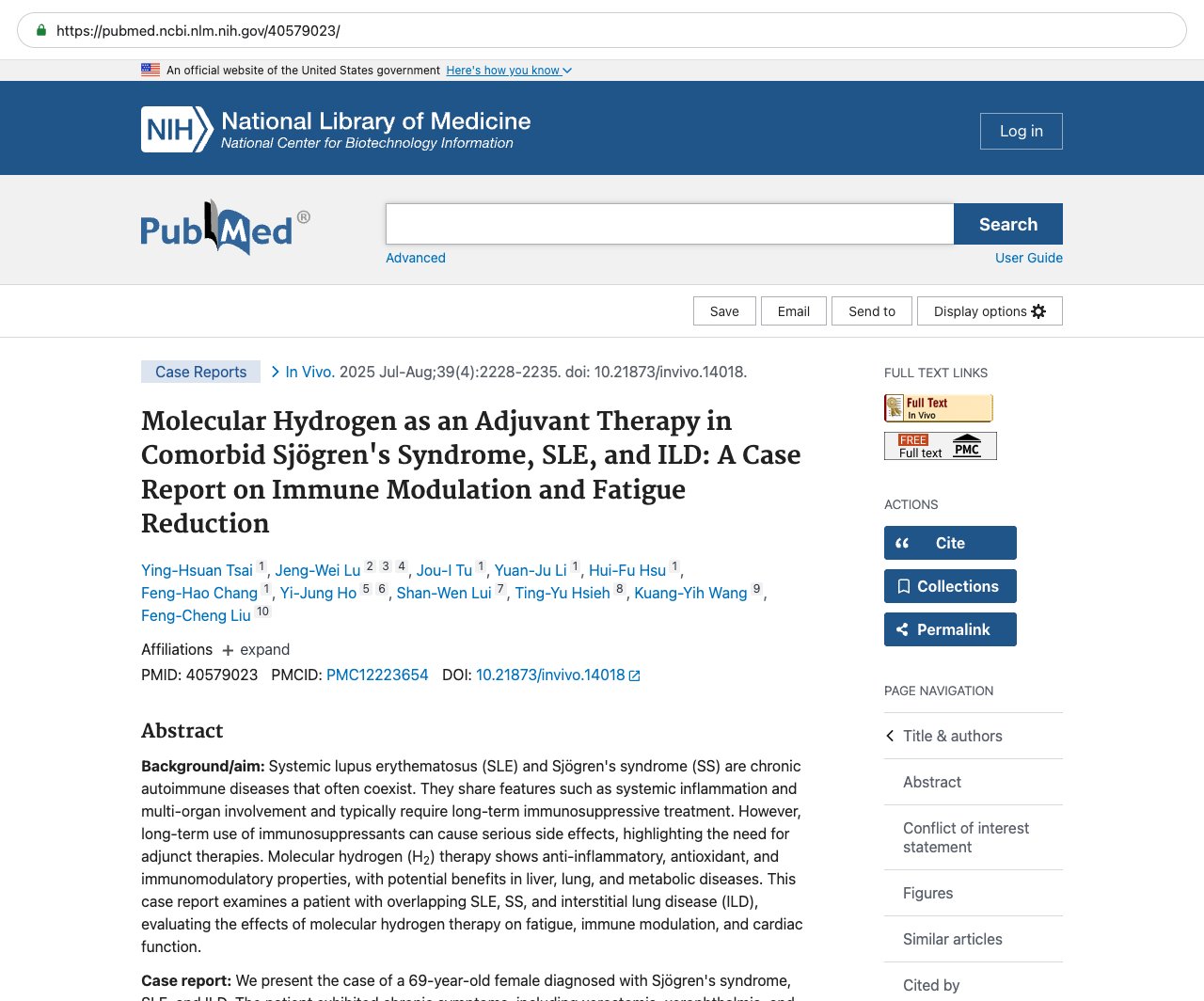
This page mirrors the published abstract (© the authors / publisher) for reference and citation. The canonical source is the PubMed record linked above. This is not medical advice.