2026 · Jiao — Therapeutic Potential of Magnesium Diboride Nanosheets in PAH-Associated Right Heart Failure: Integrated Multi-Omics Analysis Reveals Ferroptosis Suppression via LC3/ATG5/NCOA4/FTH1 Pathway
Super-Abstract
Magnesium diboride (MgB₂) nanosheets — which release H₂ upon contact with body fluids — were tested in an animal model of pulmonary arterial hypertension (PAH) and its resulting right heart failure. An integrated transcriptomic and proteomic analysis revealed that the H₂-releasing nanosheets suppressed a specific cell-death pathway (ferroptosis) through the LC3/ATG5/NCOA4/FTH1 signalling axis, offering a potential cardioprotective mechanism. This is a preclinical study with no human clinical data. (Free Radical Biology & Medicine, 2026.)
Commentary
Pulmonary arterial hypertension (PAH) is a serious, progressive disease of the lung blood vessels that forces the right ventricle to work against extreme pressure, ultimately causing right heart failure (RHF). There are no proven treatments that directly address right ventricular remodelling. Molecular H₂ has known antioxidant and anti-apoptotic properties and has shown organ-protective effects in other cardiovascular contexts. A key barrier to clinical H₂ use is delivery: inhaled H₂ is flammable, and dissolved H₂ escapes quickly. MgB₂ nanosheets address this by releasing H₂ slowly and locally. The study's use of transcriptomics and proteomics (multi-omics) to map the molecular mechanism — specifically finding that ferroptosis (an iron-dependent form of cell death) is suppressed via an autophagic iron-regulation pathway — adds mechanistic specificity. All evidence is from animal models.
Key quotes
- „Molecular hydrogen (H2), a biologically safe therapeutic agent with exceptional antioxidative, anti-inflammatory, anti-apoptotic properties and autophagic flux-modulating activities, has demonstrated organoprotective efficacy in cardiovascular and cerebrovascular disorders.“ — background: H₂'s established protective properties in cardiovascular research
- „Clinical translation is hindered by hydrogen's high explosivity and low bioavailability, necessitating the development of safer and more efficient delivery strategies.“ — the delivery problem that motivates the nanosheet approach — authors are honest about this barrier
- „This study developed novel hydrogen-releasing magnesium diboride nanosheets (MBNs), and employs an integrated transcriptomic-proteomic approach to investigate the cardioprotective effects of MBNs against PAH-induced RHF and elucidate its underlying molecular targets and mechanisms of action.“ — study design and scientific contribution
Our assessment
A mechanistically detailed preclinical study that is notable for using multi-omics to identify ferroptosis suppression as the cardiac protective mechanism of H₂-releasing nanosheets in PAH. The study is also commendably honest about the delivery barriers of H₂ therapy. However, all data are from animal models; the ferroptosis pathway and nanosheet pharmacokinetics would need to be validated in human cardiac tissue. The nanosheet formulation itself would require extensive safety, manufacturing, and delivery studies before clinical use. No human clinical evidence is presented.
Study design
- Type: preclinical animal study with multi-omics (transcriptomics + proteomics) · Model: PAH-induced right heart failure rodent model · H₂ delivery: magnesium diboride nanosheets (MBNs) releasing H₂ in situ
- Result: cardioprotective effect against PAH-induced RHF; ferroptosis suppression identified via LC3/ATG5/NCOA4/FTH1 pathway by integrated transcriptomic-proteomic analysis
Abstract
Pulmonary arterial hypertension (PAH) is a progressive obstructive pulmonary vasculopathy characterized by pathological vascular remodeling driven by excessive cellular proliferation, apoptosis resistance, chronic inflammation, fibrotic deposition, and dysregulated vasoconstriction. As the disease advances, these vascular abnormalities culminate in right heart failure (RHF). The right ventricular (RV) initially undergoes compensatory hypertrophy but ultimately decompensates, manifesting as chamber dilation, impaired contractility, and progressive fibrosis. Despite the critical determinant role of RV functional reserve in patient survival and prognosis, but no clinically validated interventions directly address RV adaptation. Molecular hydrogen (H2), a biologically safe therapeutic agent with exceptional antioxidative, anti-inflammatory, anti-apoptotic properties and autophagic flux-modulating activities, has demonstrated organoprotective efficacy in cardiovascular and cerebrovascular disorders. Nevertheless, its therapeutic potential in mitigating PAH-induced RHF remains unexplored. Clinical translation is hindered by hydrogen's high explosivity and low bioavailability, necessitating the development of safer and more efficient delivery strategies. This study developed novel hydrogen-releasing magnesium diboride nanosheets (MBNs), and employs an integrated transcriptomic-proteomic approach to investigate the cardioprotective effects of MBNs against PAH-induced RHF and elucidate its underlying molecular targets and mechanisms of action.
Source & links
Screenshot of the PubMed page
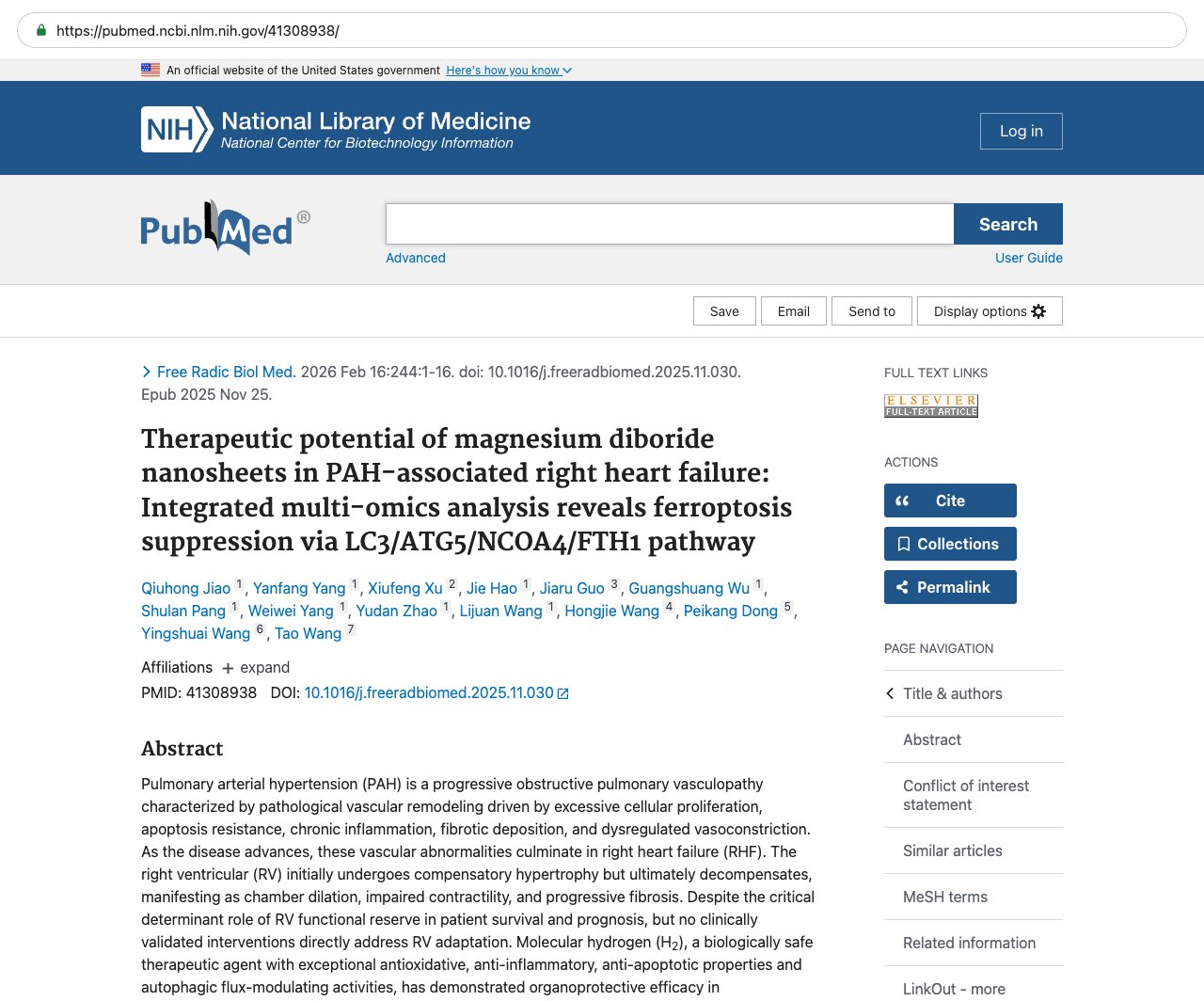
This page mirrors the published abstract (© the authors / publisher) for reference and citation. The canonical source is the PubMed record linked above. This is not medical advice.