2019 · Amberg — Effect of Physical Cues of Altered Extract Media from Biodegradable Magnesium Implants on Human Gingival Fibroblasts
Super-Abstract
As biodegradable magnesium (Mg) implants corrode, they alter the surrounding medium with elevated Mg²⁺, reduced Ca²⁺, increased osmolality, and dissolved molecular hydrogen (H₂) — all of which affect the migration rate of human gingival fibroblasts. This in-vitro study finds that the shifted Mg²⁺/Ca²⁺ ratio is the dominant factor slowing cell migration, while a constantly elevated H₂ concentration contributes as a secondary factor. These are cell-culture results; no direct health claims can be derived. (Acta Biomaterialia, 2019.)
Commentary
Guided Bone Regeneration using biodegradable magnesium membranes is a promising approach in dentistry, but the degradation products of Mg implants create a complex microenvironment around healing tissues. Amberg et al. systematically dissect which physical/chemical cues — Mg²⁺, Ca²⁺, osmolality, H₂ — are responsible for the observed slower migration of human gingival fibroblasts (HGF) near Mg surfaces. Their key finding: the temporal change in Mg²⁺/Ca²⁺ ratio is the main driver of reduced migration, with elevated H₂ playing an ancillary modulatory role. Importantly, this is a cell-type-specific finding — other cell types may respond differently. The H₂ levels here arise from corrosion of Mg metal, not from any intended therapeutic H₂ intervention.
Key quotes
- „a temporarily increased ratio of Mg2+ to Ca2+ conditioned a slow HGF migration rate“ — dominant factor: Mg/Ca ratio shift, not H₂ alone
- „the slower migration rate of HGF can be explained by the altered ratio of Mg2+ to Ca2+, caused by increasing concentrations of Mg2+ and decreasing concentrations of Ca2+ in the vicinity of the corroding Mg implant, combined with a constantly increased molecular hydrogen concentration in the supernatant“ — combined model: Mg/Ca shift + H₂ together explain reduced fibroblast migration near Mg implants
- „These results are cell type specific and should be checked carefully, if necessary, for Mg implant performance.“ — the authors' own caution: findings may not generalise to other cell types
Our assessment
A well-designed in-vitro study that provides mechanistic insight into how Mg-implant degradation products affect wound-healing cell behaviour. The H₂ involvement is secondary and arises from corrosion, not from therapeutic administration. No health promotion claims for H₂ can be drawn from this paper. Its relevance to H₂ medicine is as a safety/context paper: it helps understand H₂ concentrations that arise near corroding Mg implants and their cellular effects. The authors appropriately caveat the cell-type specificity of their findings.
Study design
- Type: in-vitro cell biology study · Model: human gingival fibroblasts (HGF); Mg alloy membranes and extract media · H₂ context: dissolved H₂ from Mg corrosion (not therapeutic administration)
- Variables tested: Mg²⁺ concentration, Ca²⁺ concentration, osmolality, dissolved H₂, full Mg extract media
- Endpoints: cell migration (scratch assay), proliferation, viability
- Result: 75 mM Mg²⁺ and 0 mM Ca²⁺ strongly reduced migration; complex Mg extract media with altered Mg/Ca ratio + elevated H₂ best explained slow HGF migration; H₂ alone had a modulatory (not dominant) effect
Abstract
Volume stable barrier membranes made of magnesium are very promising in Guided Bone Regeneration (GBR) to treat periodontal bone defects in dentistry due to their excellent biocompatibility and biodegradability. During the degradation process the cells are exposed to the alteration of various parameters, so called physical cues, involving surface alterations due to the formed corrosion layer and medium alterations arising from the dissolved corrosion products. Cell migration of human gingival fibroblasts (HGF), as a crucial parameter for optimal healing process in GBR, has been investigated on magnesium membranes and revealed that medium alterations by dissolved corrosion products have a higher impact on cell migration than surface alterations. However, the effect of each altered medium parameter on cell migration has not been adequately studied, but their roles are crucial to explain the slower migration rate on magnesium surfaces compared to titanium and tissue culture plastic surfaces. Our study investigates the single effect of Mg2+, Ca2+, H2 and increased osmolality as well as the effect of magnesium extracts, which contain a dynamic mixture of previous parameters on cell migration, proliferation and viability of HGF. We showed that at 75 mM Mg2+ concentration and at 0 mM Ca2+, respectively, the cell migration rate is greatly reduced. In complex magnesium extract media, we found that a temporarily increased ratio of Mg2+ to Ca2+ conditioned a slow HGF migration rate. Based on these findings and the characterization of supernatants from HGF migration assays on Mg membranes, we propose, that the slower migration rate of HGF can be explained by the altered ratio of Mg2+ to Ca2+, caused by increasing concentrations of Mg2+ and decreasing concentrations of Ca2+ in the vicinity of the corroding Mg implant, combined with a constantly increased molecular hydrogen concentration in the supernatant. These results are cell type specific and should be checked carefully, if necessary, for Mg implant performance. STATEMENT OF SIGNIFICANCE: The study is providing a systematic approach to explain the main effects of extract medium parameters (physical cues) such as magnesium or calcium ion concentration, osmolality and dissolved molecular hydrogen and CO2 in cell culture media modified by co-incubating with corroding magnesium implants on the migration rate of human gingival fibroblasts (HGF). This study uncovers for the first time the combinatory effect of slightly increased molecular hydrogen and the change in Mg2+/Ca2+ ratio on HGF cell migration.
Source & links
Screenshot of the PubMed page
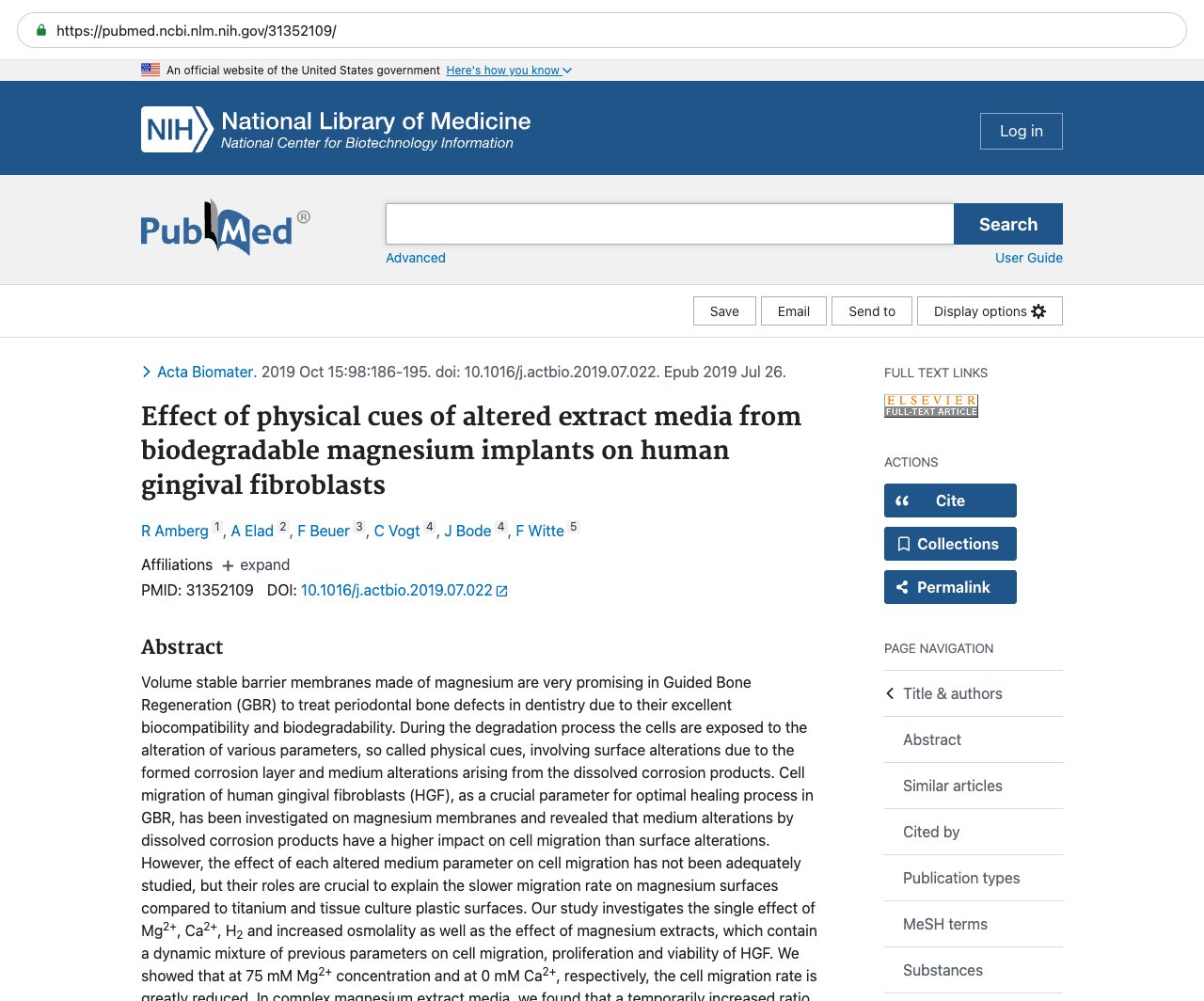
This page mirrors the published abstract (© the authors / publisher) for reference and citation. The canonical source is the PubMed record linked above. This is not medical advice.