2026 · Lei — Synergistic Stretching-Annealing and Salting-Out Enabling Ultrastrong, Ultratough Anisotropic Bacterial Cellulose Conductive Hydrogels for Bioelectric Sensors
Super-Abstract
This materials science study presents a manufacturing process (stretching + annealing + salting-out) for making bacterial cellulose-based hydrogels with extreme mechanical strength and electrical conductivity, intended for wearable bioelectric sensors (ECG, EMG). Molecular hydrogen is mentioned only as a descriptor of the chemical bonding interactions that the process improves — it is not a therapeutic agent in this study. (Carbohydrate Polymers, 2026.)
Commentary
This paper is a polymer chemistry and biomaterials engineering study. The researchers developed a process to make anisotropic (directional) hydrogels from bacterial cellulose (BC), polyvinyl alcohol (PVA), and a sulfonic acid monomer (AMPS), achieving exceptional mechanical properties: 45 MPa tensile strength, 838 % strain, and very high toughness. The phrase „molecular hydrogen“ in the abstract refers to hydrogen bonds — the weak inter-molecular forces that hold polymer chains together — not to H₂ gas therapy. This usage is a standard chemistry term, completely unrelated to hydrogen medicine. The study demonstrates that the hydrogel can record ECG and EMG signals as a wearable sensor. There is no H₂ therapy content in this paper.
Key quotes
- „This effective strategy improves molecular hydrogen and coordination interactions, enhances crystallinity, and induces the orientation of polymer chains and nanofibers along the stretching direction.“ — note: 'molecular hydrogen' here refers to hydrogen bonds in polymer chemistry — not H₂ gas therapy
- „the P10%B0.45%A10%/K-100 % hydrogel demonstrates ultrahigh mechanical strength of 45.32 MPa, high strain of 838 %, and ultrahigh toughness of 256.26 MJ/m3.“ — the mechanical performance achieved
- „the PBA/K-100 % hydrogel was successfully employed for the bioelectric signal monitoring of electrocardiograms (ECG) and electromyograms (EMG).“ — intended application: wearable biosensor for cardiac and muscle signals
Our assessment
This paper has no direct relevance to H₂ gas therapy or hydrogen medicine. The mention of „molecular hydrogen“ in the abstract refers to inter-molecular hydrogen bonding in polymer science — a routine chemistry term. The study is a strong piece of materials engineering about wearable biosensors. It is included here for completeness, but readers should be aware that no conclusions about H₂ therapeutic effects can be drawn from this paper.
Study design
- Type: materials science / in-vitro study · Model: hydrogel fabrication and characterization; ECG/EMG signal testing on human volunteers · H₂ relevance: none („molecular hydrogen” = hydrogen bonds in polymer chemistry)
- Result: hydrogel with 45.32 MPa strength, 838 % strain, 256.26 MJ/m³ toughness, 13.3 mS/cm conductivity; successful ECG and EMG signal recording as wearable sensor
Abstract
Developing high-performance hydrogels that simultaneously exhibit biocompatibility, exceptional strength, toughness, conductivity, and antibacterial properties is crucial for meeting the stringent demands of bioelectric signal monitoring. Herein, we present an integrated approach for designing anisotropic bacterial cellulose (BC) hydrogels (PBA/K-a%) involving stretching the as-prepared polyvinyl alcohol (PVA)-BC-2-acrylamido-2-methylpropanesulfonic acid (AMPS) hydrogels (PBA) to various elongation ratios (a%), followed by air-drying during annealing to align the polymer chains, and finally immersed in potassium citrate (K3Cit) solutions to enhance the polymeric interactions via a synergistic stretching-annealing and salting-out (SSAS) strategy. This effective strategy improves molecular hydrogen and coordination interactions, enhances crystallinity, and induces the orientation of polymer chains and nanofibers along the stretching direction, significantly increasing the mechanical robustness of the hydrogels. Notably, the P10%B0.45%A10%/K-100 % hydrogel demonstrates ultrahigh mechanical strength of 45.32 MPa, high strain of 838 %, and ultrahigh toughness of 256.26 MJ/m3, as well as good conductivity with 13.3 mS/cm. The cooperative incorporation of PAMPS and K3Cit endows the hydrogel with good antibacterial capacity, establishing it as a unique and effective wearable sensor. Furthermore, the PBA/K-100 % hydrogel was successfully employed for the bioelectric signal monitoring of electrocardiograms (ECG) and electromyograms (EMG), thus demonstrating its potential applications in human-machine interactions and bioelectronics.
Source & links
Screenshot of the PubMed page
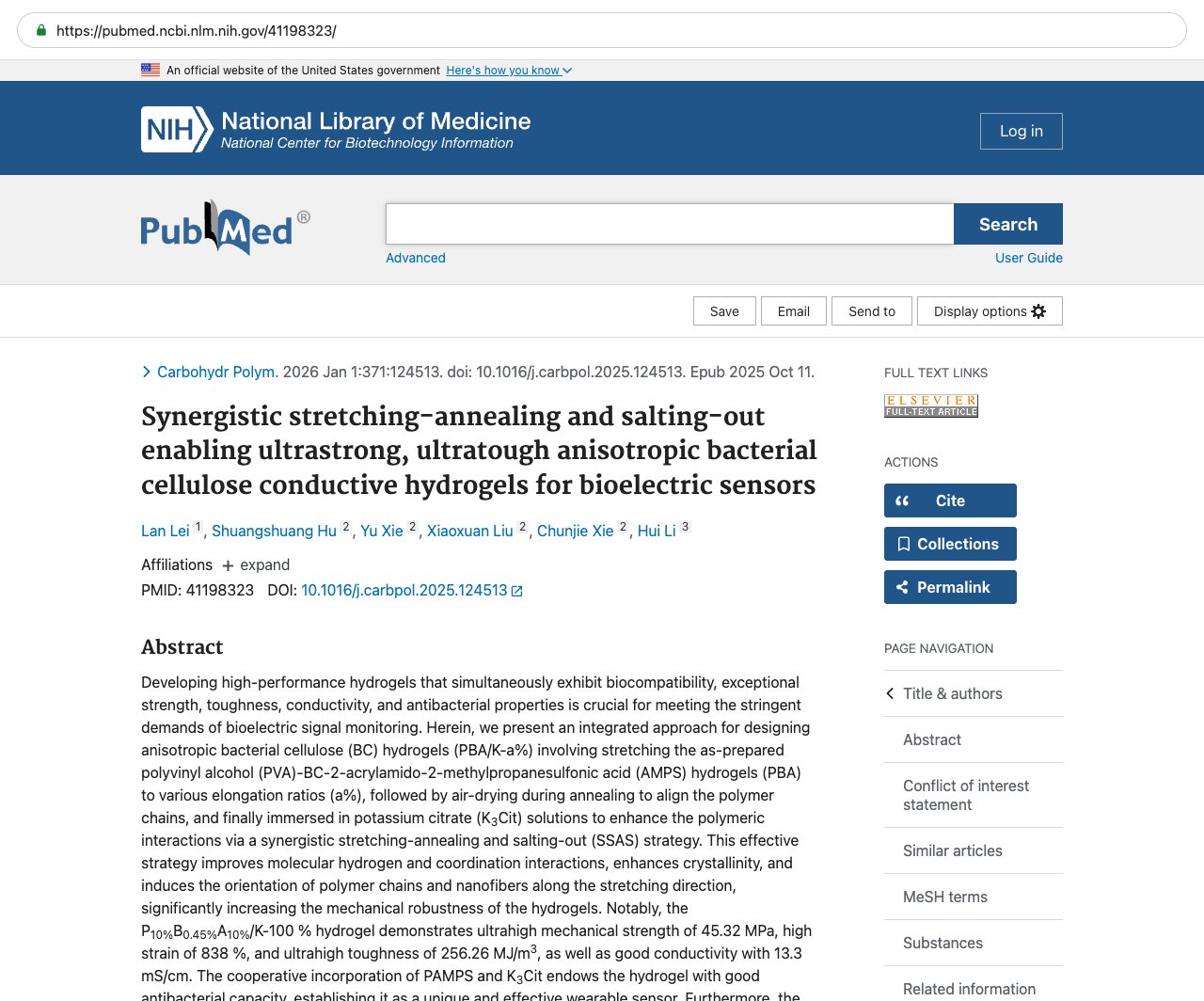
This page mirrors the published abstract (© the authors / publisher) for reference and citation. The canonical source is the PubMed record linked above. This is not medical advice.