2024 · Benoit — d-aspartate, an amino-acid important for human health, supports anaerobic respiration in several Campylobacter species.
Super-Abstract
Certain gut bacteria in the Campylobacter family can use d-aspartate — a signalling molecule important to the human nervous system — as a nutrient source for anaerobic growth, using molecular hydrogen as an electron donor. This in-vitro microbiology study identified the gene responsible and raises questions about whether these bacteria compete with the host for neurologically important molecules. (Research in Microbiology, 2024.)
Commentary
This microbiological study explores the anaerobic metabolism of Campylobacter species — bacteria associated with gastrointestinal infections. Several Campylobacter species can grow without oxygen by using molecular hydrogen (H₂) as an electron donor and various nitrogenous compounds as electron acceptors. The authors show that l-asparagine and l-aspartate enhance H₂-driven anaerobic growth in several species, while the d-enantiomers (d-Asn and d-Asp) specifically boost growth in two strains that carry a racD gene encoding a d/l-aspartate racemase. The significance is that d-aspartate is an important signalling molecule in the human nervous and neuroendocrine systems — if pathogenic bacteria scavenge this molecule, it could have health implications. However, this study is purely in-vitro (bacterial cultures) and does not examine health effects in humans or animals. The H₂ here is the bacteria's electron donor, not a therapeutic agent.
Key quotes
- „most Campylobacter species can grow anaerobically, using formate or molecular hydrogen (H2) as electron donors, and various nitrogenous and sulfurous compounds as electron acceptors.“ — H₂ here is a bacterial metabolic substrate, not a therapeutic agent
- „Disruption of racD in Cc13826 resulted in the inability of the mutant strain to use either d-enantiomer during anaerobic growth.“ — genetic proof that racD is required for d-Asp/d-Asn utilisation
- „d-Asp is an important signal molecule for both human nervous and neuroendocrine systems. To our knowledge, this is the first report of pathogens scavenging a d-amino acid essential for human health.“ — the broader health relevance: bacterial d-Asp scavenging may affect the host
Our assessment
This is an in-vitro microbiology study — all experiments were performed in bacterial cultures. Molecular hydrogen in this paper is a bacterial metabolic substrate, not a therapeutic agent. The study does not investigate H₂ therapy, H₂-rich water, or any H₂ health intervention. Its inclusion in the H₂ database reflects the broad categorisation of H₂-related research. The findings about pathogen scavenging of d-aspartate are scientifically novel, but no human or animal data are presented. No health recommendations can be derived from this study.
Study design
- Type: in-vitro microbiology study · Model: Campylobacter bacterial cultures (multiple species/strains) · H₂ role: electron donor for bacterial anaerobic respiration — not therapeutic H₂
- Result: racD gene identified as necessary for d-Asp/d-Asn-driven anaerobic growth in C. concisus and C. ureolyticus; first report of d-amino acid scavenging by gut pathogens — no in-vivo data
Abstract
Despite being classified as microaerophilic microorganisms, most Campylobacter species can grow anaerobically, using formate or molecular hydrogen (H2) as electron donors, and various nitrogenous and sulfurous compounds as electron acceptors. Herein, we showed that both l-asparagine (l-Asn) and l-aspartic acid (l-Asp) bolster H2-driven anaerobic growth in several Campylobacter species, whereas the d-enantiomer form of both asparagine (d-Asn) and aspartic acid (d-Asp) only increased anaerobic growth in Campylobacter concisus strain 13826 and Campylobacter ureolyticus strain NCTC10941. A gene annotated as racD encoding for a putative d/l-Asp racemase was identified in the genome of both strains. Disruption of racD in Cc13826 resulted in the inability of the mutant strain to use either d-enantiomer during anaerobic growth. Hence, our results suggest that the racD gene is required for campylobacters to use either d-Asp or d-Asn. The use of d-Asp by various human opportunistic bacterial pathogens, including C. concisus, C. ureolyticus, and also possibly select strains of Campylobacter gracilis, Campylobacter rectus and Campylobacter showae, is significant, because d-Asp is an important signal molecule for both human nervous and neuroendocrine systems. To our knowledge, this is the first report of pathogens scavenging a d-amino acid essential for human health.
Source & links
Screenshot of the PubMed page
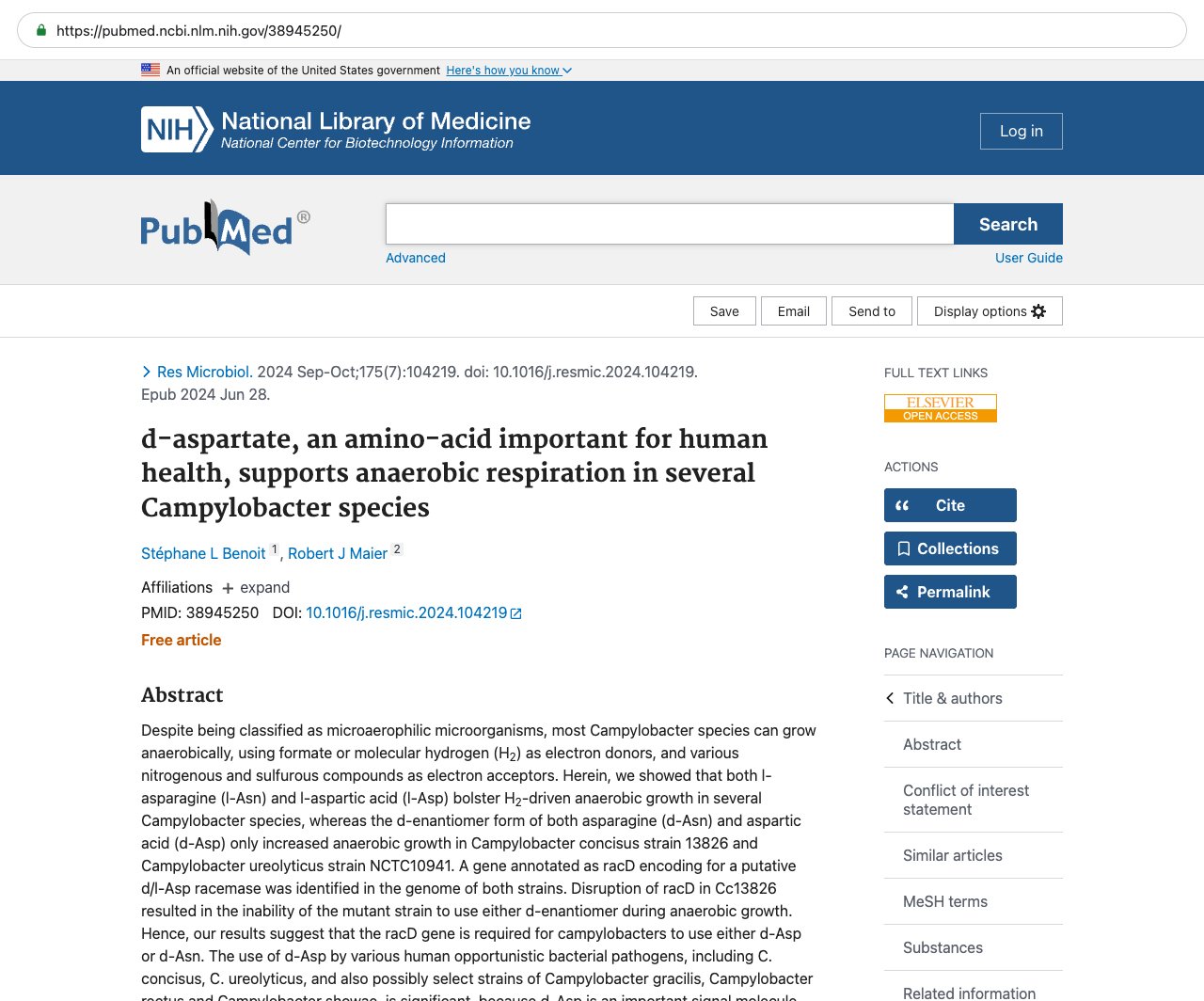
This page mirrors the published abstract (© the authors / publisher) for reference and citation. The canonical source is the PubMed record linked above. This is not medical advice.