2022 · Sebastiampillai et al. — Using a High-Throughput, Whole-Cell Hydrogenase Assay to Identify Potential Small Molecule Inhibitors of [NiFe]-Hydrogenase
Super-Abstract
This in-vitro study developed a high-throughput screening assay to identify small molecules that could inhibit [NiFe]-hydrogenase enzymes — which certain human pathogens such as E. coli and H. pylori use to metabolise molecular hydrogen for energy. Iodoquinol was identified as a potential candidate, though follow-up assays revealed confounding effects. This is a microbiology / antimicrobial resistance study, not a therapeutic hydrogen study. (Metallomics, 2022.)
Commentary
Hydrogenase enzymes allow bacteria like Helicobacter pylori and Escherichia coli to use molecular hydrogen as an energy source — giving them a metabolic advantage in the anaerobic environments of the gut. Blocking this pathway is an attractive antimicrobial strategy because the [NiFe]-hydrogenase nickel-insertion pathway is absent in human biochemistry, making it a selective target. This study builds a whole-cell high-throughput screening assay and tests a small-molecule library against it. While iodoquinol showed initial promise, immunoblot assays revealed growth-phase-dependent confounding effects, highlighting the challenge of cell-based assays. The study relates to hydrogen only in the sense that bacteria use H₂ — it is not about therapeutic H₂ for human health.
Key quotes
- „Hydrogenases provide an increased metabolic flexibility for pathogens, such as Escherichia coli and Helicobacter pylori, by allowing the use of molecular hydrogen as an energy source to promote survival in anaerobic environments.“ — the biological rationale for targeting hydrogenases in pathogens — H₂ as bacterial fuel, not human therapy
- „Inhibiting the nickel insertion pathway of [NiFe]-hydrogenases is attractive as this pathway is required for the generation of functional enzymes and is orthogonal to human biochemistry.“ — the therapeutic selectivity argument: this target does not exist in human cells
- „Further studies with immunoblot assays showed confounding effects dependent on the cell growth phase.“ — an honest null/partial result — iodoquinol's initial signal did not hold up under deeper investigation
Our assessment
This is an in-vitro microbiology study. It does not study therapeutic H₂ for humans — rather, it investigates how to block bacteria from using H₂ as fuel. The research is relevant to antimicrobial drug development. The lead compound (iodoquinol) showed confounding results, illustrating the difficulty of whole-cell screening assays. Honest limitation: No human or animal data; results apply only to bacterial cell cultures. This study should not be interpreted as evidence for or against H₂ therapy in humans.
Study design
- Type: in-vitro study (whole-cell high-throughput screening) · Model: Escherichia coli hydrogenase assay + small-molecule library · H₂ relevance: H₂ as bacterial substrate being blocked, not as therapeutic agent
- Result: iodoquinol identified as potential [NiFe]-hydrogenase nickel-pathway inhibitor in primary screening; confounding growth-phase-dependent effects observed in follow-up immunoblot assays — no confirmed inhibitor identified
Abstract
[NiFe]-hydrogenases are used by several human pathogens to catalyze the reversible conversion between molecular hydrogen and protons and electrons. Hydrogenases provide an increased metabolic flexibility for pathogens, such as Escherichia coli and Helicobacter pylori, by allowing the use of molecular hydrogen as an energy source to promote survival in anaerobic environments. With the rise of antimicrobial resistance and the desire for novel therapeutics, the [NiFe]-hydrogenases are alluring targets. Inhibiting the nickel insertion pathway of [NiFe]-hydrogenases is attractive as this pathway is required for the generation of functional enzymes and is orthogonal to human biochemistry. In this work, nickel availability for the production and function of E. coli [NiFe]-hydrogenase was explored through immunoblot and activity assays. Whole-cell hydrogenase activities were assayed in high throughput against a small molecule library of known bioactives. Iodoquinol was identified as a potential inhibitor of the nickel biosynthetic pathway of [NiFe]-hydrogenase through a two-step screening process, but further studies with immunoblot assays showed confounding effects dependent on the cell growth phase. This study highlights the significance of considering the growth phenotype for whole-cell based assays overall and its effects on various cellular processes influenced by metal trafficking and homeostasis.
Source & links
Screenshot of the PubMed page
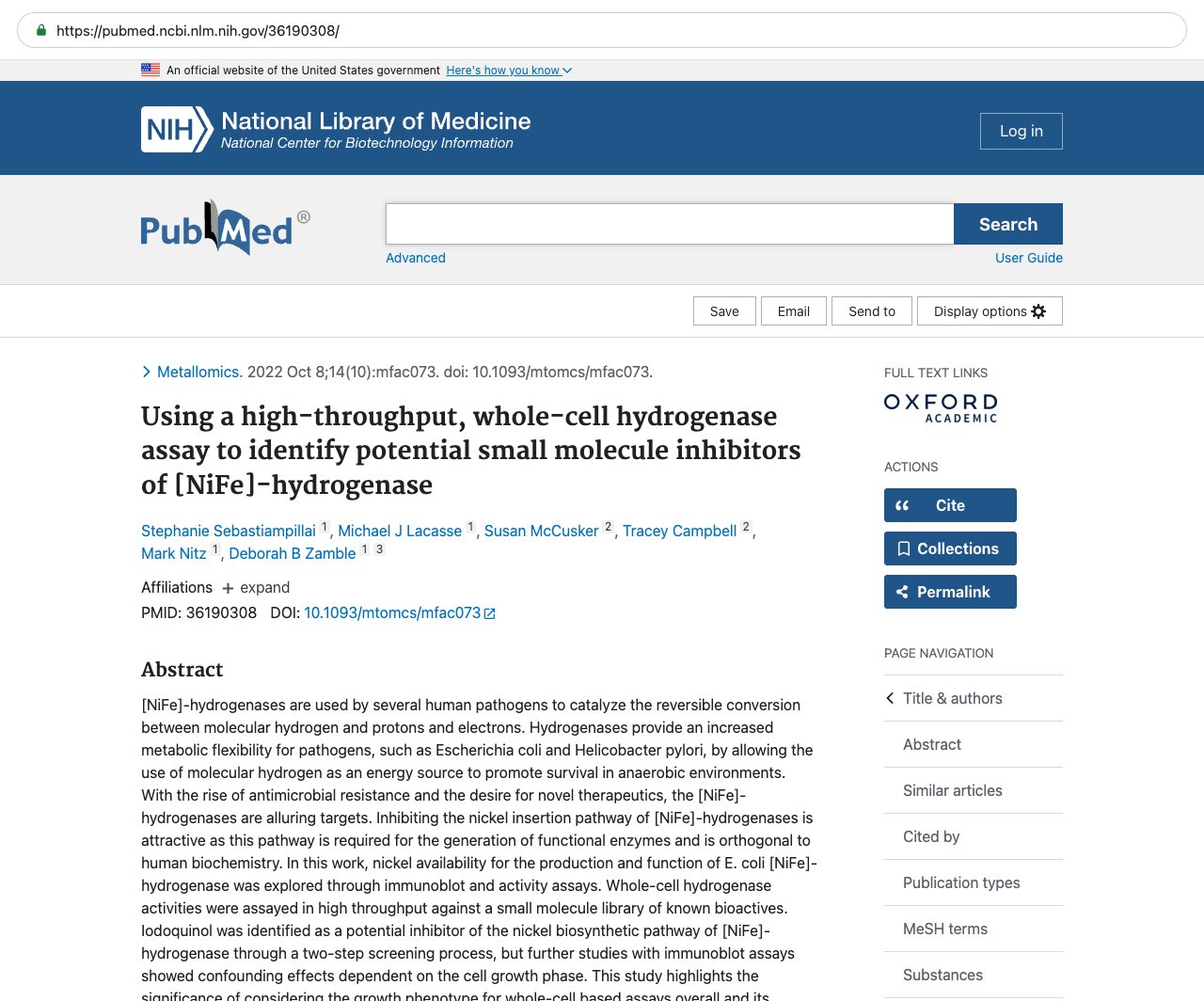
This page mirrors the published abstract (© the authors / publisher) for reference and citation. The canonical source is the PubMed record linked above. This is not medical advice.