2025 · Negishi — The Rieske Iron-sulfur Protein Is a Primary Target of Molecular Hydrogen
Super-Abstract
Molecular hydrogen is not merely a passive free-radical scavenger — it actively targets a specific mitochondrial protein called the Rieske iron-sulfur protein (RISP), a new finding that could help explain H₂'s wide-ranging and sometimes paradoxical biological effects. This in-vitro and mouse liver study demonstrates that H₂ suppresses the electron transport chain and triggers a mitochondrial stress response within minutes. (Redox Biology, 2025.)
Commentary
For years, the dominant explanation for H₂'s biological effects has been selective neutralisation of hydroxyl radicals — the most reactive ROS. This mechanistic narrative was convenient but left many observations unexplained, including why H₂ has effects at concentrations too low to scavenge significant amounts of radicals. Negishi et al. challenge this picture by identifying RISP, a key component of mitochondrial complex III, as a direct molecular target of H₂. When RISP is degraded after H₂ exposure, it triggers the mitochondrial unfolded protein response (UPRmt) — a stress adaptation pathway that may underlie many of H₂'s pleiotropic effects. This is cellular and mouse liver work; no human experiments were performed. The finding is significant because it proposes a mechanistically specific, evolutionarily grounded (hydrogenase connection) mode of action for H₂. If replicated, it could reshape how researchers understand and apply hydrogen biology.
Key quotes
- „We demonstrate that H2 is biologically active, specifically targeting the Rieske iron-sulfur protein (RISP).“ — the central new claim: H₂ has a direct molecular protein target
- „H2 suppressed electron transport chain complex III activity in mouse liver homogenates to 78.5 % within 2 min.“ — quantitative evidence of rapid mitochondrial action
- „Loss of RISP and subsequent UPRmt induction may explain the pleiotropic and paradoxical effects of H2.“ — mechanistic explanation for H₂'s diverse and sometimes counterintuitive effects
Our assessment
This is a mechanistically important in-vitro and animal (mouse liver) study — not a human clinical study. The identification of RISP as a primary H₂ target is a novel, testable hypothesis that, if replicated, would substantially advance understanding of hydrogen biology. The study is rigorous in its cell and tissue experiments. However, it does not demonstrate therapeutic benefit in any disease context, and the physiological consequences of RISP degradation require careful further investigation. This work is relevant to researchers; clinical implications remain to be determined.
Study design
- Type: in-vitro (cultured cells) and animal study (mouse liver) · Model: cultured cells + mouse liver homogenates and in vivo H₂ water administration · H₂ delivery: H₂ gas exposure (cells) and H₂-rich water (mouse liver in vivo)
- Result: H₂ induces mitochondrial unfolded protein response (UPRmt) in cells and mouse liver; complex III activity suppressed to 78.5% within 2 min; RISP degraded within 1 h via activation of mitochondrial Lon peptidase 1 (LONP1); RISP identified as primary direct molecular target of H₂
Abstract
The mechanisms underlying the biomedical effects of molecular hydrogen (H2) remain poorly understood and are often attributed to its selective reduction of hydroxyl radicals, based on the long-held notion that H2 is biologically inert. We demonstrate that H2 is biologically active, specifically targeting the Rieske iron-sulfur protein (RISP). We first observed that H2 induces the mitochondrial unfolded protein response (UPRmt) in cultured cells exposed to H2 and in mouse liver after H2 water administration. H2 suppressed electron transport chain complex III activity in mouse liver homogenates to 78.5 % within 2 min. Given the evolutionary link with hydrogenases, we examined RISP as a potential target of H2. We found that H2 promotes RISP degradation within 1 h in cultured cells by activating mitochondrial Lon peptidase 1 (LONP1). Loss of RISP and subsequent UPRmt induction may explain the pleiotropic and paradoxical effects of H2. These findings identify RISP as a primary target of H2, demonstrating that H2 is biologically active as a signaling molecule.
Source & links
Screenshot of the PubMed page
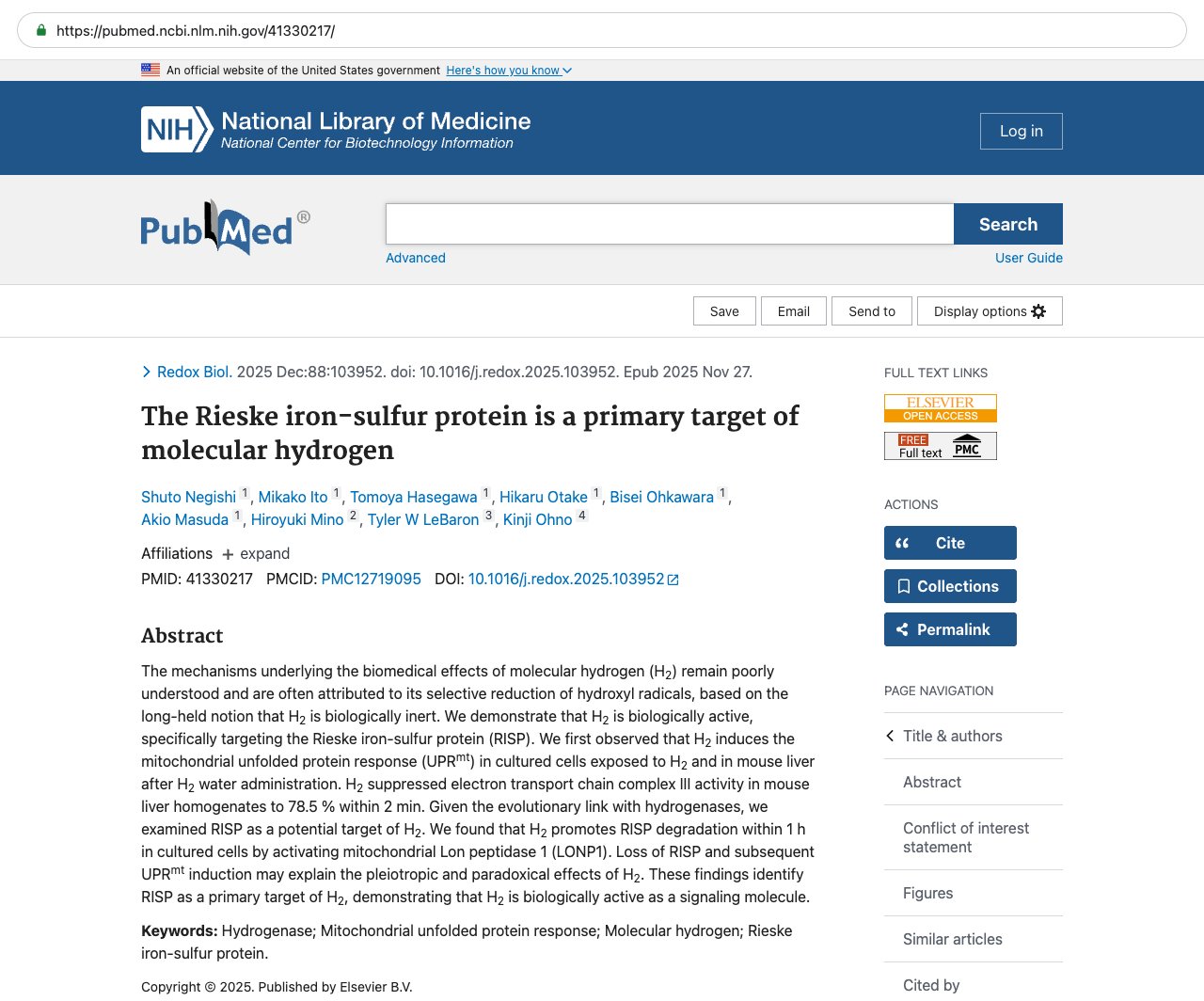
This page mirrors the published abstract (© the authors / publisher) for reference and citation. The canonical source is the PubMed record linked above. This is not medical advice.