2023 · Yang — Molecular Hydrogen Promotes Adipose-derived Stem Cell Myogenic Differentiation via Regulation of Mitochondria
Super-Abstract
In cell culture experiments, exposing fat-tissue-derived stem cells to molecular hydrogen significantly improved their survival and their ability to differentiate into muscle cells — an effect linked to improved mitochondrial function and reduced oxidative stress. This is an in-vitro study only; whether H₂ could improve stem cell therapy outcomes in living organisms or humans remains to be investigated.
Commentary
Adipose-derived stem cells (ADSCs) are an attractive candidate for muscle regeneration therapy because they are relatively easy to obtain and can differentiate into muscle cells. Their major limitation is poor survival in the oxidative, inflammatory environment found at injury sites post-transplantation. This study explores whether H₂ pre-treatment or co-treatment could improve ADSC performance by targeting mitochondria — the organelles most sensitive to oxidative stress. The results are encouraging in the cell culture setting: H₂ reduces mitochondrial ROS, increases mitochondrial number, promotes mitophagy (removal of damaged mitochondria), and enhances both cell survival and myogenic differentiation. The methods used (MTT assay, live-dead staining, western blot, confocal microscopy, transmission electron microscopy) are appropriate and give a multi-level view of the mitochondrial response. However, all findings are in-vitro, and translating stem cell + H₂ co-treatment to animal models and ultimately human therapy involves many steps not addressed here.
Key quotes
- „An appropriate volume fraction of H2 significantly decreased mitochondrial reactive oxygen species (ROS) levels, increased the number of mitochondria, and promoted mitophagy, thus enhancing the survival and myogenic differentiation of ADSCs.“ — the central in-vitro finding: H₂ improves stem cell mitochondrial health and differentiation capacity
- „This study reveals the application potential of H2 in skeletal muscle diseases or other pathologies related to mitochondrial dysfunction.“ — the authors' conclusion — framed as potential, not proven clinical benefit
- „it has a low survival rate and differentiation efficiency in the oxidative stress-rich microenvironment after transplantation“ — the problem H₂ is proposed to solve: ADSC vulnerability to oxidative injury post-transplantation
Our assessment
This is an in-vitro cell study using a human-derived stem cell line. Its findings — that H₂ improves mitochondrial function, reduces ROS, and enhances ADSC myogenic differentiation — are scientifically interesting and mechanistically plausible. However, no animal or human data exist for this specific approach, and no conclusions about clinical benefit can be drawn. The study contributes to the basic science foundation of potential H₂-assisted stem cell therapy for muscle disease, but considerable preclinical and clinical development would be needed before any therapeutic application.
Study design
- Type: in-vitro cell study · Model: human adipose-derived stem cells (ADSCs) in culture · H₂ delivery: H₂ gas at specified volume fractions (unspecified exact concentration/duration)
- Methods: MTT assay, live-dead cell staining, western blot, immunofluorescence, confocal imaging, transmission electron microscopy
- Result: H₂ decreased mitochondrial ROS; increased mitochondrial number; promoted mitophagy; enhanced ADSC survival and myogenic differentiation in oxidative stress conditions
Abstract
BACKGROUND: Acute skeletal muscle injuries are common physical or sports traumas. Cellular therapy has excellent potential for regeneration after skeletal muscle injury. Adipose-derived stem cells (ADSCs) are a more accessible type of stem cell. However, it has a low survival rate and differentiation efficiency in the oxidative stress-rich microenvironment after transplantation. Although molecular hydrogen (H2) possesses anti-inflammatory and antioxidant biological properties, its utility in mitochondrial and stem cell research has not been adequately explored. OBJECTIVE: This study aimed to reveal the role of H2 on adipose-derived stem cells' myogenic differentiation. METHODS: The protective effects of H2 in ADSCs were evaluated by MTT assay, live-dead cell staining, western blot analysis, immunofluorescence staining, confocal imaging, and transmission electron microscopy. RESULTS: An appropriate volume fraction of H2 significantly decreased mitochondrial reactive oxygen species (ROS) levels, increased the number of mitochondria, and promoted mitophagy, thus enhancing the survival and myogenic differentiation of ADSCs. CONCLUSION: This study reveals the application potential of H2 in skeletal muscle diseases or other pathologies related to mitochondrial dysfunction.
Source & links
Screenshot of the PubMed page
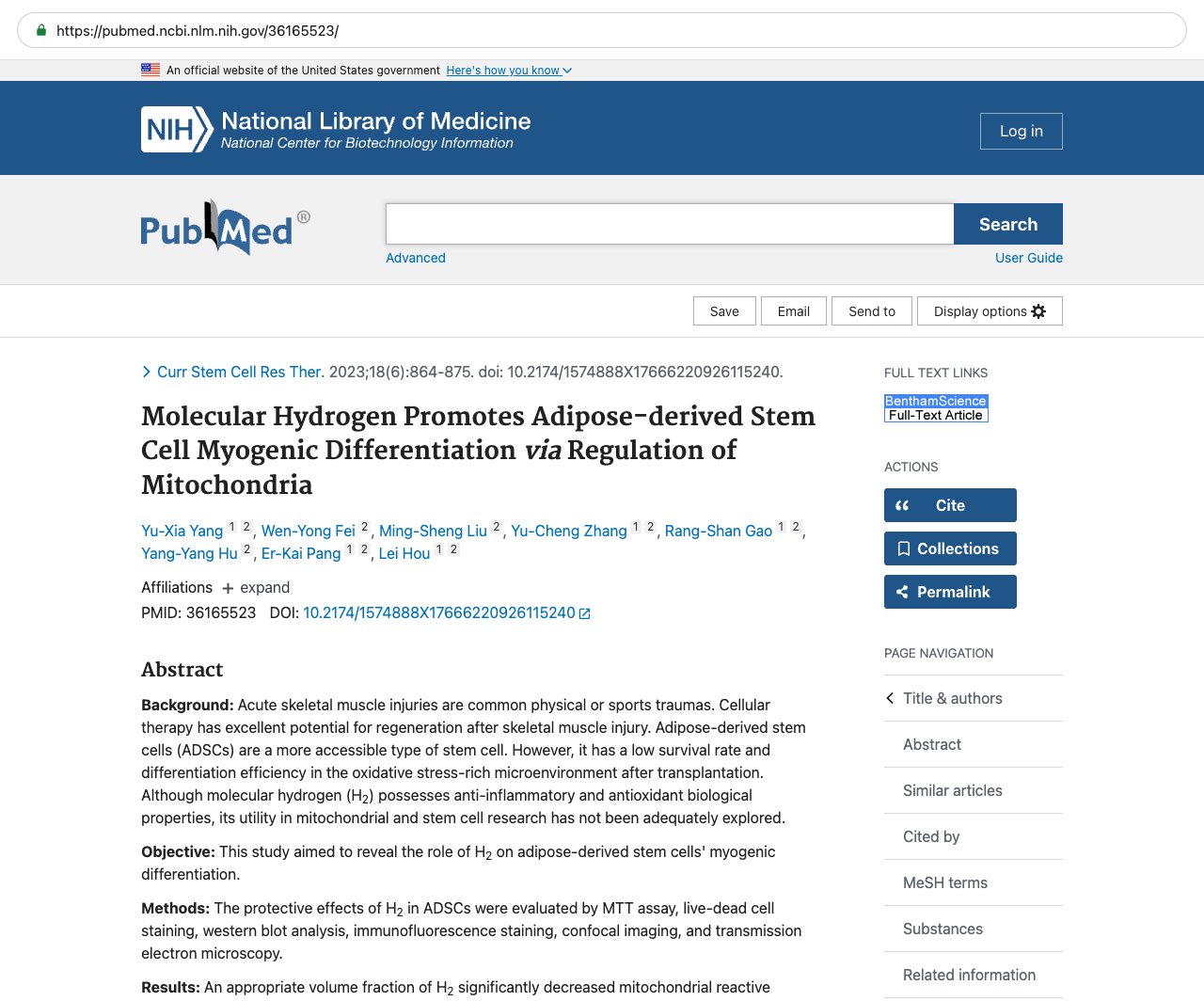
This page mirrors the published abstract (© the authors / publisher) for reference and citation. The canonical source is the PubMed record linked above. This is not medical advice.