2016 · An — Discovery of novel 2-phenyl-imidazo[1,2-a]pyridine analogues targeting tubulin polymerization as antiproliferative agents
Super-Abstract
This medicinal chemistry study reports the synthesis and cancer-cell testing of new imidazo-pyridine compounds that inhibit tubulin polymerization — an approach to blocking cancer cell division. The paper has no connection to molecular hydrogen (H₂) therapy; it concerns synthetic organic chemistry and cancer pharmacology. (European Journal of Medicinal Chemistry, 2016.)
Commentary
Tubulin polymerization inhibitors disrupt the formation of the mitotic spindle, preventing cancer cells from dividing. Colchicine and vinca alkaloids are classical examples. This paper reports the design and synthesis of a series of 2-aryl-imidazo-pyridine/pyrazine derivatives and their evaluation against HeLa cervical cancer cells for antiproliferative activity and tubulin polymerization inhibition. Compounds 1a, 3b, and 3d showed potent activity comparable to colchicine. The study is a standard medicinal chemistry discovery paper — relevant to oncology drug development but with no connection to hydrogen gas biology. The word „hydrogen” does not appear in relation to any therapeutic hydrogen application in this abstract; the study was indexed in this database due to general keyword overlap.
Key quotes
- „Several investigated compounds (1a, 3b and 3d) displayed potent antiproliferative activity against HeLa cell, and also displayed comparable tubulin polymerization inhibitory activity to colchicine.“ — the main pharmacological finding: three compounds with colchicine-comparable activity
- „These studies provided a new molecular scaffold for the further development of antitumor agents that target tubulin.“ — the authors' conclusion about the drug development value of the scaffold
- „A series of 2-aryl-imidazo-pyridines/pyrazines derivatives has been designed, synthesized and evaluated for their biological activities.“ — the scope of the study: synthesis and biological evaluation of a compound series
Our assessment
This paper is a medicinal chemistry / cancer pharmacology study with no relevance to molecular hydrogen (H₂) as a biological or therapeutic gas. It concerns synthetic tubulin polymerization inhibitors tested in cell culture. This paper provides no evidence relevant to H₂ health research. It appears in this database due to a keyword indexing overlap and is not relevant to hydrogen therapy.
Study design
- Type: in-vitro medicinal chemistry study · Model: HeLa cell line; tubulin polymerization assay · H₂ context: none — the paper concerns synthetic organic molecules, not H₂
- Result: compounds 1a, 3b, 3d showed potent antiproliferative activity against HeLa cells and tubulin polymerization inhibition comparable to colchicine; new scaffold identified for antitumor agent development
Abstract
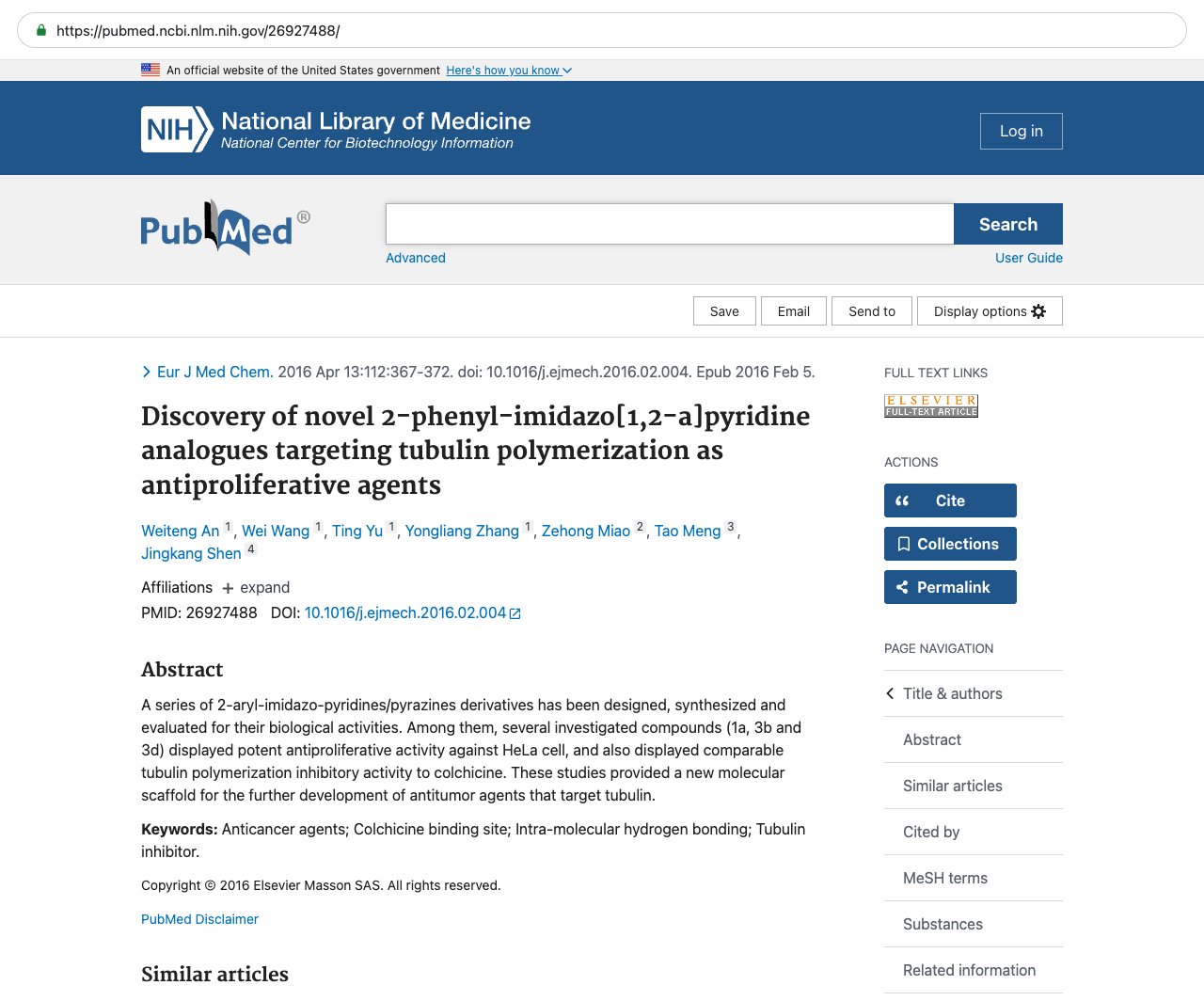
A series of 2-aryl-imidazo-pyridines/pyrazines derivatives has been designed, synthesized and evaluated for their biological activities. Among them, several investigated compounds (1a, 3b and 3d) displayed potent antiproliferative activity against HeLa cell, and also displayed comparable tubulin polymerization inhibitory activity to colchicine. These studies provided a new molecular scaffold for the further development of antitumor agents that target tubulin.
Source & links
Screenshot of the PubMed page
This page mirrors the published abstract (© the authors / publisher) for reference and citation. The canonical source is the PubMed record linked above. This is not medical advice.