2026 · Němec — The Far Side of Carboranes: Anticancer Active Monocations and Ambiently Stable Dications
Super-Abstract
Polyhedral carboranes — a class of boron-carbon cage molecules — are biologically stable and normally non-toxic; this in-vitro study shows that positively charged (cationic) carborane variants can display significant anticancer activity against human cancer cell lines, surpassing doxorubicin and cisplatin in potency. Molecular hydrogen (H₂) plays a peripheral chemical role here: its addition triggers a reversible cage-opening reaction in dicationic carboranes via a proton-coupled electron process. This is primarily a synthetic chemistry and cancer cell study, not a hydrogen therapy study. (Angewandte Chemie, 2026.)
Commentary
The connection to molecular hydrogen in this paper is chemical rather than therapeutic: H₂ participates in a reversible redox cage-opening of dicationic carboranes (alongside triethylamine), but is not the active anticancer agent. The anticancer activity was demonstrated for monocationic carborane o-2a in HeLa and other cancer cell lines with a favourable resistance factor (RF ≈ 1), suggesting lower cross-resistance compared to conventional platinum-based drugs. These are in-vitro results only; no animal or human data are presented. The paper is relevant to medicinal chemistry and the development of boron-based anticancer agents, but should not be cited as evidence for H₂ therapy in cancer.
Key quotes
- „The results demonstrated significant anticancer activity and a favorable resistance factor (RF ≈ 1) for monocationic carborane o-2a, surpassing the effects of doxorubicin and cisplatin.“ — the key in-vitro anticancer finding — cell study only, not human data
- „These water-stable dications exhibit a reversible closo-/nido- cage opening, triggered either by a strong base (DMAP) or by a combination of triethylamine and molecular hydrogen.“ — H₂ as a chemical reactant in cage-opening, not as a therapeutic agent
- „the latter involves a H2/2H+ conversion in a proton-coupled electron process.“ — the electrochemical role of H₂ in the carborane cage reaction
Our assessment
This is an in-vitro synthetic chemistry and cancer cell study. Molecular hydrogen is used as a chemical reactant in a novel cage-opening reaction — it is not studied as a therapeutic agent. The anticancer activity reported is for cationic carborane compounds in cell culture, not in animals or humans. No conclusions about H₂ cancer therapy can be drawn from this work. Its relevance to H₂ medicine is marginal and chemical in nature.
Study design
- Type: in-vitro synthetic chemistry study · Model: panel of human cancer cell lines (HeLa and others) · H₂ use: chemical reactant in carborane cage-opening (not therapeutic)
- Key finding: monocationic carborane o-2a shows anticancer activity surpassing doxorubicin and cisplatin in cell lines; RF ≈ 1 (low cross-resistance); H₂ enables reversible cage-opening in dications
- Limitation: in-vitro only; no animal or human data; H₂ is not the anticancer agent
Abstract
Polyhedral carboranes are highly biologically stable, non-toxic clusters. Whereas they are typically encountered in anionic or neutral forms, positively charged species have only recently been discovered. The in vitro antiproliferative effects of selected carboranes were assessed using a panel of human cancer cell lines, and off-target toxicity was evaluated at normal cell lines. The results demonstrated significant anticancer activity and a favorable resistance factor (RF ≈ 1) for monocationic carborane o-2a, surpassing the effects of doxorubicin and cisplatin. In pursuit of even more efficient substrates, the first dicationic polyhedral boranes were synthesized. These water-stable dications exhibit a reversible closo-/nido- cage opening, triggered either by a strong base (DMAP) or by a combination of triethylamine and molecular hydrogen, and reversed upon the addition of acid. The former transformation proceeds without a redox change, while the latter involves a H2/2H+ conversion in a proton-coupled electron process.
Source & links
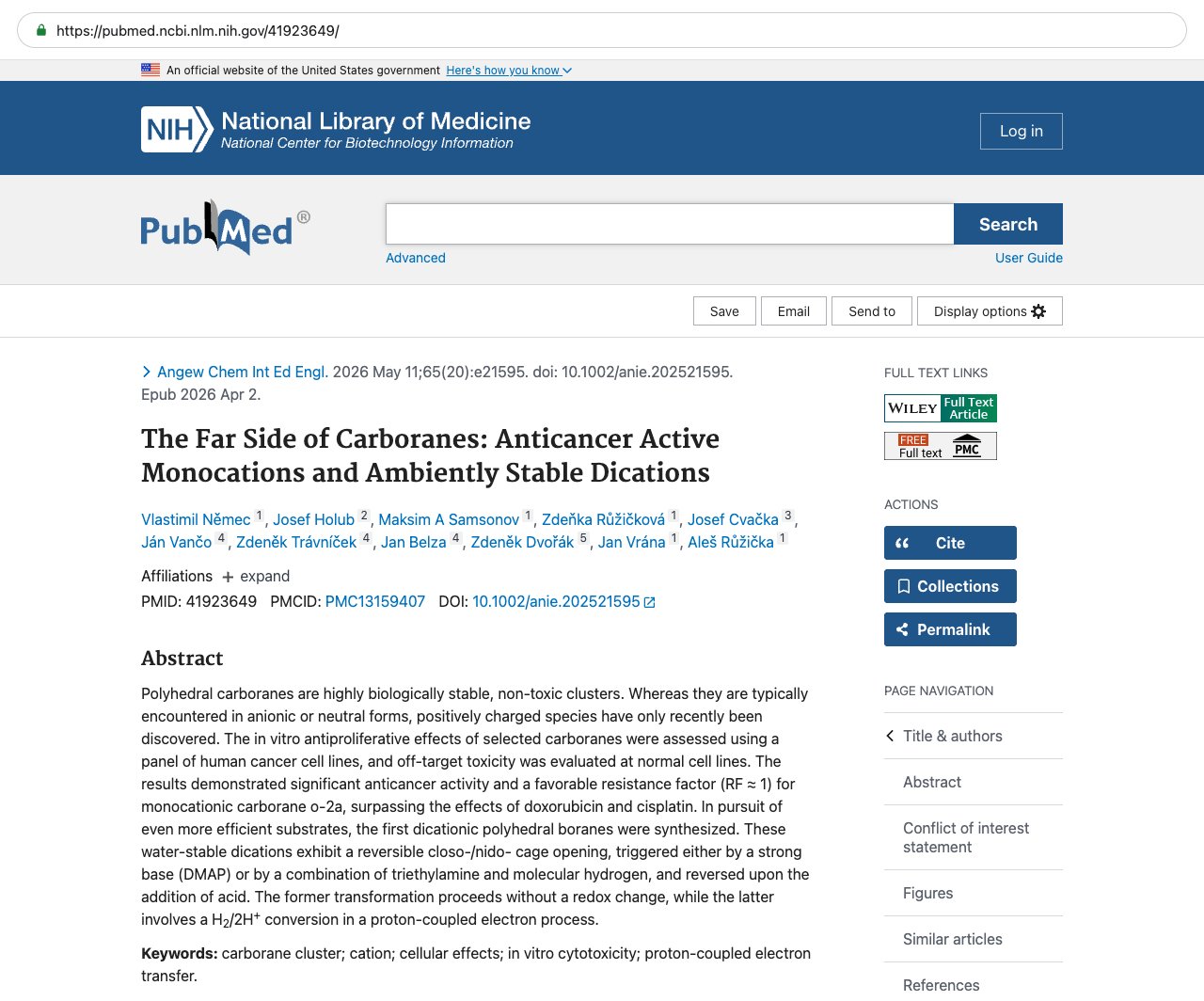
Screenshot of the PubMed page
This page mirrors the published abstract (© the authors / publisher) for reference and citation. The canonical source is the PubMed record linked above. This is not medical advice.