2025 · Zhang — Ternary Schottky Junction for Sonocatalytic Water Splitting in Gas-Immunotherapy-Mediated Cancer Treatment.
Super-Abstract
A specially designed nanoparticle catalyst (BPM) splits water inside tumours using ultrasound, generating both hydrogen and oxygen in situ. In animal experiments, this local H₂ and O₂ production disrupted cancer-cell energy metabolism, amplified immune responses, and combined effectively with immune checkpoint blockade to suppress both the treated tumour and distant metastases. (Advanced Science, 2025.)
Commentary
This is a preclinical animal study in the area of nano-oncology. The BPM sonocatalyst (bismuth fluoride, polyoxometalates, molybdenum carbide mesocrystal) exploits the Schottky junction effect to drive efficient water splitting under ultrasound — producing H₂ and O₂ simultaneously within the tumour microenvironment. H₂ is proposed to interfere with mitochondrial function in cancer cells by depleting ATP, while the concurrently generated O₂ alleviates hypoxia. The glutathione-depleting capability adds oxidative-stress pressure on tumours. The combination with immune checkpoint blockade (anti-PD-L1) triggering systemic immune responses against distant tumours (abscopal effect) is a promising but still early-stage concept. All efficacy data are from mouse models only.
Key quotes
- „Hydrogen disrupts the mitochondrial function of cancer cells, interferes with their energy metabolism, and ultimately leads to energy depletion and apoptosis.“ — proposed anti-cancer mechanism of H₂ in this model
- „BPM enhances antitumor immune responses by promoting dendritic cell maturation, activating T lymphocytes, and polarizing macrophages toward the M1 phenotype, reversing the immunosuppressive state of the tumor microenvironment.“ — immune-activation effects observed in the study
- „BPM holds potential for gas-immunotherapy combination treatments, offering a multifunctional strategy to improve cancer therapy outcomes.“ — authors' conclusion on clinical potential
Our assessment
This is a preclinical animal study; results from mouse tumour models cannot be directly transferred to humans. The sonocatalytic gas-immunotherapy concept is novel and mechanistically ambitious, combining H₂ therapy, reactive-oxygen-species manipulation, immune activation, and checkpoint blockade in a single platform. However, translational barriers are substantial: nanoparticle safety, biodistribution, ultrasound accessibility of deep tumours, and immune-related toxicity all require extensive further study. No human data exist for this approach.
Study design
- Type: preclinical animal study · Model: mouse subcutaneous and bilateral tumour models · H₂ delivery: sonocatalytic in-situ water splitting by BPM nanoparticles under ultrasound irradiation
- Endpoints: tumour volume, ATP levels, mitochondrial membrane potential, dendritic cell maturation, T-lymphocyte activation, macrophage M1 polarisation, glutathione depletion · Result: significant primary and distant tumour suppression; enhanced systemic immune response; synergy with anti-PD-L1 checkpoint blockade
Abstract
Hydrogen therapy has shown new potential in cancer treatment, particularly in high-pressure and hypoxic areas, where it demonstrates the ability to alter the tumor microenvironment and regulate tumor metabolism. Hydrogen disrupts the mitochondrial function of cancer cells, interferes with their energy metabolism, and ultimately leads to energy depletion and apoptosis. In this study, a sonocatalyst (BPM), is designed to generate hydrogen and oxygen in situ within tumors, further enhancing the therapeutic efficacy. The mesocrystalline structure of BPM, composed of bismuth fluoride, polyoxometalates, and molybdenum carbide, significantly improves charge separation and electron transfer efficiency under ultrasound irradiation, resulting in an efficient water-splitting reaction. By simultaneously generating hydrogen and oxygen within the tumor microenvironment and depleting glutathione, BPM effectively triggers oxidative stress and alleviates hypoxia, thereby disrupting mitochondrial function and inhibiting energy metabolism in cancer cells. Additionally, BPM enhances antitumor immune responses by promoting dendritic cell maturation, activating T lymphocytes, and polarizing macrophages toward the M1 phenotype, reversing the immunosuppressive state of the tumor microenvironment. The results indicate that BPM holds potential for gas-immunotherapy combination treatments, offering a multifunctional strategy to improve cancer therapy outcomes.
Source & links
Screenshot of the PubMed page
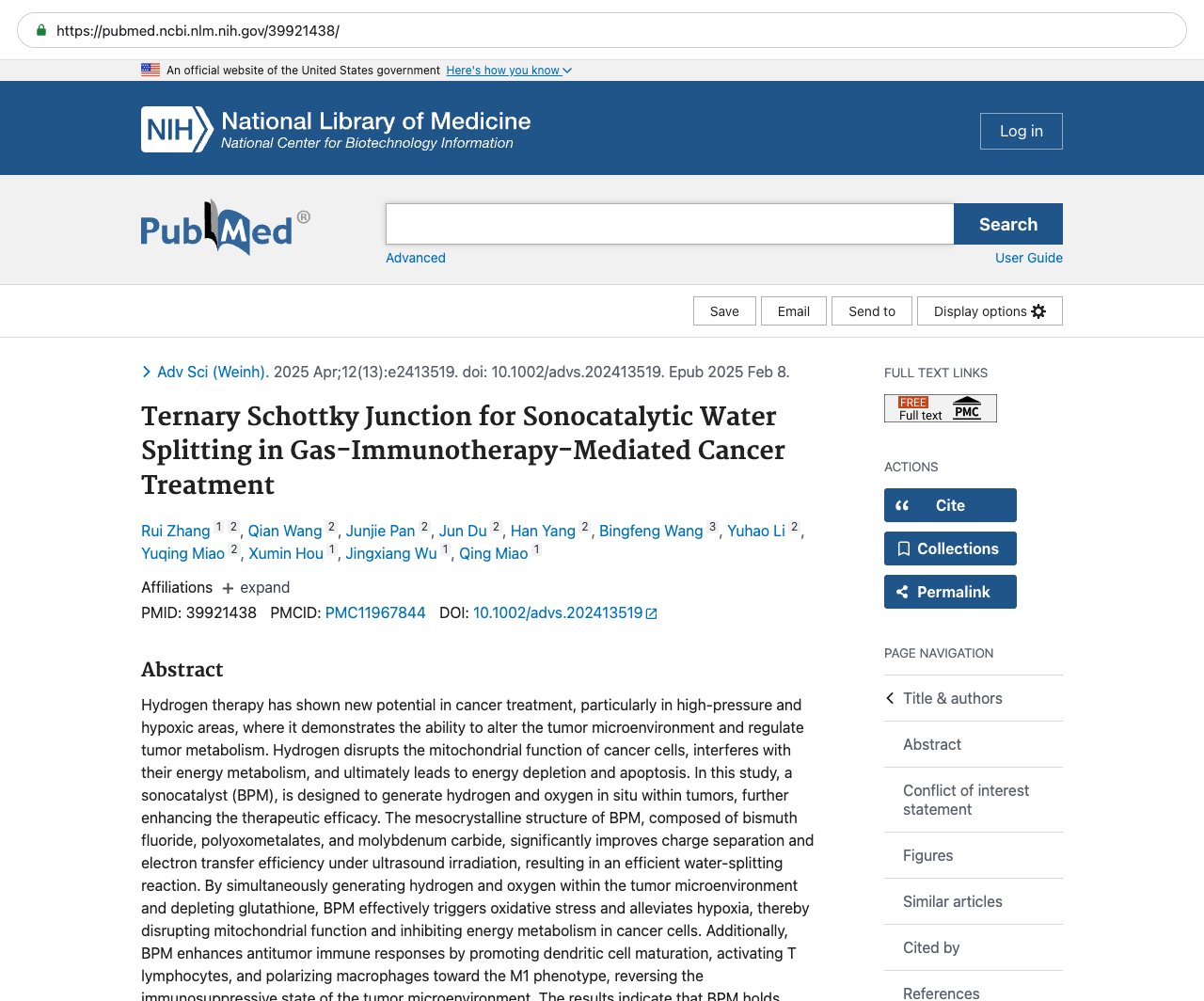
This page mirrors the published abstract (© the authors / publisher) for reference and citation. The canonical source is the PubMed record linked above. This is not medical advice.