2026 · Zhang — Sub-nano Molybdenum Oxide Nanorings as Amplified Atomic Efficiency Sonosensitizers for Highly Efficient Sonodynamic Tumor Ablation
Super-Abstract
Sub-nanometer molybdenum oxide nanorings (MoOx-S NRs) were designed as a dual-function nanosystem that generates both reactive oxygen species and hydrogen gas under ultrasound stimulation, aiming to kill cancer cells and modulate the tumor microenvironment. In cell culture and early laboratory experiments, the system produced cytotoxic singlet oxygen and superoxide radicals while hydrogen penetrated cell nuclei to reduce tumor-related inflammation. This is an in-vitro material-science study; no human evidence is presented. (Nanoscale, 2026.)
Commentary
This paper sits at the frontier of nanomedicine, combining sonosensitizer chemistry (ultrasound-activated reactive oxygen species generation) with hydrogen gas therapy. The key structural feature of MoOx-S NRs is their sub-nanometer architecture, which creates unsaturated coordination sites and high surface energy — properties that optimize catalytic efficiency under ultrasound. The study invokes „Russell-type catalytic therapy“ (singlet oxygen generation via radical combination) as the mechanism under hypoxic tumor conditions, arguing the nanoring geometry outperforms conventional MoOx nanoparticles in ROS yield. H₂ generated during ultrasound exposure is proposed to complement ROS-mediated cytotoxicity by regulating the tumor immune microenvironment and reducing inflammatory signalling. All data are from cell-culture and materials characterization experiments; the paper does not include animal tumor models.
Key quotes
- „The unique sub-nanometer structure provides unsaturated coordination sites and sulfur groups, while its high surface energy generates delocalized electrons, thereby optimizing the activation energy and enhancing the tumor Russell-type catalytic therapy mediated by singlet oxygen under hypoxic conditions.“ — structural rationale for enhanced catalytic activity
- „Under ultrasound action, the MoOx-S NRs produce cytotoxic singlet oxygen and superoxide radicals, damage cancer cells and inhibit tumor growth.“ — primary cytotoxic mechanism: ROS generation under ultrasound
- „the released hydrogen further penetrates the cell nucleus, regulating the tumor microenvironment and disrupting the inflammatory pathways to alleviate tumor-related inflammation.“ — proposed complementary role of H₂: anti-inflammatory via nuclear-level action
Our assessment
A materials-science, in-vitro study with no animal or human data. The catalytic chemistry is innovative and the combination of sonodynamic and hydrogen therapy is conceptually interesting. However, all results are from cell culture; the claim that hydrogen „penetrates the cell nucleus“ is a mechanistic proposal, not a directly measured outcome in this study. Sub-nanometer nanomaterial fabrication also raises translational challenges around batch reproducibility, biodegradation, and systemic toxicity that are not addressed here. This is not human evidence for any H₂-based cancer treatment.
Study design
- Type: in-vitro study · Model: cancer cell cultures under ultrasound stimulation · H₂ delivery: ultrasound-triggered generation from MoOx-S NRs (sub-nanometer molybdenum oxide nanorings)
- Result: increased ROS (singlet oxygen, superoxide) and H₂ generation vs. conventional MoOx NPs; cancer cell damage and growth inhibition in culture; proposed anti-inflammatory tumor microenvironment modulation by H₂
Abstract
Sub-nanometer structured molybdenum oxide nanorings (MoOx-S NRs) are designed as a dual-functional nano-sensitizer and single-atom nano-enzyme, used for ultrasound-enhanced hydrogen therapy. The unique sub-nanometer structure provides unsaturated coordination sites and sulfur groups, while its high surface energy generates delocalized electrons, thereby optimizing the activation energy and enhancing the tumor Russell-type catalytic therapy mediated by singlet oxygen under hypoxic conditions. Compared with traditional MoOx NPs, the MoOx-S NRs significantly increase the generation of reactive oxygen species and hydrogen triggered by ultrasound. Under ultrasound action, the MoOx-S NRs produce cytotoxic singlet oxygen and superoxide radicals, damage cancer cells and inhibit tumor growth. Moreover, the released hydrogen further penetrates the cell nucleus, regulating the tumor microenvironment and disrupting the inflammatory pathways to alleviate tumor-related inflammation. This work demonstrates an efficient strategy for using sub-nanometer MoOx-S NRs combined with the Russell-type catalytic and hydrogen therapy, providing a new perspective for cancer nanomedicine.
Source & links
Screenshot of the PubMed page
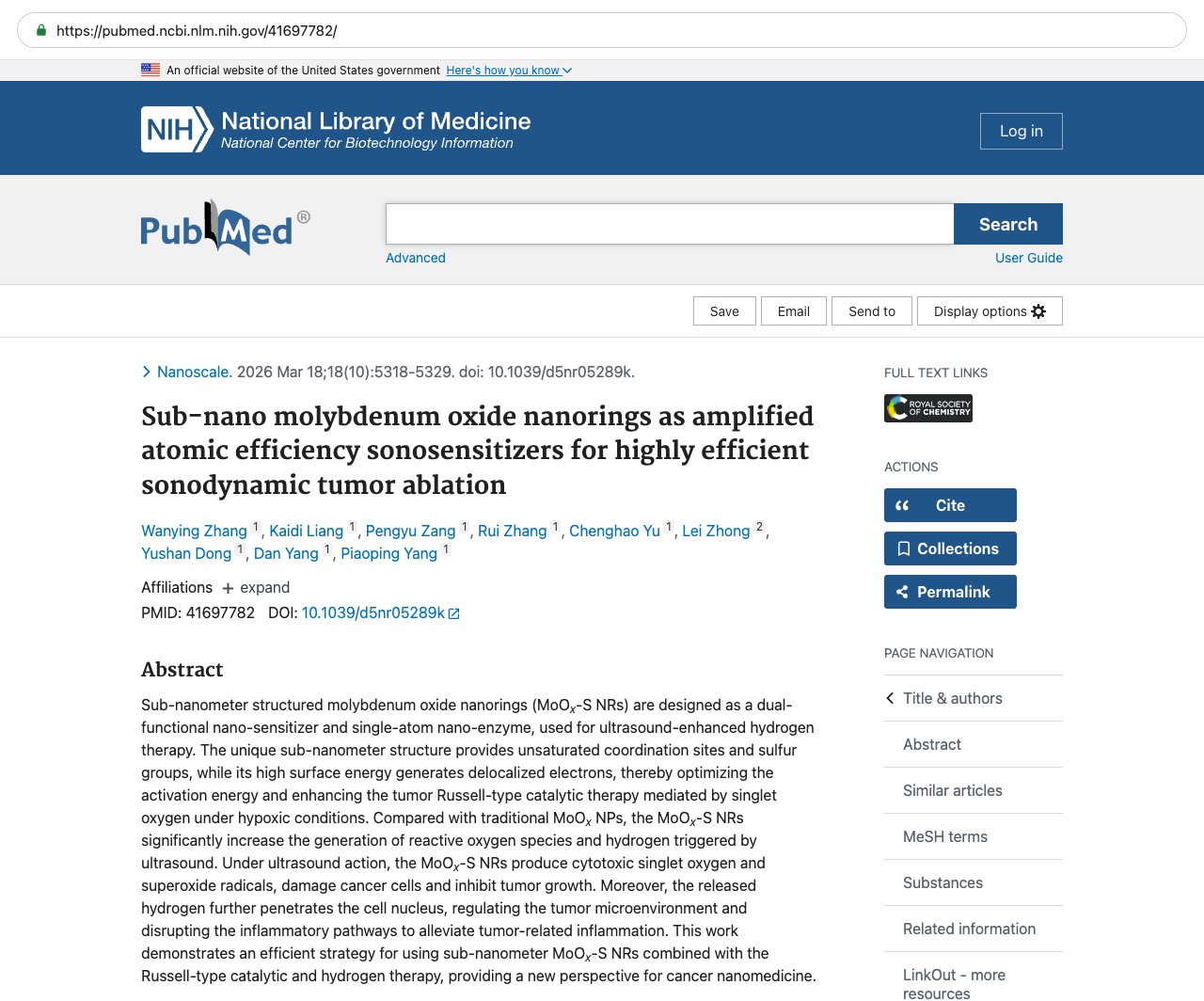
This page mirrors the published abstract (© the authors / publisher) for reference and citation. The canonical source is the PubMed record linked above. This is not medical advice.