2025 · Jiang — Engineering probiotic biohydrogen micro-factories to initiate reductive stress for boosting tumor vulnerability.
Super-Abstract
Probiotic bacteria (Enterobacter aerogenes) engineered into gel-based microcapsules produced continuous hydrogen inside tumours, inducing a state of „reductive stress“ — the opposite of oxidative stress — that disrupted cancer-cell metabolism and suppressed tumour growth. In mouse models of breast, melanoma, and liver cancer, the hydrogen-producing microcapsules also enhanced the effect of chemotherapy and reduced lung metastasis. (Biomaterials, 2025.)
Commentary
This is a preclinical animal study. The concept of „reductive stress“ as a cancer therapy mechanism is relatively novel compared to the more established oxidative-stress approach. H₂ is a strong enough antioxidant to push cancer cells into an over-reduced state — characterised by an elevated GSH/GSSG ratio — that disrupts normal metabolic and signalling functions, triggers cell-cycle arrest, and promotes apoptosis via PI3K-AKT suppression and MAPK activation. The probiotic bacterial microcapsule platform provides sustained in-situ H₂ without systemic exposure. Effectiveness was shown across multiple tumour types including drug-resistant cell lines, which is scientifically notable. Key unknowns remain: immune responses to encapsulated bacteria, long-term biosafety of E. aerogenes in immunocompromised patients, and reductive stress selectivity for cancer vs. normal cells in vivo.
Key quotes
- „The prolonged H2 release from PBMCs induced reductive stress, as evidenced by a significant increase in the GSH/GSSG ratio in 4T1 cells.“ — direct evidence of reductive stress induced by sustained H₂ release
- „PBMCs effectively suppressed the proliferation of eight tumor cell lines as well as drug-resistant cancer cells.“ — breadth of anti-tumour activity — including drug-resistant cancer cells
- „Our study introduces an innovative strategy to manipulate reductive stress in the tumor microenvironment through in situ H2 generation, thereby enhancing tumor vulnerability.“ — authors' framing of the novel reductive-stress paradigm
Our assessment
This is a preclinical animal study — results cannot be directly transferred to humans. The reductive-stress concept is novel and mechanistically well-supported by this data. Showing efficacy across eight tumour cell lines and three animal tumour models (breast, melanoma, liver) is a meaningful breadth of evidence for a single preclinical study. However, translational barriers are real: bacterial safety in cancer patients (who are often immunocompromised), long-term fate of microcapsules, and the question of whether reductive stress from H₂ is sufficiently selective for cancer vs. normal cells in vivo remain unresolved. No human data exist.
Study design
- Type: preclinical animal study · Models: mouse breast, melanoma, and liver cancer models; drug-resistant cell lines in vitro · H₂ delivery: gel-based microcapsules (PBMCs) encapsulating Enterobacter aerogenes — sustained biohydrogen production in tumour
- Endpoints: tumour growth inhibition, GSH/GSSG ratio (reductive stress), PI3K-AKT and MAPK pathway markers, apoptosis, cell-cycle arrest, pulmonary metastasis, synergy with chemotherapy · Result: significant anti-tumour effect in all models; reductive stress confirmed; synergistic inhibition of preinvasive carcinoma growth and lung metastasis
Abstract
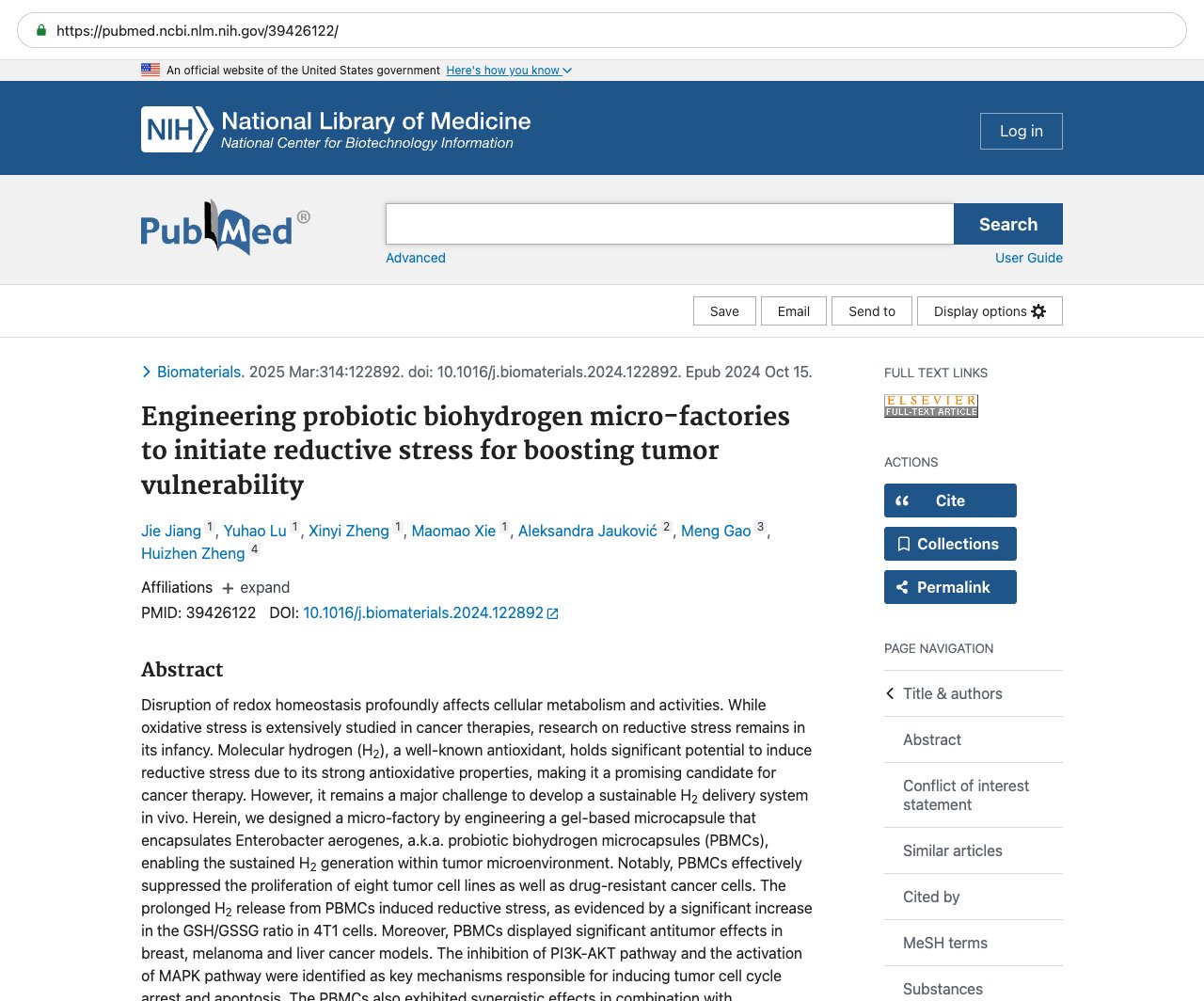
Disruption of redox homeostasis profoundly affects cellular metabolism and activities. While oxidative stress is extensively studied in cancer therapies, research on reductive stress remains in its infancy. Molecular hydrogen (H2), a well-known antioxidant, holds significant potential to induce reductive stress due to its strong antioxidative properties, making it a promising candidate for cancer therapy. However, it remains a major challenge to develop a sustainable H2 delivery system in vivo. Herein, we designed a micro-factory by engineering a gel-based microcapsule that encapsulates Enterobacter aerogenes, a.k.a. probiotic biohydrogen microcapsules (PBMCs), enabling the sustained H2 generation within tumor microenvironment. Notably, PBMCs effectively suppressed the proliferation of eight tumor cell lines as well as drug-resistant cancer cells. The prolonged H2 release from PBMCs induced reductive stress, as evidenced by a significant increase in the GSH/GSSG ratio in 4T1 cells. Moreover, PBMCs displayed significant antitumor effects in breast, melanoma and liver cancer models. The inhibition of PI3K-AKT pathway and the activation of MAPK pathway were identified as key mechanisms responsible for inducing tumor cell cycle arrest and apoptosis. The PBMCs also exhibited synergistic effects in combination with chemotherapeutics, resulting in robust inhibitions of preinvasive carcinoma growth and commonly associated pulmonary metastasis. Overall, our study introduces an innovative strategy to manipulate reductive stress in the tumor microenvironment through in situ H2 generation, thereby enhancing tumor vulnerability.
Source & links
Screenshot of the PubMed page
This page mirrors the published abstract (© the authors / publisher) for reference and citation. The canonical source is the PubMed record linked above. This is not medical advice.