2026 · Bordoni — Ru-Based NSAIDs as Potential Anticancer Therapeutics
Super-Abstract
Combining anti-inflammatory drugs (NSAIDs) with ruthenium metal centres creates novel compounds with promising anticancer activity in cell culture — and molecular hydrogen (H₂) is produced as a byproduct during synthesis, not as a therapeutic agent. Among five tested ruthenium-NSAID complexes, the salicylic acid variant showed antiproliferative activity against HeLa cancer cells. This is an in-vitro synthetic chemistry study with no direct relevance to H₂ therapy. (Molecules, 2026.)
Commentary
The connection to molecular hydrogen in this paper is purely synthetic-chemical: H₂ is released as a leaving group during the preparation of ruthenium-NSAID complexes from the ruthenium hydride precursor [Ru(H)₂(CO)(PPh₃)₃]. H₂ is not the active ingredient and is not studied as a therapeutic agent. The biological interest lies in the ruthenium-NSAID complexes themselves, which build on the established precedent of organoruthenium(II) compounds as anticancer metallotherapeutics. The preliminary results (HeLa antiproliferation for the salicylic acid complex) are in-vitro only. No animal or human data are presented. This paper should not be cited as evidence for molecular hydrogen therapy in cancer.
Key quotes
- „five well-known non-steroidal anti-inflammatory drugs (NSAIDs) were employed to substitute both PPh3 and hydride ligands in [Ru(H)2(CO)(PPh3)3] (1), thereby selectively affording neutral κ2-(O,O)-chelate complexes in satisfactory yields via molecular hydrogen release.“ — H₂ is a synthesis byproduct, not the active compound
- „The former showed promising antiproliferative activity against HeLa cancer cells, consistent with the well-established role of NSAID-ruthenium(II) complexes as a platform for the development of novel anticancer metallotherapeutics.“ — the preliminary in-vitro anticancer finding — for the ruthenium compound, not H₂
Our assessment
This is an in-vitro synthetic chemistry and cancer cell study. Molecular hydrogen appears as a synthesis byproduct — it is not investigated as a therapeutic agent. No conclusions about H₂ cancer therapy can be drawn. The paper's relevance to H₂ medicine is incidental; its scientific contribution concerns ruthenium-NSAID metallotherapeutics.
Study design
- Type: in-vitro synthetic chemistry study · Model: HeLa cancer cells + normal cell lines · H₂ use: released as synthesis byproduct from ruthenium hydride precursor (not therapeutic)
- Compounds tested: 5 Ru-NSAID chelate complexes (diclofenac, aspirin, salicylic acid, ibuprofen, others); 2 characterised by X-ray crystallography
- Key finding: Ru-salicylic acid complex shows HeLa antiproliferative activity; H₂ is not the anticancer agent
Abstract
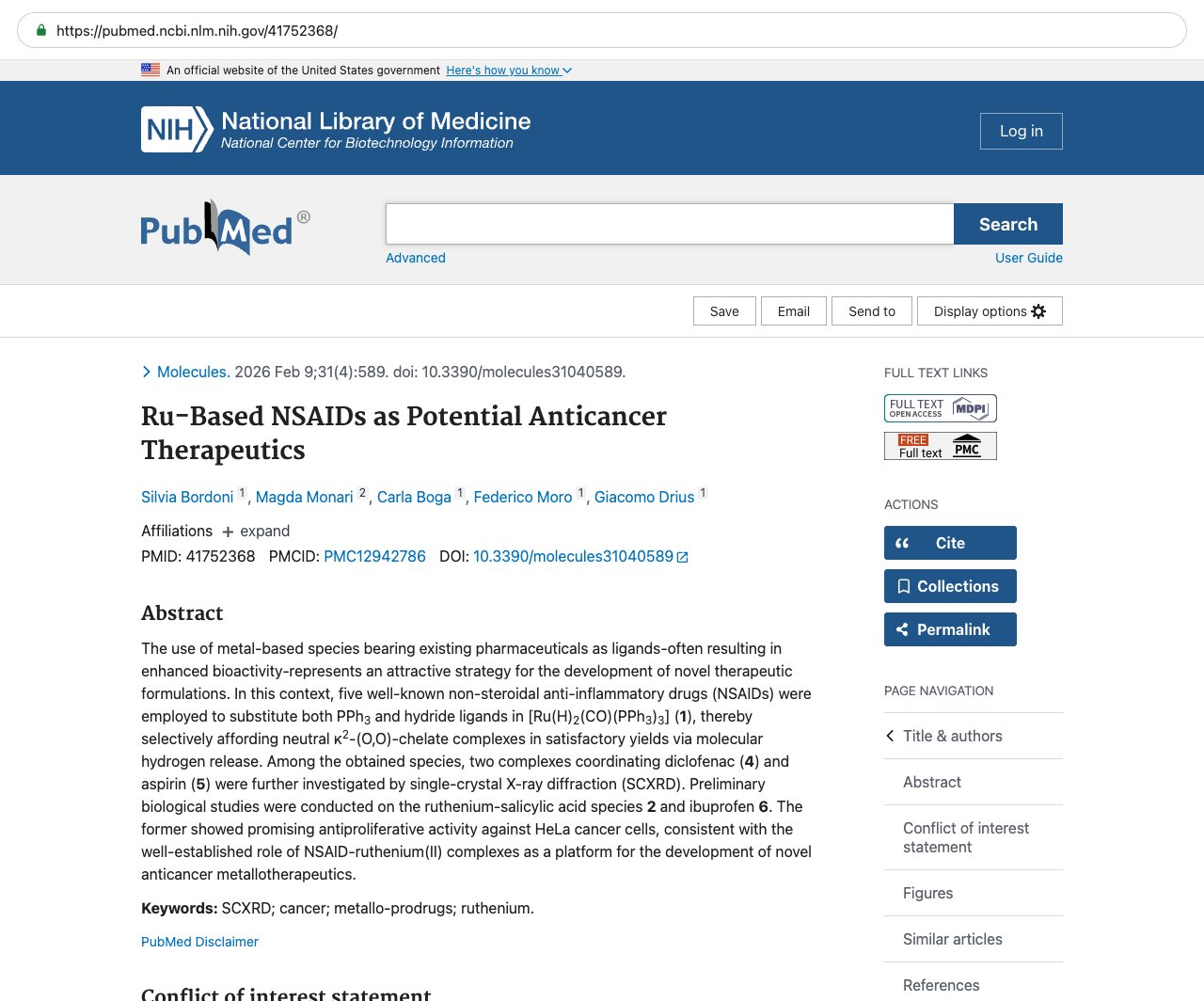
The use of metal-based species bearing existing pharmaceuticals as ligands-often resulting in enhanced bioactivity-represents an attractive strategy for the development of novel therapeutic formulations. In this context, five well-known non-steroidal anti-inflammatory drugs (NSAIDs) were employed to substitute both PPh3 and hydride ligands in [Ru(H)2(CO)(PPh3)3] (1), thereby selectively affording neutral κ2-(O,O)-chelate complexes in satisfactory yields via molecular hydrogen release. Among the obtained species, two complexes coordinating diclofenac (4) and aspirin (5) were further investigated by single-crystal X-ray diffraction (SCXRD). Preliminary biological studies were conducted on the ruthenium-salicylic acid species 2 and ibuprofen 6. The former showed promising antiproliferative activity against HeLa cancer cells, consistent with the well-established role of NSAID-ruthenium(II) complexes as a platform for the development of novel anticancer metallotherapeutics.
Source & links
Screenshot of the PubMed page
This page mirrors the published abstract (© the authors / publisher) for reference and citation. The canonical source is the PubMed record linked above. This is not medical advice.