2024 · Zhao — Hydrogen gas inhalation prior to high-intensity training reduces attenuation of nitric oxide bioavailability in male rugby players
Super-Abstract
Inhaling hydrogen protects the nitric oxide signal after hard training. In a randomized double-blind crossover in professional rugby players, H₂ inhalation kept post-exercise nitric oxide (NO) levels and their precursors higher, lowered oxidative-damage and inflammation markers, and increased total antioxidant capacity. (PeerJ, 2024.)
Commentary
This study connects two important strands: hydrogen as an antioxidant and nitric oxide (NO) as a vascular and performance signal. NO, among other things, causes blood vessels to dilate and muscles to be well perfused — but intense training can dampen NO availability. The design is solid: randomized, placebo-controlled, double-blind, crossover over three weeks with professional rugby players. One week of H₂ inhalation, one week of placebo, with a week of light training in between as a washout phase. The result: in the H₂ week, NO, L-arginine (an NO precursor) and tetrahydrobiopterin (a cofactor of NO synthesis) were significantly higher after exertion than under placebo — and remained so even after 24 hours of rest. At the same time, the oxidative DNA-damage marker and the inflammation marker interleukin-6 were lower, and total antioxidant capacity was higher. What it means: H₂ appears to preserve the vasodilating NO signal after hard training and to dampen inflammation and oxidative stress. Honestly: a small, very specific sample (professional rugby players, men only), a short period, and the abstract does not state the exact number of participants.
Key quotes
- „NO, L-arginine, and tetrahydrobiopterin levels in the H2 inhalation group were significantly higher than those in the placebo group after exercise (D6) and remained higher after 24 h of rest (D7).“ — preserved NO signal including precursors, even after 24 h
- „Levels of hydroxydeoxyguanosine and interleukin 6 were lower in the H2 inhalation week than in the placebo week“ — less oxidative DNA damage and less inflammation
- „H2 inhalation helps to maintain NO signaling after exercise and to alleviate inflammation and oxidative stress induced by high-intensity exercise training in professional athletes.“ — the central conclusion
Our assessment
Relevant for H₂ inhalation applications in competitive sport because it shows a plausible mechanism: preservation of the vasodilating NO signal plus dampening of inflammation and oxidative stress after exertion. The crossover double-blind design makes the statement robust, since each player is his own control. Limitation, stated honestly: a very small, highly specialized population (professional rugby, men only), a short intervention period, exact sample size not given in the abstract — a biomarker study, not a direct performance endpoint. The DOI stored in the dataset belongs to an unrelated paper (Antioxidants & Redox Signaling, 2011) and was therefore deliberately omitted.
Study design
- Type: RCT, randomized/double-blind/placebo-controlled, crossover · n: professional male rugby players (exact number not stated in the abstract) · Duration: 3 weeks (1 wk H₂, 1 wk washout, 1 wk placebo) · H₂ delivery: inhalation before daily high-intensity sessions
- Result metrics: NO, L-arginine, tetrahydrobiopterin ↑ vs. placebo (D6 + D7); 8-hydroxydeoxyguanosine ↓, interleukin-6 ↓; total antioxidant capacity ↑
Abstract
BACKGROUND: Inhalation of hydrogen gas (H2) as an antioxidant supplement may alleviate exercise-induced oxidative damage and protect post-exercise hydrogen peroxide signaling, which may help mediate beneficial exercise adaptation. The aims of this study were to determine the effects of H2 inhalation on plasma nitric oxide (NO) level and its synthesis precursor in professional athletes. METHODS: A randomized, placebo-controlled, double-blind, crossover trial was conducted with professional male rugby players for 3 weeks. Participants underwent 1 week of H2 supplementation and 1 week of placebo treatment prior to daily sessions of high-intensity exercise training, separated by 1 week of low-intensity training as a washout. RESULTS: Two-way (supplementation and time) repeated-measures analyses of variance showed that NO, L-arginine, and tetrahydrobiopterin levels in the H2 inhalation group were significantly higher than those in the placebo group after exercise (D6) and remained higher after 24 h of rest (D7). Levels of hydroxydeoxyguanosine and interleukin 6 were lower in the H2 inhalation week than in the placebo week on D6 and D7. In addition, total antioxidant levels were significantly higher with H2 inhalation than with placebo. SIGNIFICANCE: These results suggest that H2 inhalation helps to maintain NO signaling after exercise and to alleviate inflammation and oxidative stress induced by high-intensity exercise training in professional athletes.
Source & links
Screenshot of the PubMed page
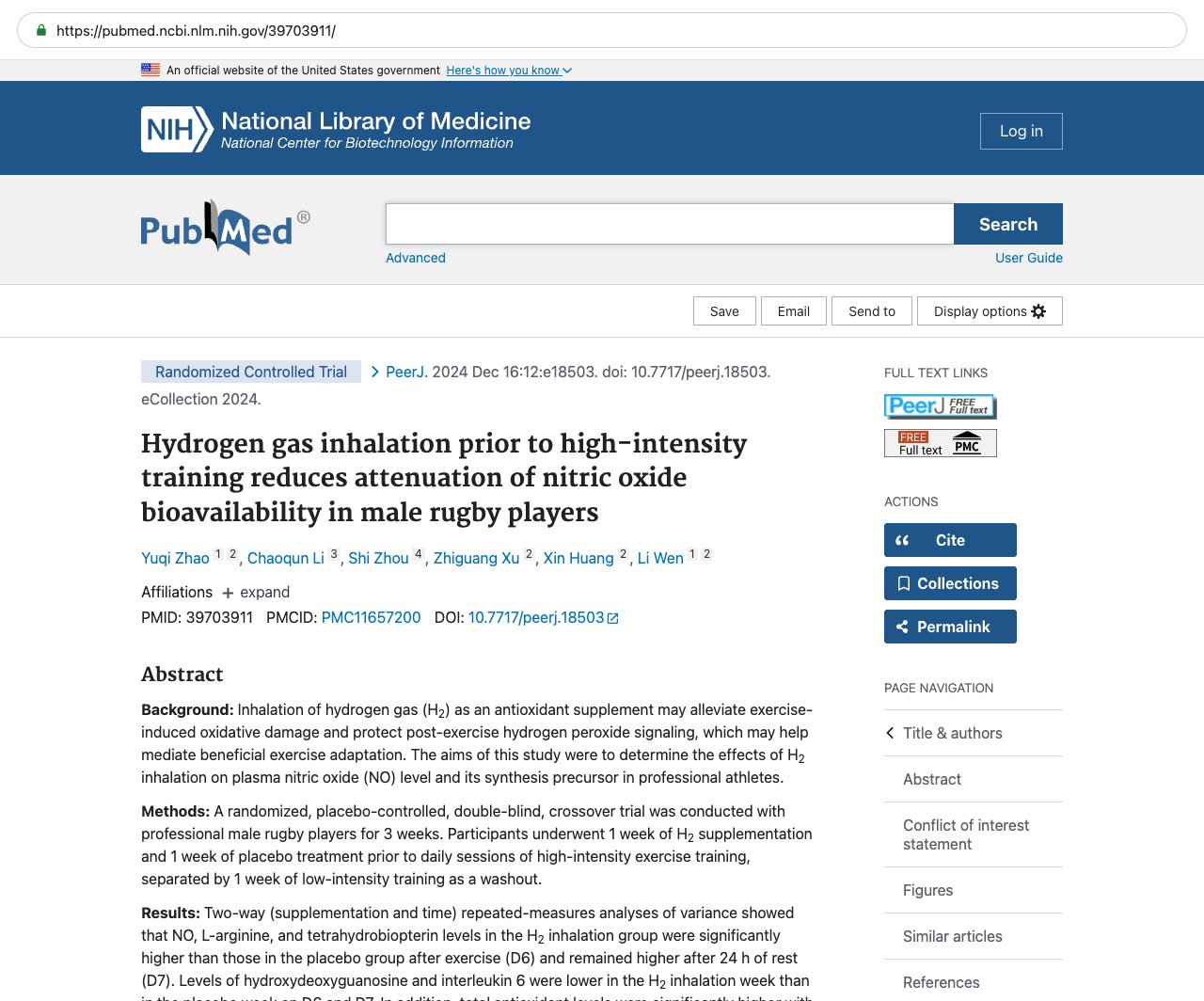
This page mirrors the published abstract (© the authors / publisher) for reference and citation. The canonical source is the PubMed record linked above. This is not medical advice.