2020 Oxidative medicine and cellular longevity Review / Meta-analysis InhalationBath / TopicalDrinking (HRW)
2020 · Kawamura et al. — Application of Molecular Hydrogen as a Novel Antioxidant in Sports Science
Super-Abstract
This review surveys the evidence on molecular hydrogen (H₂) intake and exercise, covering all administration routes and focusing on exercise-induced oxidative stress. Only six studies had been published on H₂ and exercise at the time; the review provides a summary of physiological and biochemical findings and highlights the need for more research. (Oxidative Medicine and Cellular Longevity, 2020.)
Commentary
Kawamura and colleagues systematically review the then-existing literature on H₂ and exercise — including both animal and human studies. H₂ can be administered via multiple routes covered in this review: inhalation, oral hydrogen-rich water, and hydrogen baths. The authors note that H₂ is thought to selectively reduce hydroxyl radicals (·OH) and peroxynitrite (ONOO⁻) without disturbing physiologically necessary ROS (H₂O₂, O₂·⁻). This selectivity makes it an interesting candidate for combating exercise-induced oxidative stress without suppressing beneficial ROS signalling (which conventional antioxidants often do). The review includes findings on physiological markers (e.g., lactate, VO₂max, muscle fatigue) and biochemical markers (ROS, antioxidant enzymes). With only six published exercise studies at the time, the evidence base is thin. The review is transparent about this limitation and positions H₂ as a potential — not proven — alternative to conventional exogenous antioxidants in sports science.
Key quotes
- „H2 is thought to be able to selectively reduce hydroxyl radicals and peroxynitrite and does not affect physiologically reactive species.“ — the selectivity argument: H₂ targets only the most harmful ROS
- „Thus far, including our study, only 6 studies have explored the effect of H2 on exercise.“ — honest acknowledgment of the very thin evidence base at the time
- „H2 may be a potential alternative strategy for conventional exogenous antioxidant interventions in sports science.“ — cautious positioning — H₂ as candidate, not established therapy
Our assessment
A transparent and appropriately cautious review. With only six studies available, no strong conclusions can be drawn. The authors are clear about this limitation. The theoretical rationale for H₂ in exercise (selective ·OH scavenging without blunting beneficial ROS signalling) is scientifically interesting and distinct from generic antioxidant supplementation. The review covers diseases (cancer, diabetes, brain injury) in passing, but the core focus is sports science. Since 2020, the exercise H₂ literature has grown, but a definitive evidence base remains under construction.
Study design
- Type: narrative review · n: 6 exercise studies reviewed (human and animal) · H₂ delivery: inhalation, hydrogen-rich water (oral), hydrogen bath (topical) — all routes reviewed
- Result: narrative synthesis of physiological and biochemical exercise outcomes; thin evidence base (n=6 studies); H₂ positioned as potential, not established, antioxidant strategy in sport
Abstract
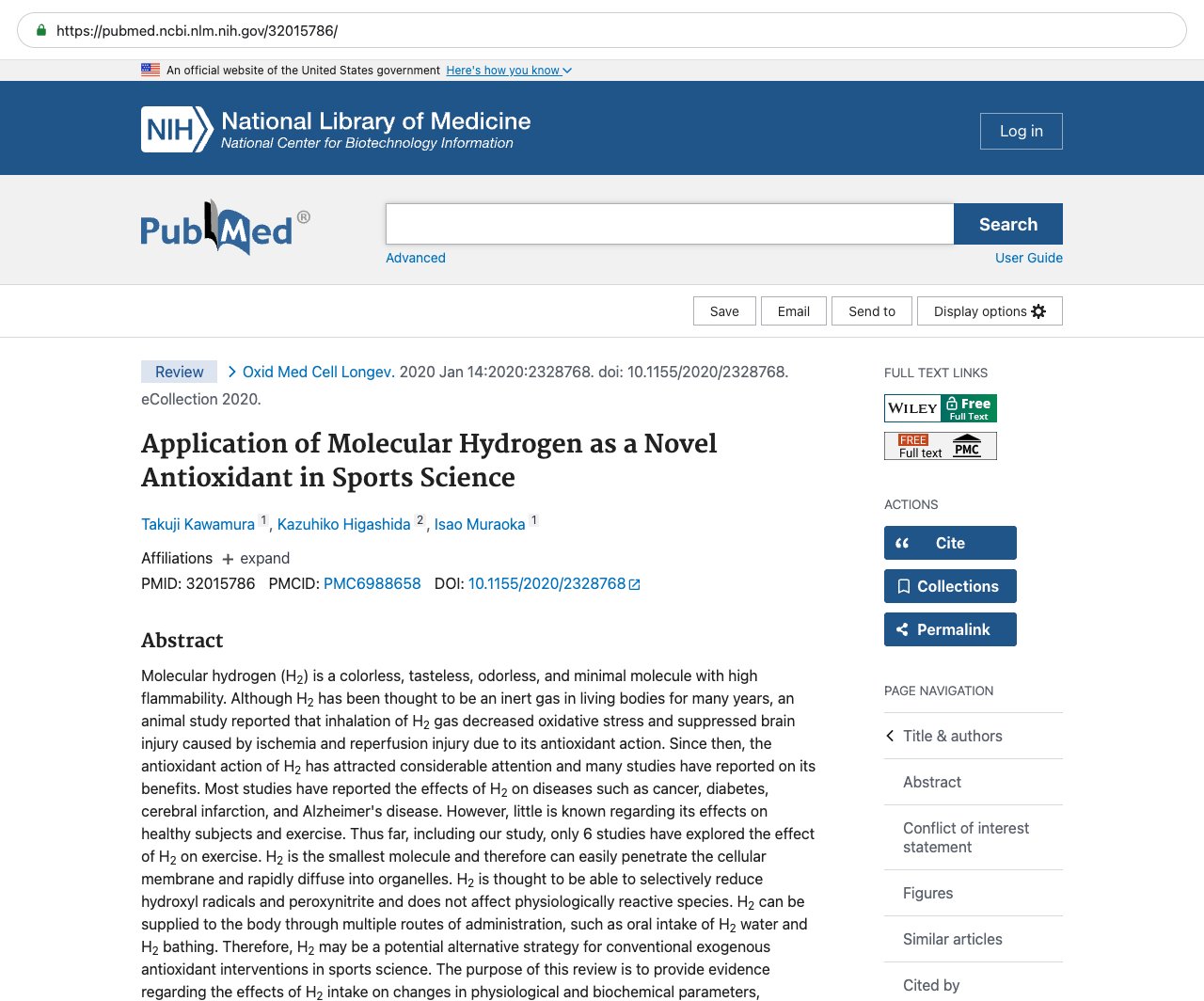
Molecular hydrogen (H2) is a colorless, tasteless, odorless, and minimal molecule with high flammability. Although H2 has been thought to be an inert gas in living bodies for many years, an animal study reported that inhalation of H2 gas decreased oxidative stress and suppressed brain injury caused by ischemia and reperfusion injury due to its antioxidant action. Since then, the antioxidant action of H2 has attracted considerable attention and many studies have reported on its benefits. Most studies have reported the effects of H2 on diseases such as cancer, diabetes, cerebral infarction, and Alzheimer's disease. However, little is known regarding its effects on healthy subjects and exercise. Thus far, including our study, only 6 studies have explored the effect of H2 on exercise. H2 is the smallest molecule and therefore can easily penetrate the cellular membrane and rapidly diffuse into organelles. H2 is thought to be able to selectively reduce hydroxyl radicals and peroxynitrite and does not affect physiologically reactive species. H2 can be supplied to the body through multiple routes of administration, such as oral intake of H2 water and H2 bathing. Therefore, H2 may be a potential alternative strategy for conventional exogenous antioxidant interventions in sports science. The purpose of this review is to provide evidence regarding the effects of H2 intake on changes in physiological and biochemical parameters, centering on exercise-induced oxidative stress, for each intake method. Furthermore, this review highlights possible future directions in this area of research.
Source & links
Screenshot of the PubMed page
This page mirrors the published abstract (© the authors / publisher) for reference and citation. The canonical source is the PubMed record linked above. This is not medical advice.