2023 · Antonenko — Biological Activity of Novel Organotin Compounds with a Schiff Base Containing an Antioxidant Fragment
Super-Abstract
Researchers synthesised five new organotin(IV) complexes containing an antioxidant Schiff-base ligand and tested them for antioxidant activity and anti-cancer cell proliferation in vitro. Compounds 1 and 5 showed the strongest antioxidant activity; compounds 2 and 5 showed the highest antiproliferative effect against cancer cell lines. This is a laboratory chemistry study with no direct H₂ component.
Commentary
Organotin compounds have attracted research interest as potential anticancer agents because some structural variants show selective toxicity toward cancer cells. This study synthesises a series of tin complexes that incorporate an antioxidant phenol fragment (Schiff base ligand) and characterises them structurally (X-ray, NMR, IR, MS). Antioxidant activity was assessed by CUPRAC and DPPH assays; antiproliferative activity against HCT-116 (colon), MCF-7 (breast), A-549 (lung), and WI-38 (normal lung) cell lines. The connection to H₂ medicine is indirect: the study sits within the oxidative stress and antioxidant research space that overlaps with H₂ research, but no molecular hydrogen was used or investigated. The inclusion in this database likely reflects thematic overlap in antioxidant and cancer biology contexts.
Key quotes
- „Compounds 1 and 5 were found to be the most active in both methods.“ — strongest antioxidant activity among the five synthesised complexes
- „Complexes 2 and 5 demonstrated the highest activity.“ — highest antiproliferative effect in cancer cell lines
- „Some of the synthesized compounds have also actively induced apoptosis and blocked proliferation in the cell cycle G2/M phase.“ — mechanism of cell death observed in cancer cell lines
Our assessment
This is a synthetic chemistry and in-vitro cell biology study with no H₂ involvement. The antioxidant and antiproliferative findings are preliminary cell-culture data that do not translate to cancer therapy in humans. Organotin compounds as a class carry known systemic toxicity concerns that would need to be resolved before any clinical application. This study is relevant to antioxidant chemistry broadly but is not evidence for H₂ therapy.
Study design
- Type: synthetic chemistry + in-vitro cell study · n: 5 synthesised compounds; cell lines HCT-116, MCF-7, A-549, WI-38 · H₂ delivery: not applicable (no H₂ used)
- Result: compounds 1 and 5 showed strongest antioxidant activity (CUPRAC/DPPH); compounds 2 and 5 highest antiproliferative activity; apoptosis induction and G2/M cell-cycle arrest observed; crystal structure of compound 2 confirmed distorted octahedral Sn geometry
Abstract
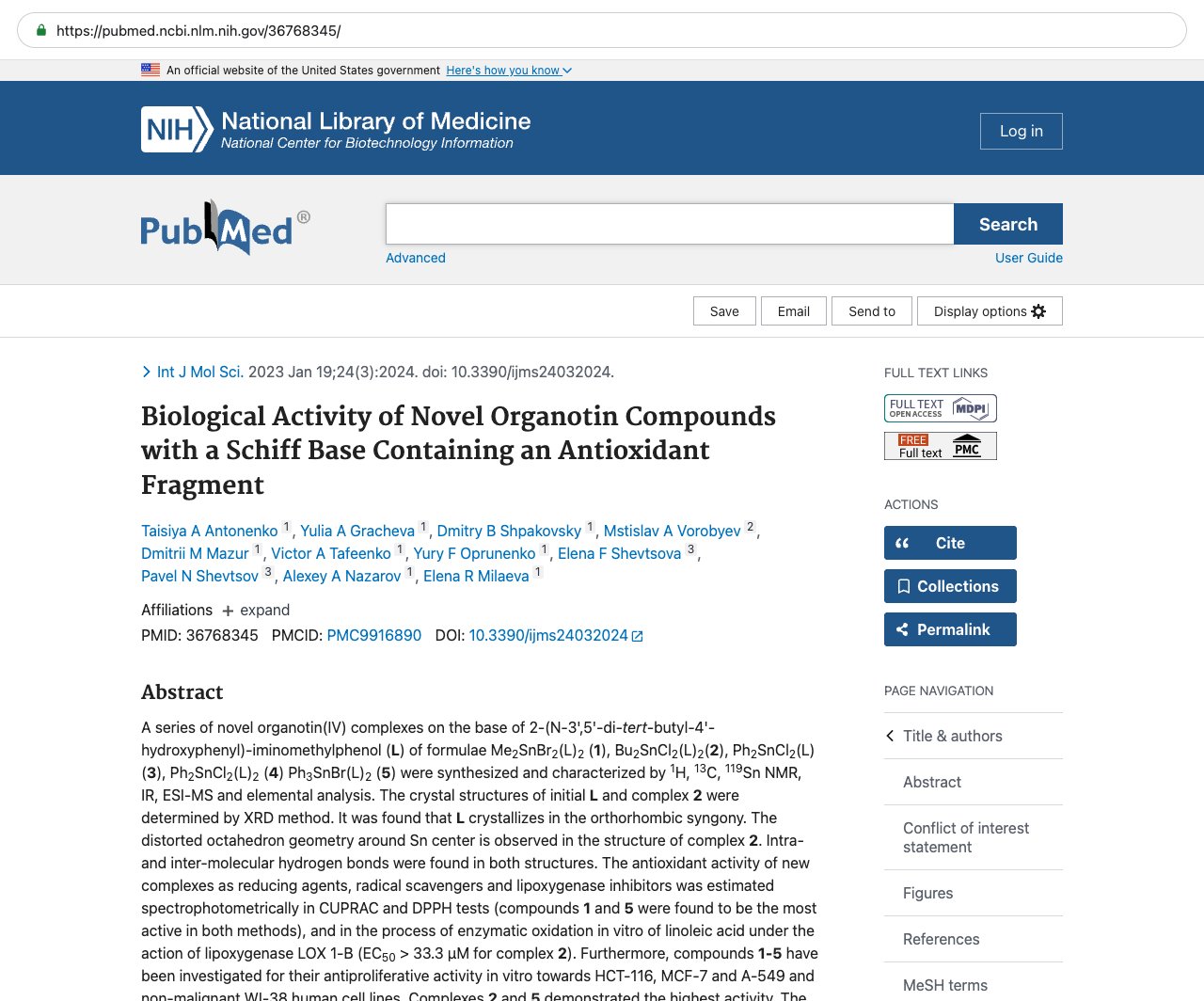
A series of novel organotin(IV) complexes on the base of 2-(N-3',5'-di-tert-butyl-4'-hydroxyphenyl)-iminomethylphenol (L) of formulae Me2SnBr2(L)2 (1), Bu2SnCl2(L)2(2), Ph2SnCl2(L) (3), Ph2SnCl2(L)2 (4) Ph3SnBr(L)2 (5) were synthesized and characterized by 1H, 13C, 119Sn NMR, IR, ESI-MS and elemental analysis. The crystal structures of initial L and complex 2 were determined by XRD method. It was found that L crystallizes in the orthorhombic syngony. The distorted octahedron geometry around Sn center is observed in the structure of complex 2. Intra- and inter-molecular hydrogen bonds were found in both structures. The antioxidant activity of new complexes as reducing agents, radical scavengers and lipoxygenase inhibitors was estimated spectrophotometrically in CUPRAC and DPPH tests (compounds 1 and 5 were found to be the most active in both methods), and in the process of enzymatic oxidation in vitro of linoleic acid under the action of lipoxygenase LOX 1-B (EC50 > 33.3 μM for complex 2). Furthermore, compounds 1-5 have been investigated for their antiproliferative activity in vitro towards HCT-116, MCF-7 and A-549 and non-malignant WI-38 human cell lines. Complexes 2 and 5 demonstrated the highest activity. The plausible mechanisms of the antiproliferative activity of compounds, including the influence on the polymerization of Tb+MAP, are discussed. Some of the synthesized compounds have also actively induced apoptosis and blocked proliferation in the cell cycle G2/M phase.
Source & links
Screenshot of the PubMed page
This page mirrors the published abstract (© the authors / publisher) for reference and citation. The canonical source is the PubMed record linked above. This is not medical advice.