2025 · Chu — Hydrogen Enhanced Photothermal Therapy for Redox-regulated Tumor Apoptosis and Immune Reprogramming
Super-Abstract
A novel nanomaterial platform combines hydrogen release with near-infrared photothermal heating to simultaneously destroy tumour cells and protect immune cells — demonstrating, for the first time, that H₂ can act as both a pro-oxidant in cancer cells and an antioxidant protector in immune cells within the same tumour environment. This animal study reports enhanced tumour killing and immune activation. (Acta Biomaterialia, 2025.)
Commentary
Photothermal therapy (PTT) uses light-absorbing materials heated by near-infrared (NIR) light to kill tumour cells. A persistent problem is that the same heat-induced ROS that kill tumours also damage the immune cells needed to sustain anti-tumour responses. Chu et al. engineer rhodium-palladium bimetallene nanosheets (RhPd-H) that release H₂ on NIR irradiation, creating a selective redox split: ROS bursts in tumour cells (pro-apoptotic), while H₂ simultaneously scavenges ROS in immune cells (protective). The experimental data support dendritic cell maturation, T-cell infiltration, and macrophage repolarisation toward anti-tumour phenotypes. The authors describe this cell-contextual duality as „novel“ and previously undocumented. It is important to note that all experiments are in animal models (mice) — no human data exist. The nanomaterial is experimental and far from clinical application.
Key quotes
- „RhPd-H serves as a dual-source of hydrogen and localized heat, inducing reactive oxygen species (ROS) bursts that selectively disrupt tumor redox homeostasis, leading to apoptosis of tumor cells.“ — how the nanosheet platform kills tumour cells
- „Synergistically, hydrogen scavenges ROS in immune cells, protecting them from oxidative stress and further promoting dendritic cell maturation, T-cell activation, and macrophage polarizaion for exerting anti-tumor effects.“ — the simultaneous immune-protective function of H₂
- „We report the novel finding that hydrogen performs both protective and activating effects on immune cells, which to our knowledge has not been previously documented, revealing a veil of mystery of hydrogen therapy.“ — authors' claim of a first-in-kind mechanistic finding
Our assessment
This is a preclinical animal study — all results are from mouse tumour models; no human data are presented. The nanosheet platform is experimental and would require extensive safety, manufacturing, and clinical testing before any human application. The dual redox-switching concept (pro-oxidant in tumour cells, antioxidant in immune cells) is mechanistically novel and scientifically important if replicated. However, mouse tumour models frequently overestimate treatment efficacy. This work is a contribution to basic cancer nanomedicine research, not a clinical advancement.
Study design
- Type: animal study (mouse tumour model) · Model: tumour-bearing mice treated with RhPd-H nanosheets + NIR irradiation · H₂ delivery: NIR-triggered H₂ release from rhodium-palladium bimetallene nanosheets
- Result: selective tumour-cell ROS bursts and apoptosis; concurrent immune-cell ROS scavenging; dendritic cell maturation, T-cell infiltration, macrophage polarisation to anti-tumour phenotype; enhanced antigen presentation; systemic anti-tumour immune memory responses observed
Abstract
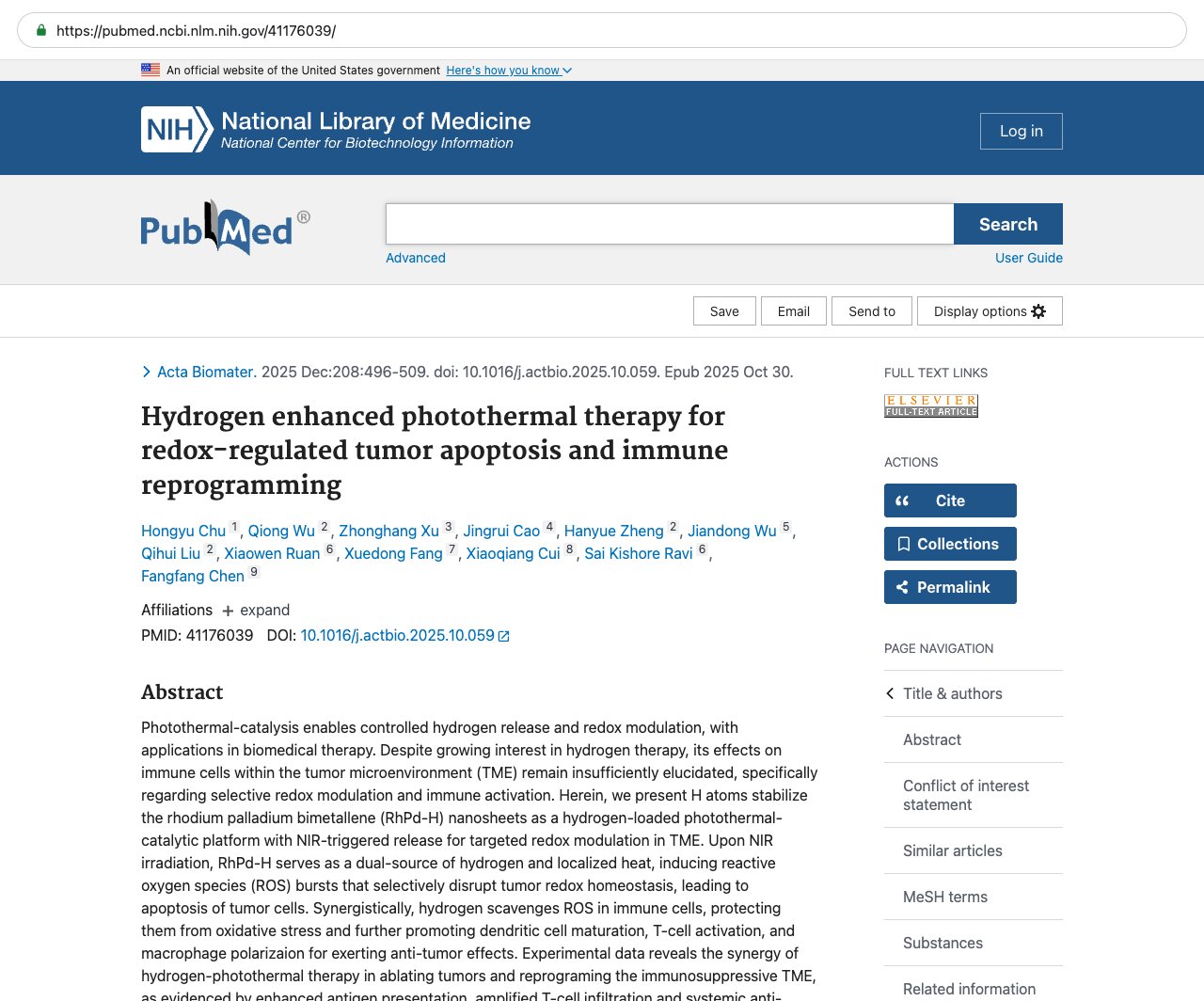
Photothermal-catalysis enables controlled hydrogen release and redox modulation, with applications in biomedical therapy. Despite growing interest in hydrogen therapy, its effects on immune cells within the tumor microenvironment (TME) remain insufficiently elucidated, specifically regarding selective redox modulation and immune activation. Herein, we present H atoms stabilize the rhodium palladium bimetallene (RhPd-H) nanosheets as a hydrogen-loaded photothermal-catalytic platform with NIR-triggered release for targeted redox modulation in TME. Upon NIR irradiation, RhPd-H serves as a dual-source of hydrogen and localized heat, inducing reactive oxygen species (ROS) bursts that selectively disrupt tumor redox homeostasis, leading to apoptosis of tumor cells. Synergistically, hydrogen scavenges ROS in immune cells, protecting them from oxidative stress and further promoting dendritic cell maturation, T-cell activation, and macrophage polarizaion for exerting anti-tumor effects. Experimental data reveals the synergy of hydrogen-photothermal therapy in ablating tumors and reprograming the immunosuppressive TME, as evidenced by enhanced antigen presentation, amplified T-cell infiltration and systemic anti-tumor memory responses. Particularly, we report the novel finding that hydrogen performs both protective and activating effects on immune cells, which to our knowledge has not been previously documented, revealing a veil of mystery of hydrogen therapy. By integrating hydrogen-mediated redox editing and immunomodulation, this work establishes a paradigm-shifting strategy for precise tumor therapy. STATEMENT OF SIGNIFICANCE: This work unveils a paradigm-shifting duality of hydrogen (H₂) within the tumor microenvironment: simultaneously acting as a pro-oxidative inducer of reactive oxygen species (ROS) bursts in tumor cells while serving as a protective antioxidant and immunomodulator in immune cells. Under NIR irradiation, H₂ released from hydrogen-stabilized rhodium-palladium bimetallene (RhPd-H) nanosheets synergizes with photothermal energy to disrupt redox homeostasis and trigger selective apoptosis in tumors. Concurrently, in immune cells, H₂ scavenges photothermal-induced ROS-shielding them from oxidative damage while activating dendritic cell maturation, cytotoxic T-cell infiltration, and macrophage polarization toward antitumor phenotypes. This cell-contextual redox switching not only ablates tumors directly but also reprograms the immunosuppressive microenvironment, revealing an unprecedented biological mechanism for hydrogen therapy and establishing differential redox editing as a transformative strategy for precision cancer treatment.
Source & links
Screenshot of the PubMed page
This page mirrors the published abstract (© the authors / publisher) for reference and citation. The canonical source is the PubMed record linked above. This is not medical advice.