2026 · Wu — Hydrogen Ameliorates Psoriasis-Like Skin Inflammation via Inhibiting the cGAS-STING Pathway
Super-Abstract
In a mouse model of psoriasis, hydrogen-rich water significantly reduced skin inflammation by inhibiting the cGAS-STING signalling pathway — a key driver of the excessive immune activation characteristic of psoriasis. Hydrogen decreased markers of keratinocyte proliferation (Ki-67, BCL2, BAX) and reduced reactive oxygen species and inflammatory cytokines both in cell culture and in animals. (Clinical and Experimental Immunology, 2026.)
Commentary
Psoriasis is a chronic inflammatory skin disease driven by abnormal T-cell and keratinocyte activation, characterised by thick scaly plaques. Current treatments include biologics that target specific cytokines (TNF-α, IL-17, IL-23) but have significant costs and side effects. The cGAS-STING pathway is an innate immune sensing system that — when abnormally activated — amplifies inflammation and keratinocyte proliferation. This study builds on the authors' earlier work showing hydrogen-rich water improves psoriasis severity in mice, and now provides a mechanistic explanation: H₂ suppresses cGAS-STING activation. Results come from both an imiquimod-induced psoriasis mouse model and keratinocyte cell culture. The evidence is preclinical — no human clinical trial data are presented.
Key quotes
- „the cyclic guanosine monophosphate-adenosine monophosphate synthase-stimulator of interferon gene signaling was activated in psoriasis-like skin inflammation, which was dramatically inhibited by hydrogen treatment both in vitro and in vivo.“ — the identified pathway: cGAS-STING is activated in psoriasis and suppressed by H₂
- „hydrogen decreased proliferative marker expression, including BCL2, BAX, and Ki-67, and significantly reduced ROS and inflammatory cytokines production.“ — the measured effects: less keratinocyte proliferation and less inflammation
- „Our study suggests that molecular hydrogen could function as a potential treatment for psoriasis.“ — the authors' conclusion — stated as potential, not established therapy
Our assessment
A preclinical (animal + in-vitro) study with a concrete mechanistic finding. Identifying cGAS-STING as the pathway targeted by H₂ in psoriasis is a meaningful scientific contribution that distinguishes this from generic „antioxidant“ explanations. However, the evidence is entirely from mouse models and cell culture. Human psoriasis involves complex immune dysregulation that is not fully replicated in imiquimod mouse models. Clinical trials in human psoriasis patients — which do not yet exist — would be required to establish whether H₂ has any clinically meaningful effect. This is not a human therapeutic proof.
Study design
- Type: preclinical animal + in-vitro study · Model: imiquimod-induced psoriasis mouse model + keratinocyte cell culture · H₂ delivery: hydrogen-rich water (drinking)
- Result: cGAS-STING pathway suppression; reduced keratinocyte proliferation (BCL2, BAX, Ki-67 downregulation); decreased ROS and inflammatory cytokines in both cell culture and animal model
Abstract
Psoriasis is a chronic disease caused by abnormal immune system response, which is characterized by excessive keratinocyte proliferation and the activation of cytokine signaling pathways. In a previous study, we demonstrated in a psoriasis mouse model that hydrogen-rich water, an effective reactive oxygen species (ROS) scavenger, significantly improves disease severity. However, the precise molecular mechanism by which hydrogen helps in psoriasis treatment remains inadequately understood. This study assessed the role of hydrogen in suppressing keratinocyte hyperproliferation. We observed that the cyclic guanosine monophosphate-adenosine monophosphate synthase-stimulator of interferon gene signaling was activated in psoriasis-like skin inflammation, which was dramatically inhibited by hydrogen treatment both in vitro and in vivo. Consistently, hydrogen decreased proliferative marker expression, including BCL2, BAX, and Ki-67, and significantly reduced ROS and inflammatory cytokines production. Our study suggests that molecular hydrogen could function as a potential treatment for psoriasis.
Source & links
Screenshot of the PubMed page
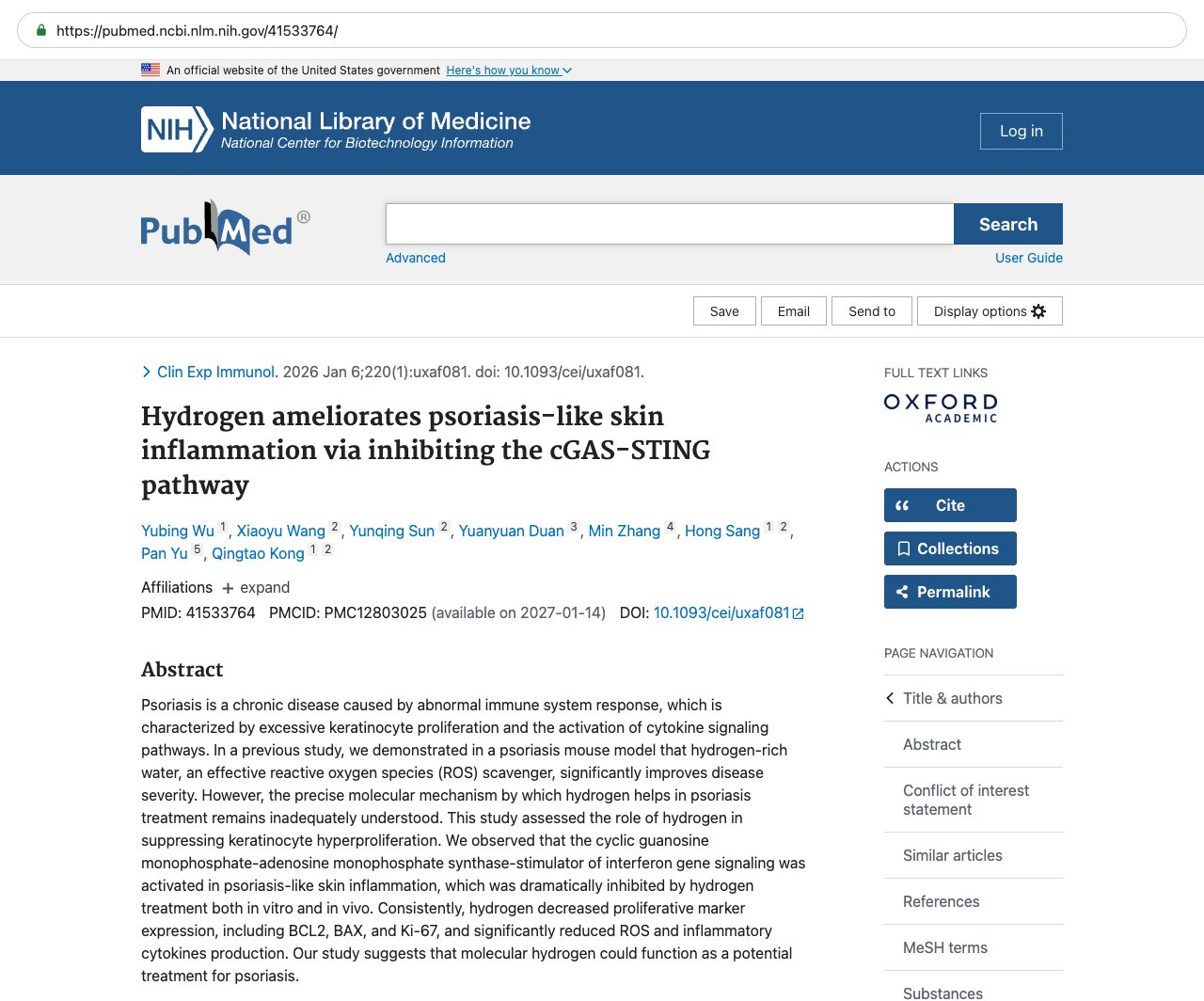
This page mirrors the published abstract (© the authors / publisher) for reference and citation. The canonical source is the PubMed record linked above. This is not medical advice.