2024 · Wang — Combined use of hydrogen-rich water and enzyme-digested edible bird's nest improves PMA/LPS-impaired wound healing in human inflammatory gingival tissue equivalents.
Super-Abstract
In a laboratory model of inflamed human gum tissue, the combination of hydrogen-rich water and a processed form of edible bird's nest significantly counteracted the wound-healing damage caused by an inflammatory stimulus. When used together, these two substances outperformed either one alone in reducing inflammation and restoring tissue integrity. (Human Cell, 2024.)
Commentary
Gingival (gum) wound healing is frequently impaired in chronic periodontitis, where oxidative stress and inflammatory mediators slow or block recovery. This study built a three-dimensional human gingival tissue equivalent (iGTE) from primary human gingival fibroblasts, keratinocytes, and macrophages, then induced an inflammatory/oxidative injury with PMA and LPS. Hydrogen-rich water (HW), enzyme-digested edible bird's nest (EBND), and sialic acid (SA) were tested individually and in combination. All three substances reduced PMA/LPS-induced wound healing delay and inflammation (IL-6, IL-8) in both 2D cell monolayers and the 3D tissue model. The HW + EBND combination showed particularly strong results. This is an entirely in-vitro study using a sophisticated tissue model — no human patients were involved. The tissue equivalent, while more physiologically relevant than simple cell lines, still does not capture the complexity of living human oral tissue with vascularisation, innervation, or the full oral microbiome.
Key quotes
- „Pretreatment of HW, EBND, and SA significantly suppressed PMA/LPS-induced wound healing delay and inflammatory responses in cell monolayers, as well as in the iGTE.“ — the core finding: all three substances improved wound healing in the inflamed tissue model
- „In the iGTE, PMA/LPS significantly reduced the epithelial thickness while causing a decrease in K8/18, E-cadherin, laminin and elastin expression and an increase in COX-2 expression along with ulcer-like lesions.“ — the damage profile in the tissue model: structural proteins lost, inflammation activated
- „the combined use of HW and EBND exhibited particularly robust results.“ — the synergy finding: combination outperformed either substance alone
Our assessment
This is an in-vitro study using a 3D human gingival tissue model — no human patients are involved. The tissue equivalent is more sophisticated than a simple cell line, but still does not replicate the full physiology of human gum tissue. The combination of hydrogen-rich water and bird's nest extract is unusual and requires confirmation in clinical trials before any conclusions about oral wound healing in humans can be drawn. Results from this inflammation model cannot be directly applied to periodontal disease or oral wound healing in patients.
Study design
- Type: in-vitro study (3D tissue equivalent + cell monolayers) · Model: human gingival tissue equivalent (primary fibroblasts, keratinocytes, macrophages) + PMA/LPS inflammatory stimulus · H₂ delivery: hydrogen-rich water (HW) as pretreatment
- Result: HW, EBND, SA each reduced wound healing delay and IL-6/IL-8; HW + EBND combination most effective; restored epithelial thickness, structural proteins (K8/18, E-cadherin), reduced COX-2 — in-vitro only, no human patient data
Abstract
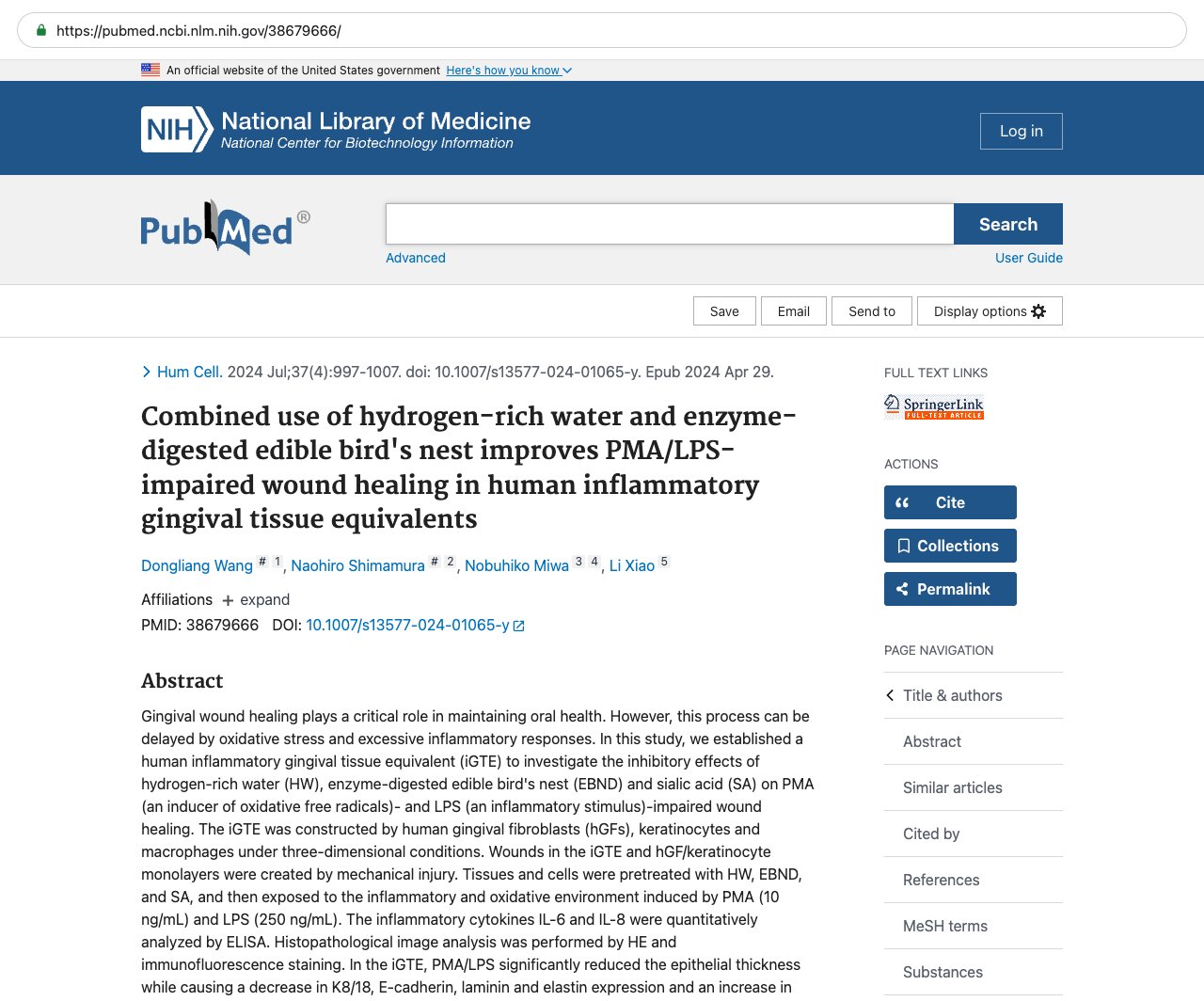
Gingival wound healing plays a critical role in maintaining oral health. However, this process can be delayed by oxidative stress and excessive inflammatory responses. In this study, we established a human inflammatory gingival tissue equivalent (iGTE) to investigate the inhibitory effects of hydrogen-rich water (HW), enzyme-digested edible bird's nest (EBND) and sialic acid (SA) on PMA (an inducer of oxidative free radicals)- and LPS (an inflammatory stimulus)-impaired wound healing. The iGTE was constructed by human gingival fibroblasts (hGFs), keratinocytes and macrophages under three-dimensional conditions. Wounds in the iGTE and hGF/keratinocyte monolayers were created by mechanical injury. Tissues and cells were pretreated with HW, EBND, and SA, and then exposed to the inflammatory and oxidative environment induced by PMA (10 ng/mL) and LPS (250 ng/mL). The inflammatory cytokines IL-6 and IL-8 were quantitatively analyzed by ELISA. Histopathological image analysis was performed by HE and immunofluorescence staining. In the iGTE, PMA/LPS significantly reduced the epithelial thickness while causing a decrease in K8/18, E-cadherin, laminin and elastin expression and an increase in COX-2 expression along with ulcer-like lesions. In mechanically scratched hGFs and keratinocyte monolayers, PMA/LPS significantly impaired wound healing, and promoted the secretion of IL-6 and IL-8. Pretreatment of HW, EBND, and SA significantly suppressed PMA/LPS-induced wound healing delay and inflammatory responses in cell monolayers, as well as in the iGTE. Remarkably, the combined use of HW and EBND exhibited particularly robust results. Combined use of HW and EBND may be applied for the prevention and treatment of wound healing delay.
Source & links
Screenshot of the PubMed page
This page mirrors the published abstract (© the authors / publisher) for reference and citation. The canonical source is the PubMed record linked above. This is not medical advice.