2017 Circulation journal : official journal of the Japanese Circulation Society Mechanism / Preclinical Inhalation
2017 · Asanuma — Translational Study of Hydrogen Gas Inhalation as Adjuncts to Reperfusion Therapy for Acute Myocardial Infarction
Super-Abstract
This translational study investigated hydrogen gas inhalation as an add-on to reperfusion therapy in acute myocardial infarction — bridging animal and early clinical research. The abstract is not available in the database; details can be found via the DOI link. (Circulation Journal, 2017.)
Commentary
The abstract for this publication was not available in the source data. Based on the title, this appears to be a translational study — meaning it aimed to bridge preclinical (animal) H₂ inhalation findings with human cardiac reperfusion scenarios. Reperfusion therapy (PCI, thrombolysis) in acute myocardial infarction (AMI) is the standard of care, but reperfusion itself causes oxidative injury. Asanuma is a known researcher in H₂ cardioprotection. For full details of methods and results, please consult the original publication via DOI: 10.1253/circj.cj-17-0520.
Key quotes
- „Translational Study of Hydrogen Gas Inhalation as Adjuncts to Reperfusion Therapy for Acute Myocardial Infarction.“ — the title itself, as no abstract text was available in the database record
Our assessment
No abstract was available for this study, so a complete assessment cannot be provided. The translational framing of the title suggests this paper bridges animal and (possibly early) clinical data on H₂ inhalation as cardioprotection during AMI reperfusion. The full text should be consulted directly. No evidence-based claims can be made here without access to the actual study data.
Study design
- Type: translational study (design details unavailable — abstract not in source data) · Topic: H₂ gas inhalation as adjunct to reperfusion therapy in acute myocardial infarction
- H₂ delivery: inhalation · Setting: AMI / reperfusion context (PCI or equivalent, details unavailable)
- Result: not available from abstract — please see full text via DOI 10.1253/circj.cj-17-0520
Source & links
Screenshot of the PubMed page
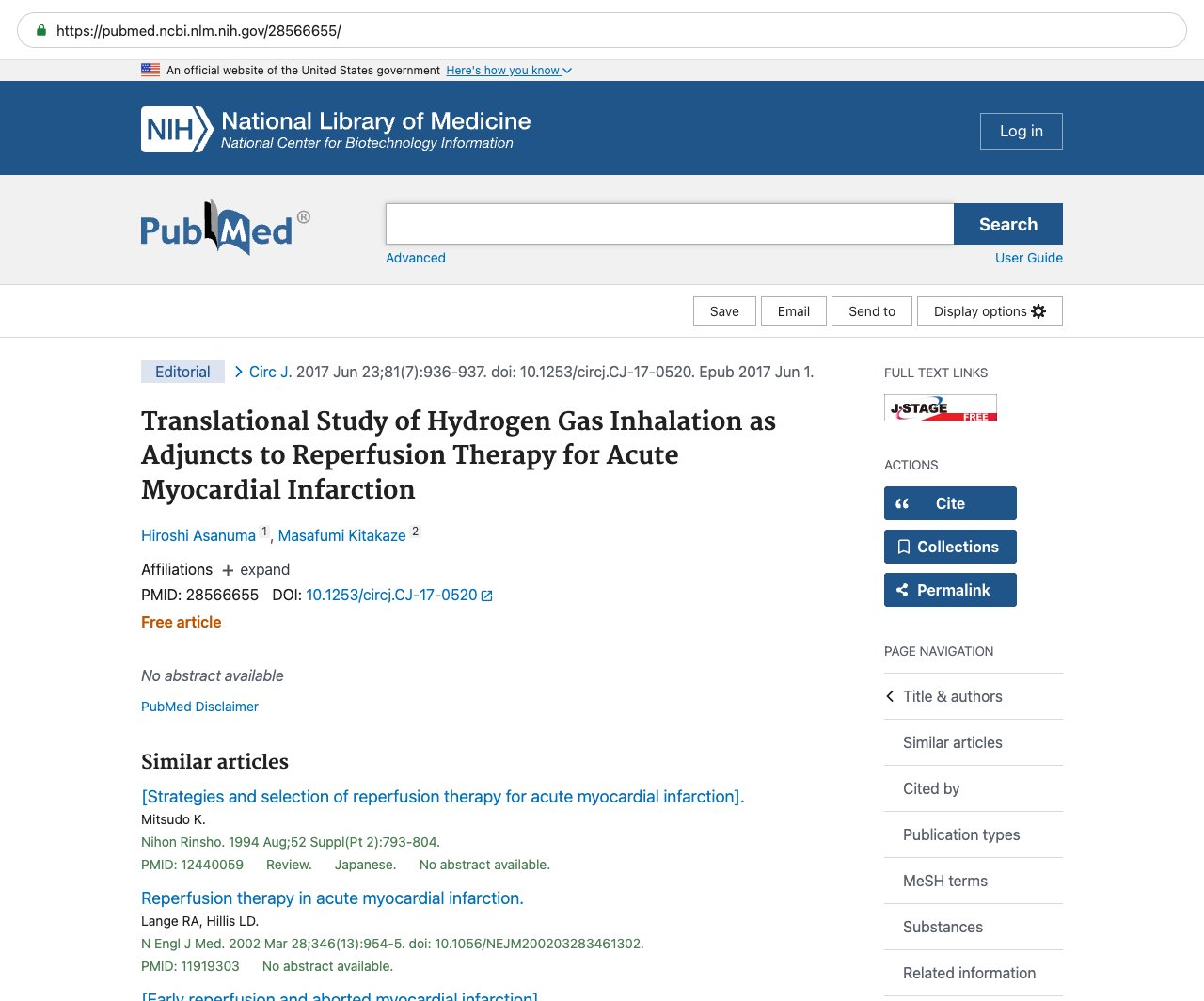
This page mirrors the published abstract (© the authors / publisher) for reference and citation. The canonical source is the PubMed record linked above. This is not medical advice.